

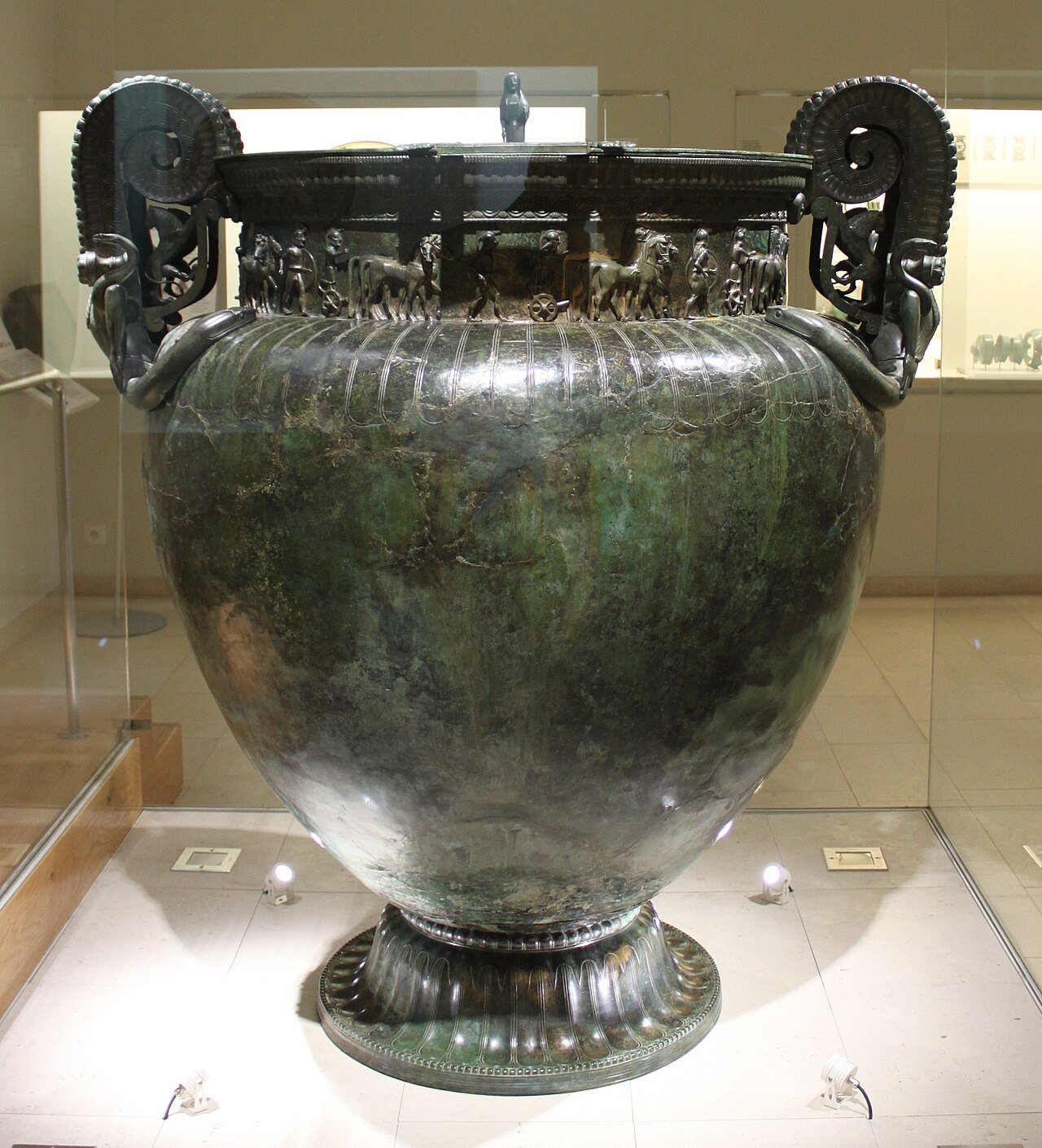
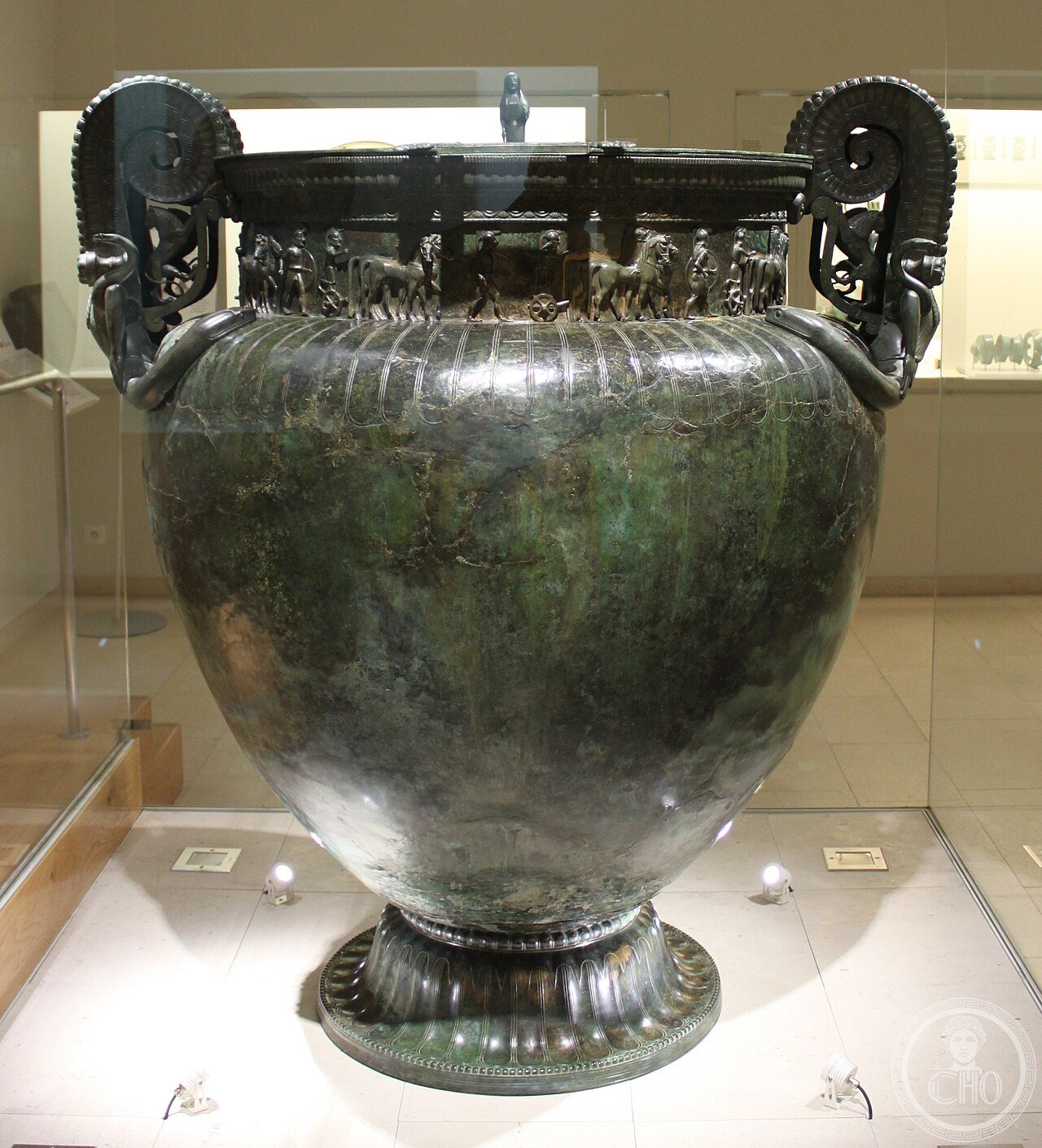
A Celtic princess burial of c. 480 BC in Burgundy, France, containing the largest bronze vessel of the ancient world — a 208-kilogram Greek krater transported 700km from the Mediterranean — and a solid gold torc of extraordinary craftsmanship, raising questions about the social role of women in Celtic Europe that remain unanswered.
At a glance
On a hillside above the village of Vix in the Côte-d’Or department of Burgundy, where the Seine becomes navigable near the major Celtic oppidum of Mont Lassois, a burial mound discovered in 1953 contained the most extraordinary single object to have survived from ancient Celtic culture: the Vix Krater, a bronze wine-mixing vessel 1.64 metres tall and weighing 208 kilograms — the largest bronze vessel of the ancient world — alongside the buried body of a high-status woman approximately 30–35 years old at death (c. 480 BC).
The krater is Greek in type and Greek in manufacture — decorated with a frieze of hoplite soldiers and horse-drawn chariots in the finest archaic style — but it is four times larger than the largest known Greek bronze vessel, suggesting it was made to special commission. How it arrived in central France, who the woman buried with it was, and what her role in Celtic society meant are questions that have generated decades of scholarly debate without resolution. The burial and the krater together represent one of the most remarkable intersections of Mediterranean and Celtic worlds known from European prehistory.
Key facts
- Burial date: c. 480 BC (Hallstatt D3 / early La Tène transition)
- The Vix Krater: 1.64 m tall, 208 kg, capacity approximately 1,100 litres
- Gold torc: 480 g of solid gold, decorated with winged horses at the terminals
- The Lady of Vix: woman aged approximately 30–35, approximately 165 cm tall
- Discovery: January 1953, excavated by René Joffroy
- Burial vehicle: dismantled four-wheeled wagon on which the body was laid
- Greek origin of krater: probably commissioned via the Greek colony of Massalia (Marseille), 700km south
- Museum: all objects at Musée du Pays Châtillonnais, Châtillon-sur-Seine
History
Mont Lassois, the flat-topped hill rising above the Seine valley near Vix, was one of the principal Celtic oppida (fortified hilltop towns) of the Hallstatt D period, occupied roughly 600–450 BC. Its strategic position — at the head of the navigable Seine, controlling the trade route between the tin-rich British Isles and the Mediterranean markets via the Rhône corridor — made it a distribution point for prestige goods flowing in both directions. Greek wine amphorae, Attic pottery, and Etruscan bronzes have been found in large quantities on Mont Lassois, alongside locally produced luxury metalwork. The chieftains of Mont Lassois were embedded in the Mediterranean exchange network at the highest level.
The burial mound containing the Lady of Vix was constructed just below the northeast slope of Mont Lassois in a small tumulus field. When René Joffroy excavated it in January 1953, he found a timber-lined burial chamber containing the central burial — the woman on the dismantled wagon — and, arranged around her, the disassembled krater (transported in sections, reassembled in the chamber), her personal jewellery, and Greek and Etruscan vessels including Attic black-figure cups. The gold torc lay around her neck: 480 grams of solid gold, its terminals formed as hollow spheres decorated in filigree, each sphere surmounted by a tiny winged horse in the round — a level of goldsmithing that has no parallel in the Celtic world of the period.
The question of who the Lady of Vix was — queen, priestess, sacred mediator between the human and divine worlds? — has never been definitively answered. Her burial wealth exceeds that of most male warrior burials of the same period and region, suggesting a social position independent of the standard Iron Age gender hierarchy. Some scholars have argued for a ritual or priestly role; others that she was the consort or daughter of the principal chieftain and was buried with wealth that reflected his status rather than hers. The debate continues.
What you see
At the site of Vix today, the burial mound has been partially restored and is accessible on foot on the slopes below Mont Lassois. The mound is approximately 42 metres in diameter in its current eroded state; it was originally larger. The hilltop of Mont Lassois itself, reached by a path from the village of Vix, offers extensive views over the upper Seine valley and visible earthwork traces of the Iron Age ramparts, though no standing structures survive. Ongoing excavations by French universities have in recent years revealed the remains of a large ceremonial hall on the plateau — approximately 35 metres long — that may have been the feasting hall associated with the Mont Lassois chieftains in the same period as the burial.
The objects themselves — the krater, the gold torc, the bronze cauldron, the Attic pottery, the wagon fittings, the personal jewellery — are all displayed in the Musée du Pays Châtillonnais in Châtillon-sur-Seine, 15km northeast of Vix. The museum was purpose-built around the Vix collection and provides the full context for understanding the burial, with the krater displayed at full height in a dedicated room that was designed to accommodate its scale. The museum is the essential destination for anyone visiting the region for the Vix burial.
Practical information
- Burial mound site: freely accessible on foot below Mont Lassois, near the village of Vix (Côte-d’Or, Burgundy)
- Mont Lassois hilltop: accessible via footpath from Vix village; no admission charge
- Musée du Pays Châtillonnais: 14 rue de la Libération, 21400 Châtillon-sur-Seine; admission charged; check seasonal opening hours before visiting
- Combined visit: Allow at minimum half a day for the museum; add 1–2 hours for the site visit at Vix/Mont Lassois
Getting there
Châtillon-sur-Seine is approximately 85km northwest of Dijon via the D965/D971. By car from Dijon: approximately 1 hour 15 minutes. The village of Vix is 15km southwest of Châtillon-sur-Seine via the D965 and D32. Public transport connections to this area are limited; a car is strongly recommended for visiting both the museum and the site. The nearest TGV station is Montbard (40km south), on the Paris–Lyon line.
Nearby
- Châtillon-sur-Seine town: 15km northeast, with the museum and the historic town centre; the Source de la Douix, a sacred spring, lies within the town
- Fontenay Abbey (40km south): 12th-century Cistercian monastery, UNESCO World Heritage Site, one of the best-preserved Romanesque abbeys in France
- Alise-Sainte-Reine / Alésia (50km southeast): site of Julius Caesar’s siege of Vercingetorix in 52 BC, with the MuséoParc Alésia
Sources
- Joffroy, R. (1954). Le trésor de Vix. Paris: Presses Universitaires de France.
- Arnold, B. (1991). The deposed princess of Vix: the need for an engendered European prehistory. In The Archaeology of Gender, D. Walde & N. Willows (eds.). Calgary: Archaeological Association.
- Wikipedia: Vix grave
- Musée du Pays Châtillonnais: musee-vix.fr
Find it on the map
See this place and what’s around it →📷 Become a Cultural Heritage Online photographer
Share your photos of places: they stay published under your name as the author. The more they're seen, the more you get noticed — and soon a contest will reward the most appreciated photos.
Log in or sign up free to add a photo