
Byzantine ghost city where a philosopher sparked the Renaissance
What It Is
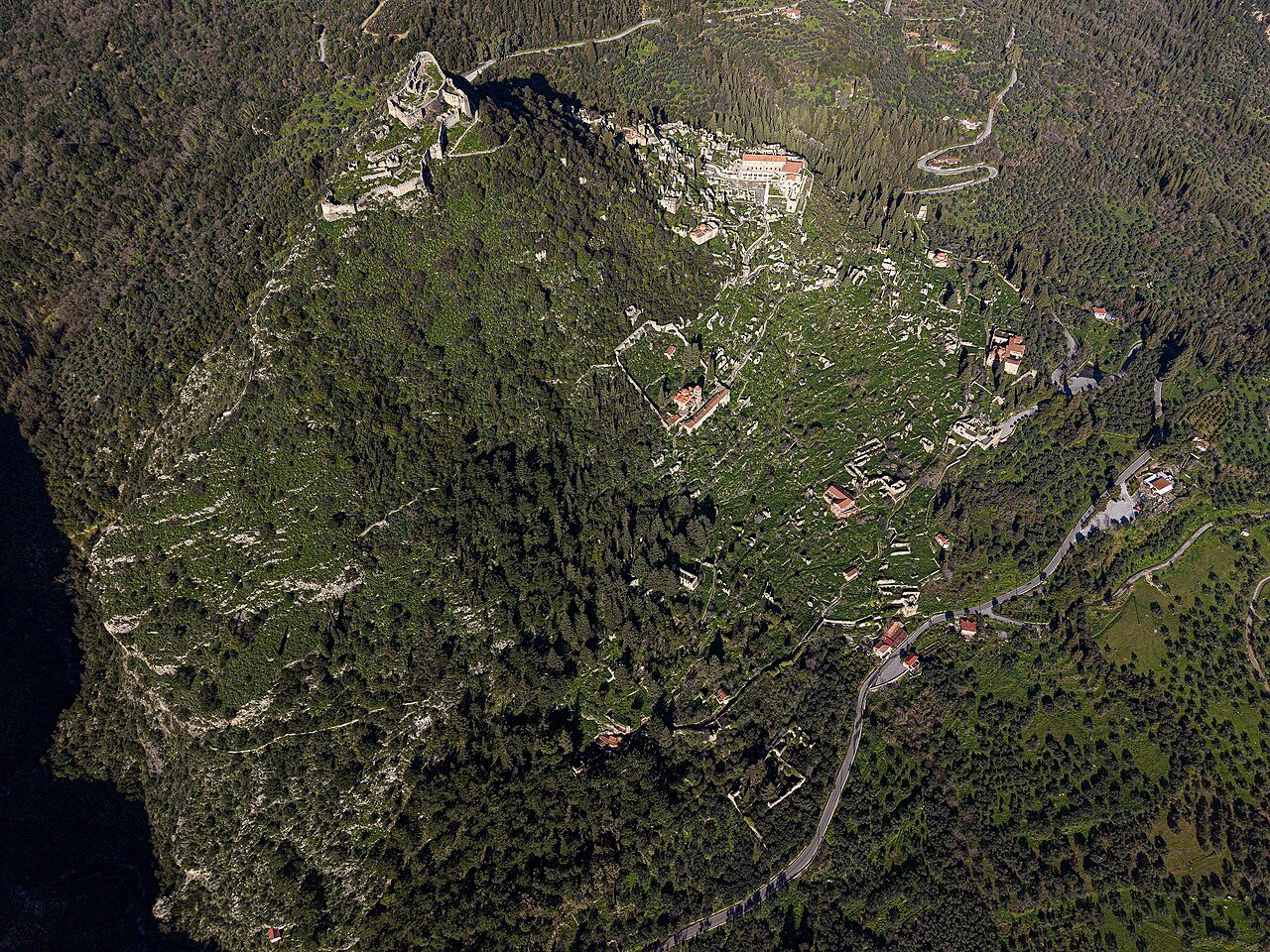
Mystras is a fortified Byzantine city built on the steep slopes of Mount Taygetos in the Peloponnese, Greece. Founded in 1249 by the Frankish prince William II of Villehardouin, it passed to Byzantine control in 1262 and became the seat of the Despotate of the Morea — the last significant Byzantine territory in mainland Greece. When the Ottoman Turks conquered it in 1460, seven years after the fall of Constantinople, the city was simply abandoned. It was never re-inhabited. Today the entire medieval city — palaces, churches, monasteries, streets, and domestic houses — survives in remarkable preservation across a series of terraces descending from a hilltop castle, gradually being reclaimed by pine trees and wildflowers.
The Philosopher Who Launched the Renaissance
Mystras’s most consequential contribution to world history is intellectual. In the early 15th century, as Constantinople’s empire contracted to almost nothing, Mystras became the intellectual capital of Byzantine culture. Among its resident scholars was Gemistos Plethon (c. 1355–1452 AD) — a philosopher who combined Platonic philosophy with ancient Greek religious concepts and wrote a radical program for reforming the Byzantine state. When Plethon traveled to Italy to attend the Council of Florence (1438–1439), his lectures on Plato astonished the Italian humanists. Cosimo de Medici, ruler of Florence, was so impressed that he founded the Platonic Academy in Florence largely as a result — an institution that directly launched the Renaissance rediscovery of Plato and transformed European intellectual life. This makes Mystras, in a real sense, one of the birthplaces of the Renaissance.
The Last Byzantine Emperor
Constantine XI Palaiologos, the last emperor of the Byzantine Empire, was not crowned in Constantinople. He was proclaimed emperor at Mystras in 1449, in the Metropolis cathedral that still stands within the UNESCO site. He then sailed to Constantinople, where he died fighting the Ottoman assault of 29 May 1453. The fall of Mystras seven years later, in 1460, completed the end of the Byzantine state. Mystras is therefore the place where the last chapter of a thousand-year empire began — and where it quietly ended when the inhabitants departed and left their city intact behind them.
The Frescoes and Their Legacy
The churches and monasteries of Mystras contain some of the finest surviving examples of Late Byzantine fresco painting. The frescoes in the Pantanassa convent, the Peribleptos chapel, and the Metropolis cathedral show a style that is naturalistic and emotionally expressive in ways that break decisively from earlier Byzantine conventions. Art historians have traced direct influences from these Late Byzantine frescoes to early Italian Renaissance painting, particularly in the Venetian tradition. The Mystras frescoes represent a moment when Byzantine art was independently evolving toward naturalism — an evolution cut short by the Ottoman conquest at its most creative peak.
What You Walk Through
Mystras is an active archaeological site spread across approximately three square kilometres on a mountainside. The layout is vertical: from the lower town you climb through medieval streets to the upper town and then to the castle at the summit. Key monuments include the Palace of the Despots (one of the most substantial surviving secular Byzantine buildings), the Metropolis cathedral with the proclamation stone of Constantine XI, the Pantanassa convent, the Peribleptos chapel, and the Brontochion monastery. Walking the full site takes three to four hours; the ascent to the castle adds another forty minutes. Summer heat makes morning visits strongly preferable.
The Living Convent Inside the Ruins
One detail distinguishes Mystras from almost every other UNESCO archaeological site in Greece: people live inside it. The Pantanassa convent, founded in 1428, is still home to a small community of Orthodox nuns. Visitors may enter the convent church to see its frescoes — among the latest and finest in the site, completed around 1430 — but the nuns’ enclosure is private. Their presence gives Mystras an unusual quality: the past coexists with a continuous religious life that has persisted across five centuries of political change, from Byzantine despots to Ottoman governors to modern Greece.
UNESCO Status and Practical Visit
Mystras was inscribed on the UNESCO World Heritage List in 1989 as an outstanding example of a Byzantine fortified city. The site is divided into two separately ticketed zones (lower and upper town); a combined ticket is available. The nearest modern town is Sparta, approximately eight kilometres east. The site is open year-round. There is a small museum at the entrance with sculptural finds and architectural fragments from the city.
Getting There
Mystras is located in the Peloponnese, approximately 250 kilometres from Athens by road. From Athens take the E65 motorway south to Tripoli and then drive south on the A7/E961 toward Sparta. From Sparta, signs direct you to Mystras on the lower slopes of Mount Taygetos to the west. There is a car park at the lower entrance. Public transport from Athens to Sparta is possible by KTEL bus (approximately 3.5 hours), with local taxis completing the journey to the site.
Find it on the map
See this place and what’s around it →
📷 Become a Cultural Heritage Online photographer
Share your photos of places: they stay published under your name as the author. The more they're seen, the more you get noticed — and soon a contest will reward the most appreciated photos.
Log in or sign up free to add a photo