
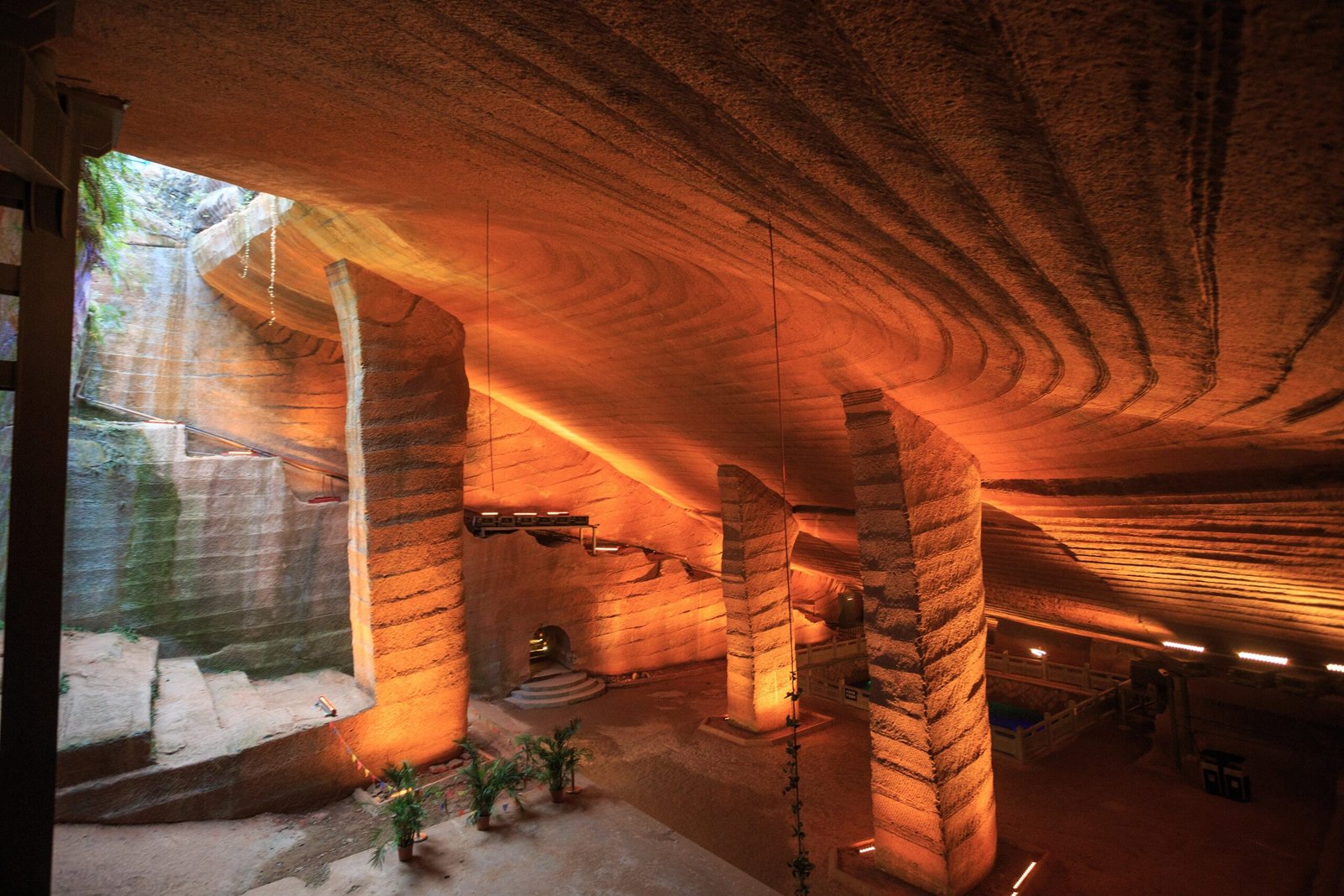
Twenty-four immense artificial caverns, each the size of a cathedral, carved entirely from siltstone beneath the fields of Longyou County, Zhejiang Province — and completely absent from 2,000 years of meticulous Chinese historical records. When local villagers began pumping water from what they assumed were natural ponds in 1992, they uncovered one of the most baffling archaeological mysteries in the world.
The Discovery That Should Not Have Existed
In June 1992, a farmer named Wu Anai began pumping a pond that had never dried up even in the worst droughts. After 17 days of continuous pumping, a vaulted chamber emerged from the water — not a natural cave but a precisely engineered artificial space. Further investigation found that 24 separate caverns had been carved beneath the fields and fish ponds of Longyou County, each approximately 30 metres high, with some floor areas exceeding 2,000 square metres. The total underground complex covers more than 30,000 square metres. The rock is siltstone — not the soft limestone of passive cave formation but a medium requiring deliberate, sustained effort to remove.
The Chisel-Mark Enigma
Every single surface of all 24 caverns — ceilings, walls, floors, pillars, stairways — is covered in a uniform pattern of parallel chisel marks, running at precisely 60 degrees to the horizontal, in rows approximately 6 centimetres wide. The pattern is absolutely identical across all 30,000 square metres. No comparable tool-mark signature has ever been found at any other archaeological site on Earth. The consistency across 24 separate caverns, presumably carved by hundreds of workers, implies either a level of craft discipline without parallel in ancient history or a technique that enforced the pattern mechanically — and neither explanation has been satisfactorily advanced.
Two Thousand Years of Silence
China has maintained extraordinarily detailed written records since at least 771 BC. The Shiji, completed around 94 BC, documents history back to mythological origins. Local gazetteers have catalogued county-level events since the Tang Dynasty. The Zhejiang provincial archives are among the most comprehensive in China. The Longyou Caves appear in none of them — not a single character in any known Chinese text mentions 24 underground caverns in Longyou County. The most defensible inference is that the caves were sealed before approximately 212 BC, when Qin Dynasty administrative standardisation began. Before that horizon: silence.
The Scale of Construction
Chinese engineers estimate that excavating 24 caverns of this scale required removing approximately one million cubic metres of rock — equivalent to filling 400 Olympic swimming pools. At realistic work rates for hand tools, this implies roughly 1,000 workers labouring continuously for four to six years. The structural engineering is sophisticated: the arched ceiling profiles distribute compressive loads efficiently, which explains why none of the 24 caverns has collapsed despite an estimated age of over 2,000 years and significant regional seismic activity. The pillars supporting the roofs are geometrically precise. Whoever designed these spaces understood rock mechanics.
What Were They For?
The absence of artefacts, inscriptions, skeletal remains, storage vessels, or any object indicating function has made purpose genuinely undeterminable. Proposed interpretations include underground granaries, military installations, quarries for construction stone, and ceremonial spaces — none of which accounts for all the evidence. The most intellectually honest answer, which Chinese archaeologists have increasingly adopted, is: we do not know. The caves were built at enormous cost by a highly organised workforce with advanced structural knowledge, they were clearly important enough to merit that investment, and then they vanished from collective memory so completely that their existence was unknown to anyone alive until 1992.
Visiting the Caves
Five of the 24 caverns are open to visitors, fitted with wooden walkways and lighting. A small museum presents the archaeological findings. The site is in Shiyantan village, approximately 6 kilometres from Longyou city centre in Zhejiang Province, reachable from Quzhou or Hangzhou by road. No UNESCO designation has been awarded — partly because World Heritage inscription requires demonstrated Outstanding Universal Value against a specific cultural tradition, which cannot be established without knowing whose tradition the caves belong to.
Map & Location
Find it on the map
See this place and what’s around it →📷 Become a Cultural Heritage Online photographer
Share your photos of places: they stay published under your name as the author. The more they're seen, the more you get noticed — and soon a contest will reward the most appreciated photos.
Log in or sign up free to add a photo