

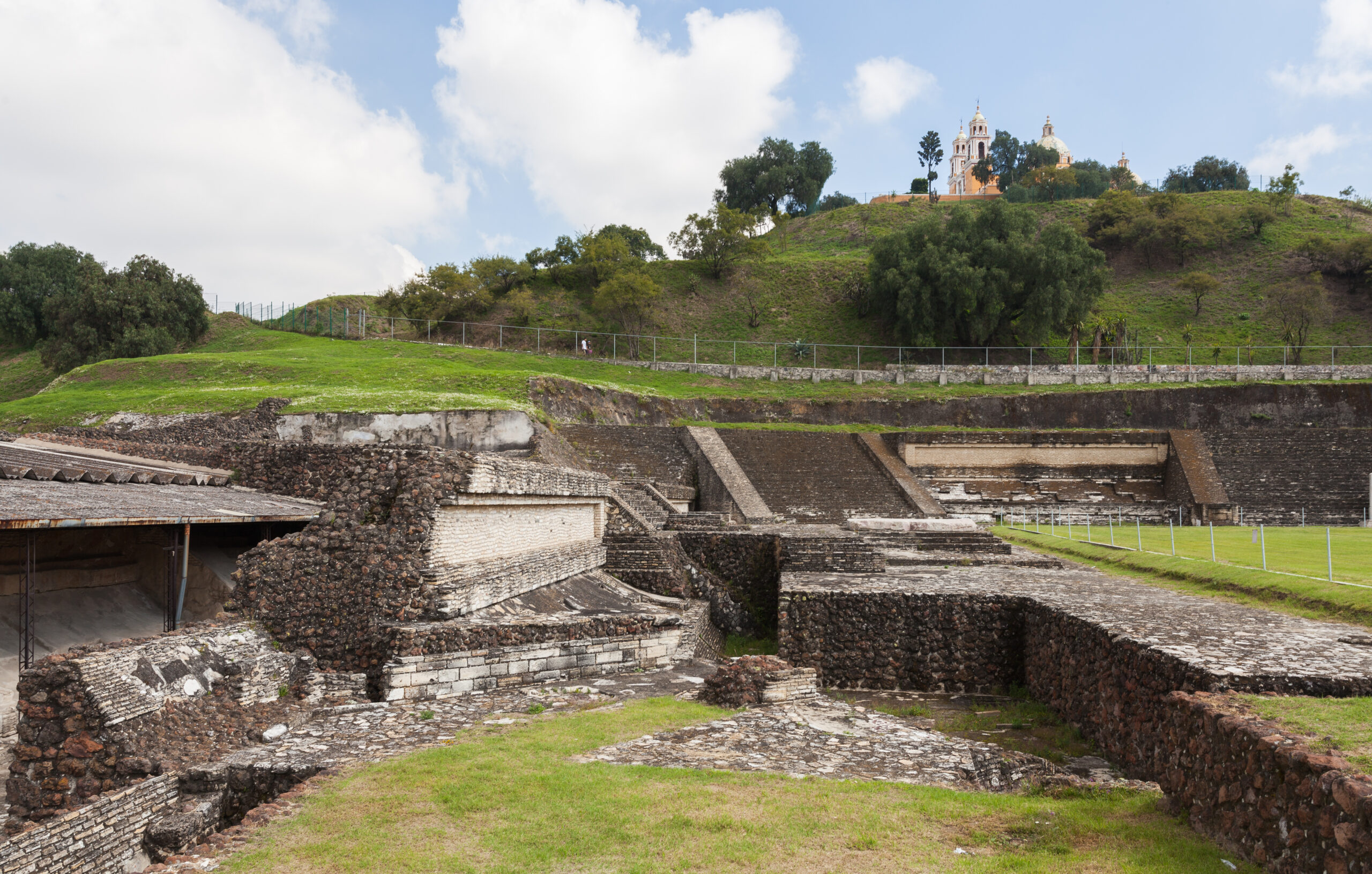
The World Largest Pyramid — Hidden in Plain Sight
The Great Pyramid of Cholula is the largest pyramid on Earth by volume: 4.45 million cubic metres — nearly four times the volume of the Great Pyramid of Giza. It stands 55 metres high, covers 160,000 square metres at its base, and looks exactly like a natural hill. Almost nobody outside archaeological circles knows it exists. The outermost surface is sun-dried adobe brick, which over centuries of abandonment and rainfall erodes into earth-coloured rubble indistinguishable from a natural slope. On its summit stands a Spanish colonial church, built in 1594.
The Spanish who commissioned the church did not know they were building on a pyramid. They placed it on the hill because hills were prominent — the church would be visible for miles across the Valley of Puebla. In doing so they inadvertently preserved the pyramid: the ecclesiastical status of the site protected it from quarrying and agricultural terracing that destroyed many other pre-Columbian earthworks in the region.
Four Pyramids Inside One
The Great Pyramid was built in four superimposed stages over approximately 1,200 years, from roughly 300 BC to 900 AD, by successive pre-Aztec civilisations. Each generation of builders constructed a new, larger pyramid over the existing structure — a Russian-doll architecture that preserved earlier phases intact within the mass of the later ones.
The cultures responsible for each stage are not definitively identified. Cholula was a major religious city in the central Mexican highlands for most of this period — a pilgrimage site whose main pyramid was the ceremonial heart of the city. Various Mesoamerican cultures controlled the city across the 1,200-year building span: the Preclassic period builders, Teotihuacan-influenced populations, and finally early Postclassic groups whose building programme ended around 900 AD.
The construction material — sun-dried adobe brick — was chosen for ease of production in vast quantities. It could be manufactured anywhere clay soil existed and dried quickly in the dry season. It was structurally sound enough for the construction purposes but had one long-term weakness: exposure to rain and vegetation slowly dissolved it. Once abandoned, the outer surface began its transformation into hill.
Eight Kilometres of Tunnels
Between 1931 and 1970, the Mexican government excavated approximately 8 kilometres of tunnels through the pyramid interior. These tunnels revealed the successive construction phases in cross-section, allowing archaeologists to walk from the 900 AD exterior shell progressively inward through older and older strata to the 300 BC core. Each layer preserved the earlier pyramid stairways, platforms, and painted interior surfaces.
Approximately 800 metres of the tunnel network is accessible to visitors today. Walking inside the pyramid — surrounded by ancient adobe walls, the passages lit artificially, the smell of compacted earth mixed with cool trapped air — gives a visceral sense of the structure scale that no aerial photograph can convey. The tunnels open periodically into excavated rooms where murals are visible in situ, their pigments still identifiable after nearly two millennia.
Most of the pyramid exterior remains unexcavated. A full surface excavation would require removing the colonial church (politically and legally impossible), the vegetation, and centuries of accumulated soil — a project of enormous cost that no government programme has ever funded. The hill you see today is what future visitors will see for the foreseeable future.
The Mural of the Drinkers
Among the most significant discoveries made during tunnel excavation is the Mural de los Bebedores (Mural of the Drinkers), a polychrome fresco 57 metres long. It is one of the longest pre-Columbian murals known to survive, comparable in scale to the great murals at Teotihuacan.
The mural depicts a ritual feast or festival in which 57 figures consume pulque, a fermented alcoholic beverage made from the sap of the maguey agave plant. The figures are shown in progressive states of intoxication. Archaeologists interpret the scene as a representation of a ceremony associated with Mayahuel, the Mesoamerican goddess of the maguey plant.
The mural was painted around 200 AD on the exterior wall of the second-generation pyramid. When the third construction phase was built over it, the mural was buried under adobe rubble, preserving it intact for nearly 1,800 years. It is viewable in the tunnels today, though portions have deteriorated since excavation exposed them to air.
Volume vs Height: The Giza Comparison
The Great Pyramid of Giza (c. 2560 BC) stands 138.8 metres tall. The Great Pyramid of Cholula stands 55 metres tall. By height, Giza is more than twice as tall. But the volume comparison reverses the relationship: Cholula contains 4.45 million cubic metres of material; Giza contains 2.6 million cubic metres. Cholula is nearly 70 percent larger by the measure that reflects total material invested.
The profiles of the two pyramids reflect different architectural purposes. Giza was designed to be seen — a monument to pharaonic power, its sharp triangular profile visible from the Nile Delta. Cholula was designed to be used — a stepped ceremonial platform whose footprint expanded outward generation by generation as each culture added its layer. The result is a structure that is enormous at the base but modest in height: a flat-topped ceremonial mountain rather than a celestial needle.
The Church on the Summit
The Iglesia de Nuestra Senora de los Remedios was completed in 1594. Its placement on the highest visible point in the Cholula plain was standard colonial religious practice — churches were built on the sites of indigenous temples or in visually dominant positions as deliberate statements of religious replacement. The Franciscan missionaries who supervised early colonial building at Cholula were aware of the pre-Columbian religious significance of the hill but unaware of its true nature as a pyramid.
The church remains active. Sunday mass is celebrated on the summit of the world largest pyramid. The churchyard commands a view across the Cholula plain to the snow-capped cone of Popocatepetl volcano (5,426 m), one of the defining panoramas of central Mexico. Popocatepetl is still active; its eruptions are periodically visible from the churchyard.
Visiting the Great Pyramid of Cholula
- Location
- San Andres Cholula, Puebla, Mexico. 12 km west of Puebla city centre.
- Coordinates
- 19.0572 N, 98.3017 W — altitude 2,200 m.
- Tunnels open
- Tuesday to Sunday, 09:00–17:00. Closed Mondays and national holidays.
- Admission
- INAH general admission fee; free for Mexican nationals on Sundays.
- Getting there
- Direct bus from Puebla CAPU terminal (approx. 30 min); taxi from Puebla centre approx. 20 min.
- On-site
- Tunnel walkway (800 m accessible section), site museum, mural viewing areas, churchyard access via external path.
Find it on the map
See this place and what’s around it →📷 Become a Cultural Heritage Online photographer
Share your photos of places: they stay published under your name as the author. The more they're seen, the more you get noticed — and soon a contest will reward the most appreciated photos.
Log in or sign up free to add a photo