
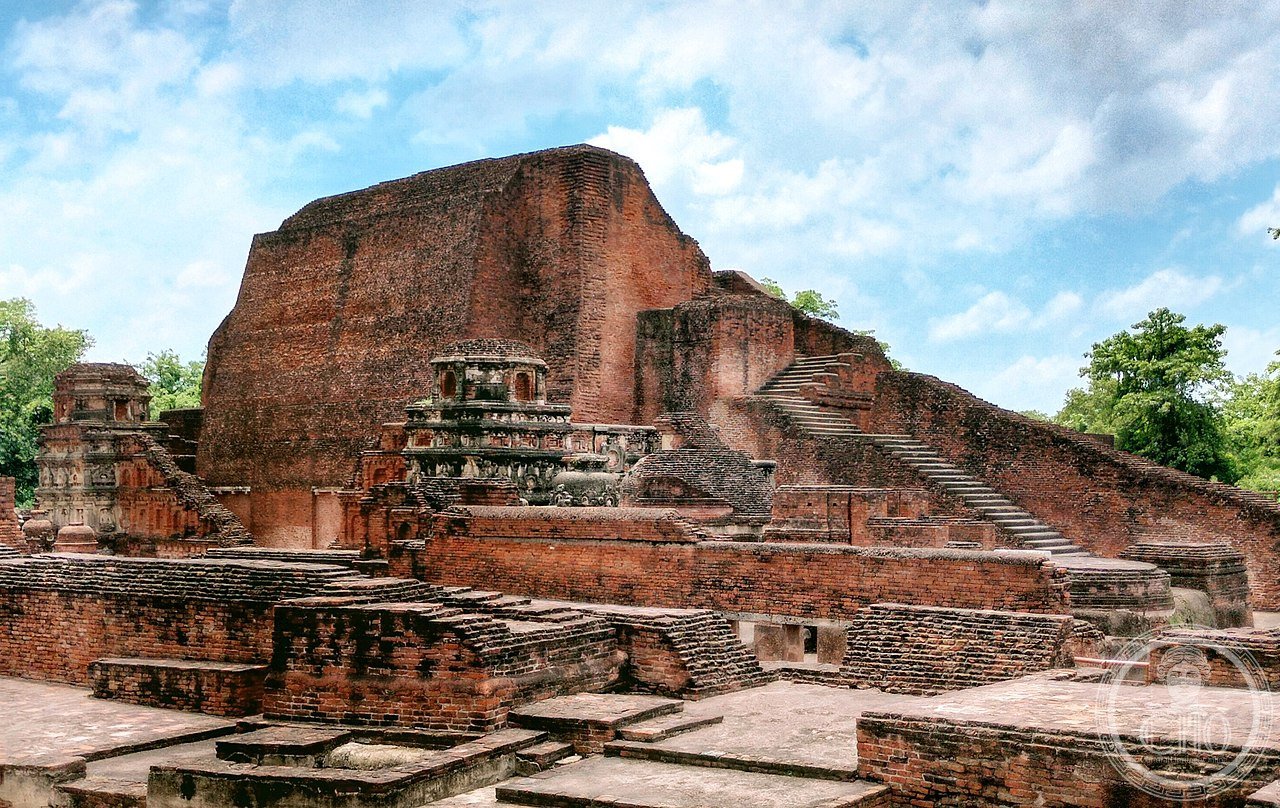

The Greatest University of the Ancient World
Before Oxford existed. Before Bologna. Before any European institution had conceived of the idea of a residential university, Nalanda had already been doing it for centuries. Founded in the 5th century AD under the patronage of the Gupta emperors in what is now the Indian state of Bihar, Nalanda was the world’s first large-scale residential university — a place where students lived, studied, debated, and learned under one institutional roof, supported by the institution itself.
At its height, between the 7th and 11th centuries AD, Nalanda housed approximately 10,000 students and 2,000 teachers. It drew scholars and pilgrims from Tibet, China, Korea, Japan, Mongolia, and Central Asia. Its curriculum ranged across Buddhist philosophy, logic, grammar, Vedic studies, medicine, mathematics, astronomy, and metaphysics. For nearly 700 years, it was arguably the most important centre of learning on Earth.
Xuanzang’s Account: A Library of Nine Floors
Our most vivid description of Nalanda at its peak comes from a Chinese Buddhist monk named Xuanzang (also romanised as Hsuan-tsang), who studied at the university from approximately 630 to 644 AD. Xuanzang had made an extraordinary 17-year journey from China, travelling through Central Asia and arriving in India specifically to study at Nalanda under the master Silabhadra. He left detailed accounts of what he found.
According to Xuanzang, Nalanda’s library complex was housed in three separate buildings, each standing nine storeys high. The complex was called the Dharmaganja — the Treasury of Dharma — and it contained millions of volumes. The three buildings were named Ratnasagara (Ocean of Jewels), Ratnodadhi (Sea of Jewels), and Ratnadadhi (Container of Jewels). Whether these precise names and the nine-storey height are entirely literal or partly embellished by later tradition is debated, but the scale of the library — and its international reputation — is well attested by multiple sources.
Xuanzang also described the daily routine at Nalanda: a bell woke students and teachers, lectures began at dawn, debates were scheduled throughout the day, and the intellectual atmosphere was one of intense competition and rigour. Entrance examinations were administered at the gate; only those who could satisfy the gatekeeper’s philosophical questions were admitted. The majority of applicants were turned away.
Five Centuries of Patronage
Nalanda was not a private institution. It was sustained by royal patronage on a massive scale over many generations. The Gupta emperors, who founded it in the 5th century, endowed the university with revenues from surrounding villages. The Pala dynasty, which succeeded them and ruled Bihar and Bengal from the 8th to 12th centuries, became Nalanda’s most enthusiastic patrons, funding new construction and attracting teachers from across the Buddhist world.
The campus that resulted from this sustained investment was enormous. Archaeological excavations have uncovered a complex of monasteries (viharas) and temples arranged on a north-south axis over an area of approximately 1.5 square kilometres — and this represents only a fraction of the original site, most of which remains unexcavated beneath the modern village and agricultural land that surrounds the ruins.
The Fire of 1193: A Library That Burned for Three Months
In 1193 AD, a Mamluk military commander named Bakhtiyar Khilji led a cavalry raid through Bihar. His forces attacked and sacked several Buddhist monasteries, and at Nalanda they encountered resistance from monks. Khilji’s army killed most of the monks and set the buildings on fire. According to the Tibetan historian Taranatha, writing in the 17th century, the library of Nalanda burned for three months.
This figure — three months of burning — has become one of the most cited images in the history of the destruction of knowledge. Whether it is literally accurate or a metaphorical expression of the magnitude of the loss is uncertain; no contemporaneous account from the site survives, precisely because the people who might have written it were gone. What is not in doubt is the outcome: Nalanda ceased to function as a university after 1193 and was never rebuilt at the same scale. The surviving monks dispersed, many fleeing to Tibet, carrying texts and oral traditions with them. This exodus is one reason Tibetan Buddhism preserves so much of the philosophical tradition that Nalanda had spent centuries developing.
The destruction of Nalanda is frequently cited as one of the pivotal events in the decline of Buddhism in India. Buddhism had already been losing ground to revived Hindu traditions for centuries before Khilji’s raid, but the loss of Nalanda — the intellectual heart of Indian Buddhism — accelerated that decline. By the 14th century, Buddhism had largely disappeared as a living tradition from the Indian subcontinent.
Archaeological Excavations
The ruins of Nalanda were first surveyed by Alexander Cunningham in 1861, working for the Archaeological Survey of India. He identified the site correctly with the ancient university described by Xuanzang. More systematic excavations were conducted by F.O. Oertel between 1915 and 1920, and subsequent campaigns throughout the 20th century have uncovered twelve major temple complexes, six large monasteries, lecture halls, and a wealth of sculptures, coins, and inscriptions.
The brick structures visible today are substantial: the foundations and lower walls of viharas still stand to several metres, and the main temple mounds convey something of the original monumental scale. The archaeological site is notable for the exceptional quality of its sculptural finds, including bronze Buddha images and terracotta plaques, many now in the Nalanda Museum adjacent to the site.
UNESCO Inscription and Modern Revival
The archaeological remains of Nalanda were inscribed as a UNESCO World Heritage Site in 2016 under the full name “Nalanda Mahavihara at Nalanda, Bihar.” The inscription recognised both the outstanding universal value of the ruins and the site’s exceptional significance in the history of education, Buddhism, and cross-cultural exchange across Asia.
In 2014, a modern Nalanda University was inaugurated near the ruins as part of an Indian government initiative to revive the institution’s legacy. The new university, supported by several Asian nations, focuses on research and postgraduate study with an international orientation. It operates on a new campus a short distance from the archaeological site.
Visiting Nalanda
The Nalanda archaeological site is located approximately 95 kilometres southeast of Patna, the capital of Bihar state, and about 13 kilometres north of Rajgir — itself a site of major historical significance in both Buddhist and Jain traditions. The Nalanda Museum, adjacent to the ruins, houses a substantial collection of sculptures, bronzes, and artifacts from the excavations. The site itself is open year-round and is best visited in the cooler months between November and February.
The surrounding Bihar region contains multiple sites of extraordinary historical depth — Bodh Gaya, where the Buddha attained enlightenment; Rajgir, where the first Buddhist council was held; Vaishali, associated with the Licchavi republic. A visit to Nalanda fits naturally into a broader circuit of early Indian history that few travellers outside specialist Buddhism and South Asian studies ever make.
- Location
- Nalanda district, Bihar, India (95km southeast of Patna)
- Coordinates
- 25.1358° N, 85.4431° E
- Period
- 5th century AD – 1193 AD (Gupta through Pala dynasties)
- UNESCO inscription
- 2016 (World Heritage Site)
- Key figure
- Xuanzang (630–644 AD) — Chinese pilgrim whose accounts describe the university at its peak
- Destruction
- 1193 AD by Bakhtiyar Khilji; library reportedly burned for three months
- Wikipedia
- Nalanda — Wikipedia
Find it on the map
See this place and what’s around it →📷 Become a Cultural Heritage Online photographer
Share your photos of places: they stay published under your name as the author. The more they're seen, the more you get noticed — and soon a contest will reward the most appreciated photos.
Log in or sign up free to add a photo