
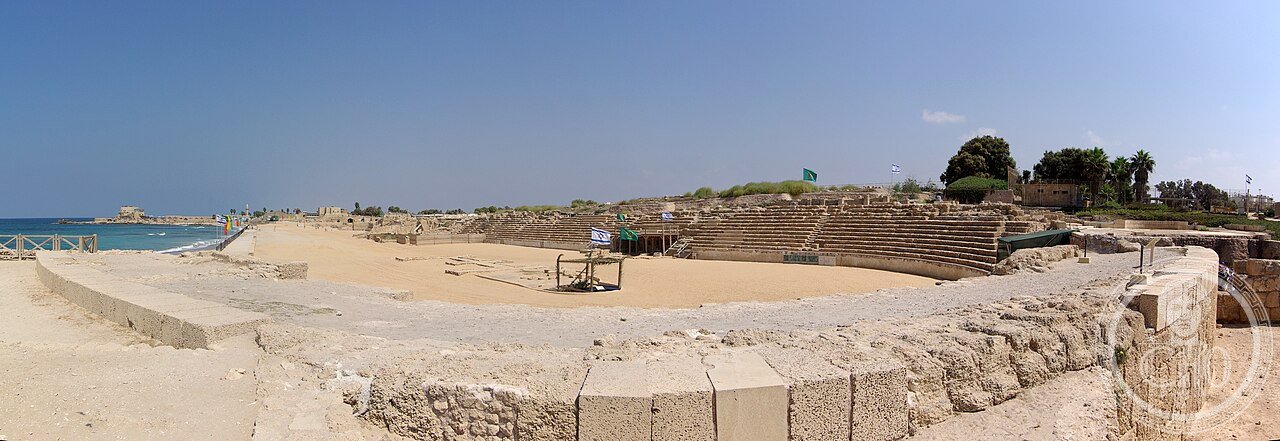
Herod’s Impossible Harbor
Around 22 BC, King Herod the Great began one of the most ambitious construction projects in the ancient Mediterranean world: a harbour city on the flat, harbourless coast of Judaea. There was no natural bay, no protective headland, nothing to recommend the site from a nautical standpoint. Herod built the harbour anyway. He called it Sebastos — the Greek translation of “Augustus” — and dedicated the city it served, Caesarea Maritima, to his patron the Roman Emperor.
What Herod built at Sebastos was the largest artificial harbour in the ancient world. It extended 900 metres into the open sea, sheltering an area of approximately 100,000 square metres. The breakwaters were constructed from a revolutionary material: Roman pozzolanic concrete, made by mixing volcanic ash imported from Pozzuoli in Italy with seawater and lime. This hydraulic concrete set underwater — a chemical reaction that produces a material stronger than ordinary concrete and highly resistant to seawater. It was, as far as we know, the first large-scale deployment of this technique in the ancient world.
A City of the Roman World
Caesarea Maritima was not merely a port. It was a fully realised Roman city, designed and built from scratch in the Mediterranean tradition. Herod equipped it with a palace, temples, a hippodrome, a theatre seating around 4,000 spectators, an elaborate sewer system flushed by tidal action, and a colonnaded main street. The city’s grid plan, its public spaces, and its architectural vocabulary were thoroughly Roman — a political statement as much as an aesthetic choice.
After Herod’s death in 4 BC, Caesarea became the administrative capital of the Roman province of Judaea and the official residence of the Roman prefects and procurators who governed it. This is where the machinery of Roman power in the region was housed, where taxes were assessed, troops were garrisoned, and judicial decisions were made. It was the most Roman city in the Levant — by design.
The Stone That Named Pilate
In 1961, excavators working at Caesarea made one of the most consequential archaeological discoveries of the 20th century. A limestone block, reused in the construction of a later theatre stairway, bore a Latin inscription in four lines. The first line reads Tiberieum — a building dedicated to the Emperor Tiberius. The second line reads, in damaged but legible form: [Pontius] Pilatus. The third: [Praef]ectus Iuda[eae] — Prefect of Judaea.
This stone, now in the Israel Museum in Jerusalem (a cast remains at Caesarea), is the only direct archaeological evidence ever found for the existence of Pontius Pilate. He appears in the New Testament gospels as the Roman official who presided over the trial of Jesus; he is mentioned by the historian Josephus and briefly by Tacitus. But until 1961, all evidence of his existence was textual. The Caesarea inscription changed that. For archaeologists and historians, it is one of the most significant single objects to emerge from the ground in the Holy Land.
The Harbor That Sank
Sebastos, the great harbour, no longer stands above water. Within a few centuries of its construction, geological subsidence caused the coastline around Caesarea to drop by as much as 6 metres. The massive concrete breakwaters, the quays, the lighthouse foundations, and the warehouses along the harbour’s edge are now submerged in the Mediterranean, lying in 5 to 10 metres of water.
This is not, it turns out, a tragedy for archaeology. The underwater conditions have preserved structural details that would have eroded or been robbed for building material had they remained on land. Beginning in 1976, a team led by archaeologists Robert Hohlfelder and Avner Raban conducted systematic underwater excavations that documented the harbour’s construction techniques, scale, and phasing in remarkable detail. Their work revealed how Herod’s engineers had used wooden forms lowered to the seabed as moulds for the concrete — a logistical feat of the first order.
Israel’s First Underwater Archaeological Park
Today, the submerged harbour of Caesarea is accessible to visitors in two ways: scuba divers can explore the ruins with a guide through the Caesarea Underwater Archaeological Park, Israel’s first such site, while non-divers can view the submerged structures from glass-bottom boats operating out of the modern marina. The harbour ruins visible underwater include massive concrete blocks, column drums, anchors, ceramic storage vessels, and the ghostly outlines of the ancient quay walls.
The Caesarea National Park on land encompasses the Roman theatre (still used today for summer concerts under the stars), the Byzantine street lined with ancient statues, the hippodrome, and the imposing Crusader citadel that occupies part of the ancient harbour promontory. The juxtaposition of periods — Herodian, Roman, Byzantine, Crusader — is part of what makes Caesarea unusual even among Israeli archaeological sites, where layered history is the norm.
Caesarea in the New Testament and Early Christianity
Caesarea Maritima appears repeatedly in the New Testament. The Apostle Peter baptised the Roman centurion Cornelius here — traditionally regarded as the first conversion of a Gentile to Christianity. The Apostle Paul was imprisoned in Caesarea for two years before being sent to Rome for trial; his imprisonment took place in the praetorium, the official residence and administrative centre that would have been among the grandest buildings in the city. The early Christian theologian Origen established a famous library and scriptural research centre at Caesarea in the 3rd century, which Eusebius of Caesarea — the first major historian of Christianity — would later use extensively.
The City in Later Centuries
Caesarea remained important through the Byzantine period, when it was a major episcopal see, and through the Arab conquest of 640 AD. The Crusaders rebuilt and fortified it in the 12th century, constructing the massive walls and moat system that still define a large part of the visible site today. The city was taken by Saladin in 1187, recaptured by Richard I of England in 1191, and finally abandoned after a definitive Mamluk siege in 1265. After the Mamluks, Caesarea was largely uninhabited for centuries — which is one reason the ancient remains survived as well as they did.
Visiting Caesarea Maritima
The Caesarea National Park is located on the Mediterranean coast approximately 50 kilometres north of Tel Aviv, near the modern town of Or Akiva. The park is open year-round and includes the Roman theatre, the hippodrome, the Byzantine cardo, the Crusader citadel, harbour promenades, and access to the underwater park. A separate ticket covers the underwater experience. The modern Caesarea harbour area includes restaurants and a small beach alongside the ancient ruins, creating one of the more incongruous but enjoyable archaeological atmospheres in the Mediterranean world.
- Location
- Caesarea, Haifa District, Israel (Mediterranean coast, 50km north of Tel Aviv)
- Coordinates
- 32.4995° N, 34.9050° E
- Built
- c. 22–10 BC by Herod the Great; active to 13th century AD
- Key discovery
- Pilate Stone (1961) — only direct archaeological evidence of Pontius Pilate
- Harbour
- Sebastos — largest artificial harbour in the ancient world; now partly submerged
- Wikipedia
- Caesarea Maritima — Wikipedia
Find it on the map
See this place and what’s around it →📷 Become a Cultural Heritage Online photographer
Share your photos of places: they stay published under your name as the author. The more they're seen, the more you get noticed — and soon a contest will reward the most appreciated photos.
Log in or sign up free to add a photo