
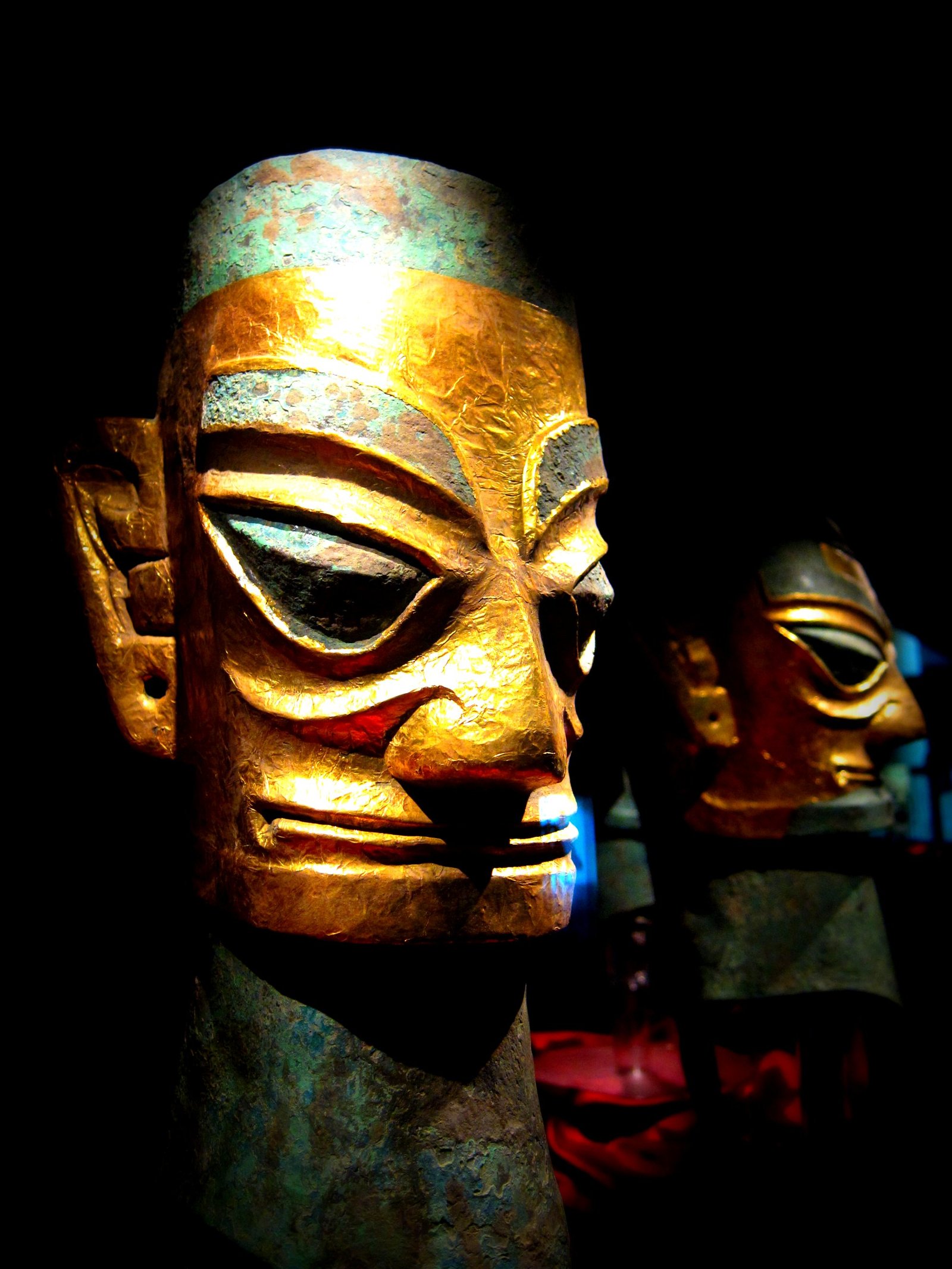
Found by chance in 1986 during irrigation work in Sichuan Province, Sanxingdui revealed a Bronze Age civilization completely unknown to history — with an art style so unlike anything in the contemporary Chinese world that its discovery rewrote the prehistory of China.
At a glance
Sanxingdui (“Three Star Mounds”) is an archaeological site in Guanghan, Sichuan Province, representing the capital of the ancient Shu culture — a Bronze Age civilization that flourished in the Chengdu plain roughly between 2800 and 1100 BC. Two sacrificial pits discovered in 1986 by construction workers contained thousands of objects buried in deliberate ritual deposits: bronze masks with eyes that protrude up to 16 centimetres from the face, a bronze “World Tree” nearly four metres tall with birds on its branches, gold-sheathed ceremonial staffs, and jade bi discs. None of these objects have a counterpart in the Shang or Zhou dynasty cultures of the Yellow River valley that contemporary Chinese archaeology had previously defined as the cradle of Chinese civilization. Six additional pits excavated between 2020 and 2023 yielded thousands more objects, including a complete gold face mask. The site museum in Guanghan holds the world’s definitive collection of Shu culture material.
Key facts
- Period: c. 2800–1100 BC (Bronze Age, Shu culture)
- Discovery: First pits found 1986 by irrigation workers; systematic excavation since; new pits 3–8 excavated 2020–2023
- Location: Guanghan, Sichuan Province, China — 40 km north of Chengdu
- Signature object: Bronze “sunken eye” masks with eyes protruding up to 16 cm; largest bronze mask 138 cm wide
- World Tree: Bronze tree standing 3.96 m tall with 27 birds on its branches — the largest surviving bronze tree from any Bronze Age culture
- Status: On China’s UNESCO Tentative List; new museum complex opened 2023
History
In the spring of 1986, workers digging an irrigation ditch near Guanghan accidentally struck a cache of jade and bronze objects. Archaeologists from the Sichuan Provincial Institute of Archaeology arrived quickly and identified two large rectangular sacrificial pits (Pit 1 and Pit 2), clearly the result of deliberate ritual burning and burial. The objects retrieved over the following weeks included bronze heads, elephant tusks, jade and stone tools, and bronze vessels — but also items with no precedent in known Chinese Bronze Age material culture: standing human figures with elongated hands, mask faces with disproportionately large eyes, and a ceremonial bronze tree of extraordinary complexity.
The civilization that produced these objects — now termed the Shu culture — left no written records and bears no relationship to the Shang dynasty oracle-bone script or the artistic conventions of the Yellow River cultural sphere. Its origins and the nature of its contact (if any) with other Bronze Age civilizations remain debated. Chinese sources from later periods include mythological references to ancient kingdoms of Shu, but these were long regarded as legends; Sanxingdui proved a major Bronze Age culture had indeed existed independently in the Sichuan basin.
From 2020 to 2023, a major excavation campaign opened six new pits (numbered 3 through 8). Conducted under climate-controlled conditions with live-streamed excavation, the campaign produced thousands of additional objects including a near-complete gold face mask, a bronze altar depicting cosmological scenes, and extraordinary examples of bronze vessels that combine Shu iconography with forms familiar from Shang dynasty metallurgy — suggesting at least some degree of exchange between the two cultures. Excavation at Sanxingdui continues.
What you see
The original excavation site lies at the edge of the modern city of Guanghan; access is through the Sanxingdui Museum, whose new 55,000-square-metre campus (opened 2023) was designed by the architectural firm CCTN around the archaeological pits themselves. The museum’s centrepiece is Pit 8, where visitors look down through glass floors at an excavation still in progress — objects emerging from the earth in real time, bronze and gold glinting under controlled lighting. The permanent collection in the older museum building houses the iconic objects from 1986: the standing bronze human figure (168 cm tall, on a pedestal 90 cm high — total height 2.62 m, the largest known bronze human figure from any Bronze Age culture in the world), the “sunken-eye” masks, and the reconstructed World Tree.
The precision of Sanxingdui bronze-casting is impossible to fully account for with the tools the Shu culture possessed. Hold your gaze on the protruding eyes of the largest mask — 16 centimetres of hollow bronze cylinder projecting from a face 138 centimetres wide — and the question of how this culture developed, in apparent isolation, is not merely academic. It is visceral.
Practical information
- Opening hours: Tuesday–Sunday 08:00–18:00 (last entry 17:00); closed Mondays
- Admission: Museum entrance fee; new campus opened 2023 — check sanxingdui.com.cn for current prices
- Best time: Year-round; the museum is indoors and climate-controlled
- Location: Sanxingdui Museum, Guanghan, Sichuan Province, China
- Language: Chinese-language labelling predominates; English audio guides available for rent
Getting there
Guanghan is located approximately 40 kilometres north of Chengdu. From Chengdu, the most convenient option is the Chengdu-Deyang intercity rail (approx. 25 minutes to Deyang, then local bus or taxi to Guanghan). Direct buses from Chengdu’s Zhaojue Temple bus station to Guanghan run frequently (approx. 1 hour). From Chengdu Shuangliu International Airport (CTU) or the newer Tianfu International Airport (TFU), the journey takes 1–1.5 hours by road. Guanghan itself is a small city with limited tourist infrastructure; most visitors do Sanxingdui as a day trip from Chengdu.
Nearby
- Chengdu: 40 km south; the Sichuan Museum holds additional Shu culture material, and the city is the base for visiting Sanxingdui
- Jinsha Site Museum (Chengdu): A related Shu culture site discovered in 2001 in the suburbs of Chengdu, c. 1200–650 BC; gold, bronze, and jade objects that extend the Sanxingdui story into a later period
- Leshan Giant Buddha: 150 km south of Chengdu; the world’s largest pre-modern stone Buddha (71 m, Tang dynasty, UNESCO WHS)
Sources
- Wikipedia — Sanxingdui
- Sanxingdui Museum — sanxingdui.com.cn
- UNESCO Tentative List — China nomination documentation
Find it on the map
See this place and what’s around it →📷 Become a Cultural Heritage Online photographer
Share your photos of places: they stay published under your name as the author. The more they're seen, the more you get noticed — and soon a contest will reward the most appreciated photos.
Log in or sign up free to add a photo