
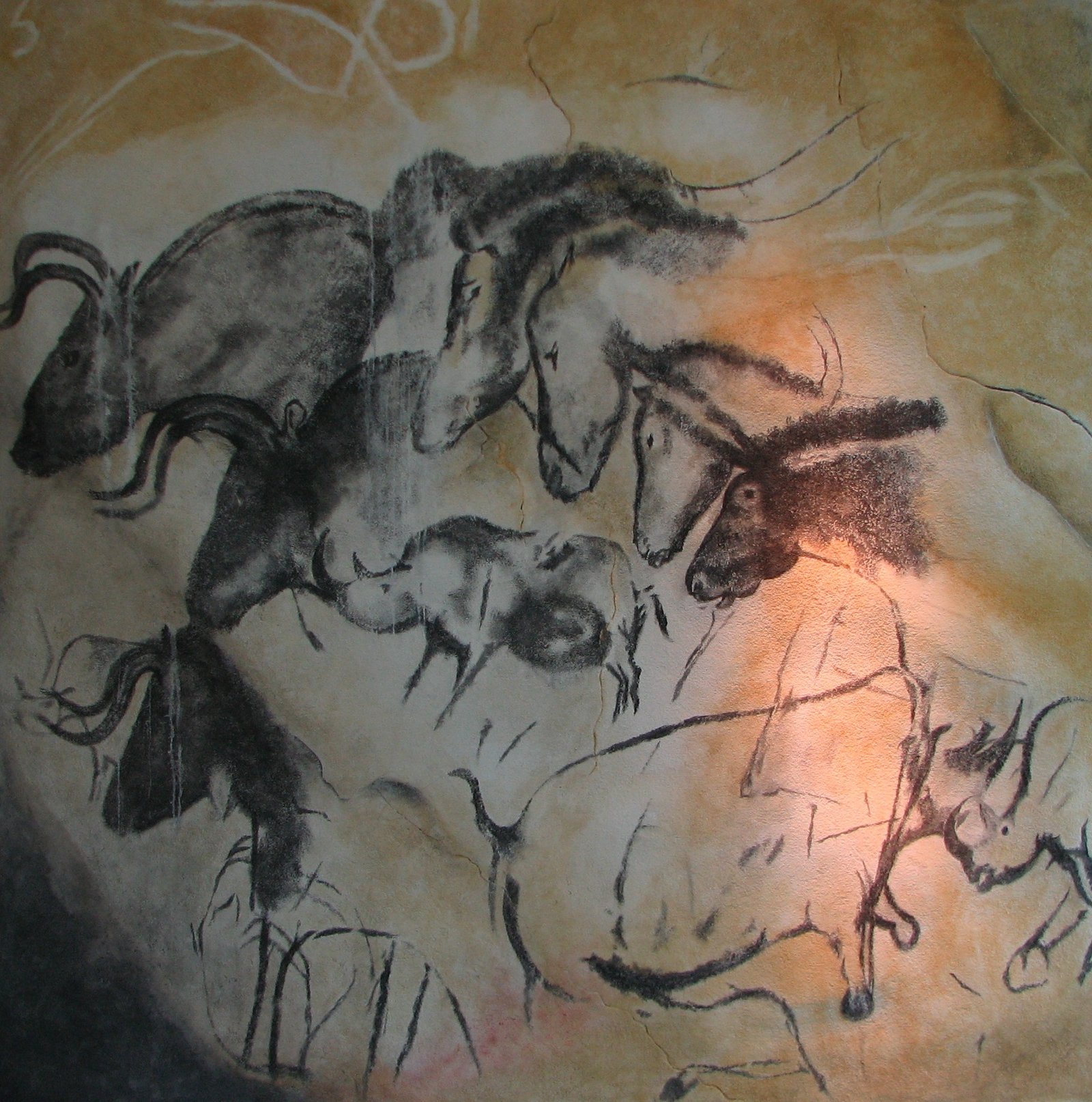
Discovered in 1994 in the Ardèche Gorge and immediately sealed to the public, Chauvet Cave holds the oldest known figurative art in the world — paintings of lions, rhinoceroses, and woolly mammoths made by human hands 36,000 years ago, with a mastery of line and perspective not seen again until the Renaissance.
At a glance
The Chauvet-Pont d’Arc Cave, to give its full name, was sealed by a rockfall approximately 21,500 years ago and remained unknown until December 18, 1994, when three French speleologists — Jean-Marie Chauvet, Éliette Brunel, and Christian Hillaire — followed a draught of air through a narrow opening in the Ardèche Gorge and found themselves in a system of chambers covered in paintings. The cave contains 425 individual animal images of at least 14 species, including 73 woolly mammoths, 57 aurochs, 36 cave bears, and the earliest known depictions of cave lions and woolly rhinoceroses anywhere. Radiocarbon dating places the oldest paintings at 36,000–32,000 BC, making Chauvet roughly twice as old as the Lascaux cave paintings and the oldest known figurative art in human history. The cave was listed as a UNESCO World Heritage Site in 2014 as the “Decorated Cave of Pont d’Arc.” It has been closed to the public since its discovery; Werner Herzog’s 2010 documentary Cave of Forgotten Dreams remains the only film made inside.
Key facts
- Age: c. 36,000–32,000 BC (Aurignacian/Gravettian periods) — oldest known figurative art in the world
- Discovery: December 18, 1994, by Jean-Marie Chauvet, Éliette Brunel, and Christian Hillaire
- UNESCO: World Heritage Site since 2014 (as “Decorated Cave of Pont d’Arc”)
- Paintings: 425 individual animal images, 14+ species; closed since 1994
- Film: Werner Herzog, Cave of Forgotten Dreams (2010) — the only film crew permitted inside
- Replica: La Caverne du Pont d’Arc (opened 2015, 3 km from the original) replicates all paintings at 1:1 scale using 3D scanning
History
On December 18, 1994, three experienced cave explorers — Jean-Marie Chauvet, Éliette Brunel, and Christian Hillaire — were exploring the limestone cliffs above the Ardèche Gorge near Vallon-Pont-d’Arc when they detected a draught rising from a pile of rubble. They cleared the opening and lowered themselves into darkness. What they found over the following hours, moving deeper into a system of connected chambers with their electric headlamps, was a surface of limestone virtually covered with images: bears, horses, rhinoceroses, lions, bison, aurochs, deer, mammoths, and a human figure — all painted in charcoal or red ochre with a confidence and technical sophistication that defied expectation. There were no signs of human habitation: no hearths for warmth, no debris of daily life. The cave had been used as a sanctuary, not a dwelling.
The discovery was immediately reported to the French Ministry of Culture. André Leroi-Gourhan’s student Jean Clottes led the scientific assessment, and radiocarbon dates returned readings that shocked the archaeological world: the oldest paintings dated to approximately 36,000 years before present, placing them in the Aurignacian period — a full 18,000 years older than the paintings at Lascaux that had defined the previous understanding of cave art’s origins and sophistication. The cave was sealed with a reinforced door within weeks of its discovery. The Lascaux paintings had been opened to tourists in 1948 and by the 1960s were being destroyed by CO₂ and fungal growth from human breath. That mistake would not be repeated.
A rockfall had sealed the original entrance approximately 21,500 years ago, preserving the cave in isolation: cave bear skeletons remain on the floor in the positions where the animals died; torch marks on the walls are intact; there are even the footprints of a child in the clay, estimated at 26,000 years old. The cave has been studied by teams of scientists under strict access protocols; no member of the public has ever entered since its discovery. The rockfall that sealed it is the reason it survived.
What you see
Werner Herzog’s 2010 documentary Cave of Forgotten Dreams (filmed in 3D with special ministerial permission) provides the only available moving-image record of the cave’s interior. Herzog’s camera lingers on the Panel of Lions — 12 cave lions in pursuit or confrontation, painted with overlapping contour lines that convey movement — and on the megaceros deer rendered with charcoal shading that creates genuine three-dimensionality. Several paintings use the natural relief of the cave wall to give volume to the animals’ bodies: a bison’s shoulder emerges from a limestone bulge; a bear’s head is positioned so that a crack in the wall becomes its open mouth. The technical vocabulary here — motion, shading, spatial composition, use of the substrate — was not “rediscovered” until the Italian Renaissance, 34,000 years later.
The accessible experience is La Caverne du Pont d’Arc, opened in 2015 approximately 3 kilometres from the original site on the plateau above the Ardèche Gorge. Built using precise 3D scans of every surface, the replica is not a simplified version but a full-scale volumetric recreation: the same floor undulations, the same ceiling heights, the same relationship between image and rock surface. Standing before the Panel of Lions in the replica — 40,000-year-old eyes rendered with precision — the question is not whether the original is worth seeing. It is whether the gap between then and now is as large as we assumed.
Practical information
- Original cave: Closed to public since 1994; no exceptions
- Replica — La Caverne du Pont d’Arc: Open year-round; timed-entry tickets required; book in advance at cavernedupontdarc.fr
- Replica address: Route de Bourg-Saint-Andéol, 07150 Vallon-Pont-d’Arc, France
- Best time: Shoulder season (April–June, September–October); July–August is crowded; the cave is temperature-controlled at 13°C year-round — bring a layer
- Duration: Allow 2–2.5 hours for the guided replica visit
Getting there
Vallon-Pont-d’Arc is located in the Ardèche department of southern France, approximately 75 km from Montélimar (TGV station on the Paris–Marseille line) and 90 km from Nîmes. By car from Paris: approximately 6 hours via the A7 motorway south, exiting toward Aubenas. The Ardèche Gorge is a major summer tourist destination; rental cars from Montélimar or Avignon are the most practical option. No direct rail connection reaches Vallon-Pont-d’Arc; bus connections from Aubenas serve the area in summer months.
Nearby
- Ardèche Gorge (Gorges de l’Ardèche): The river canyon below the cave site is one of the most spectacular natural landscapes in southern France; canoe descents from Vallon-Pont-d’Arc to Saint-Martin-d’Ardèche (32 km, 1–2 days) pass beneath the natural Pont d’Arc arch
- Pont du Gard: 100 km southeast; the intact Roman aqueduct bridge (UNESCO WHS), arguably the finest Roman engineering work visible in France
- Grotte de Font-de-Gaume (Les Eyzies, Dordogne): The last authentic painted cave open to public visits in France (16,000 BC); limited daily tickets; approximately 3.5 hours northwest
Sources
- Wikipedia — Chauvet Cave
- UNESCO World Heritage Centre — Decorated Cave of Pont d’Arc, known as Grotte Chauvet-Pont d’Arc, Ardèche
- La Caverne du Pont d’Arc — cavernedupontdarc.fr
Find it on the map
See this place and what’s around it →Historical events at this place (1)
📷 Become a Cultural Heritage Online photographer
Share your photos of places: they stay published under your name as the author. The more they're seen, the more you get noticed — and soon a contest will reward the most appreciated photos.
Log in or sign up free to add a photo