
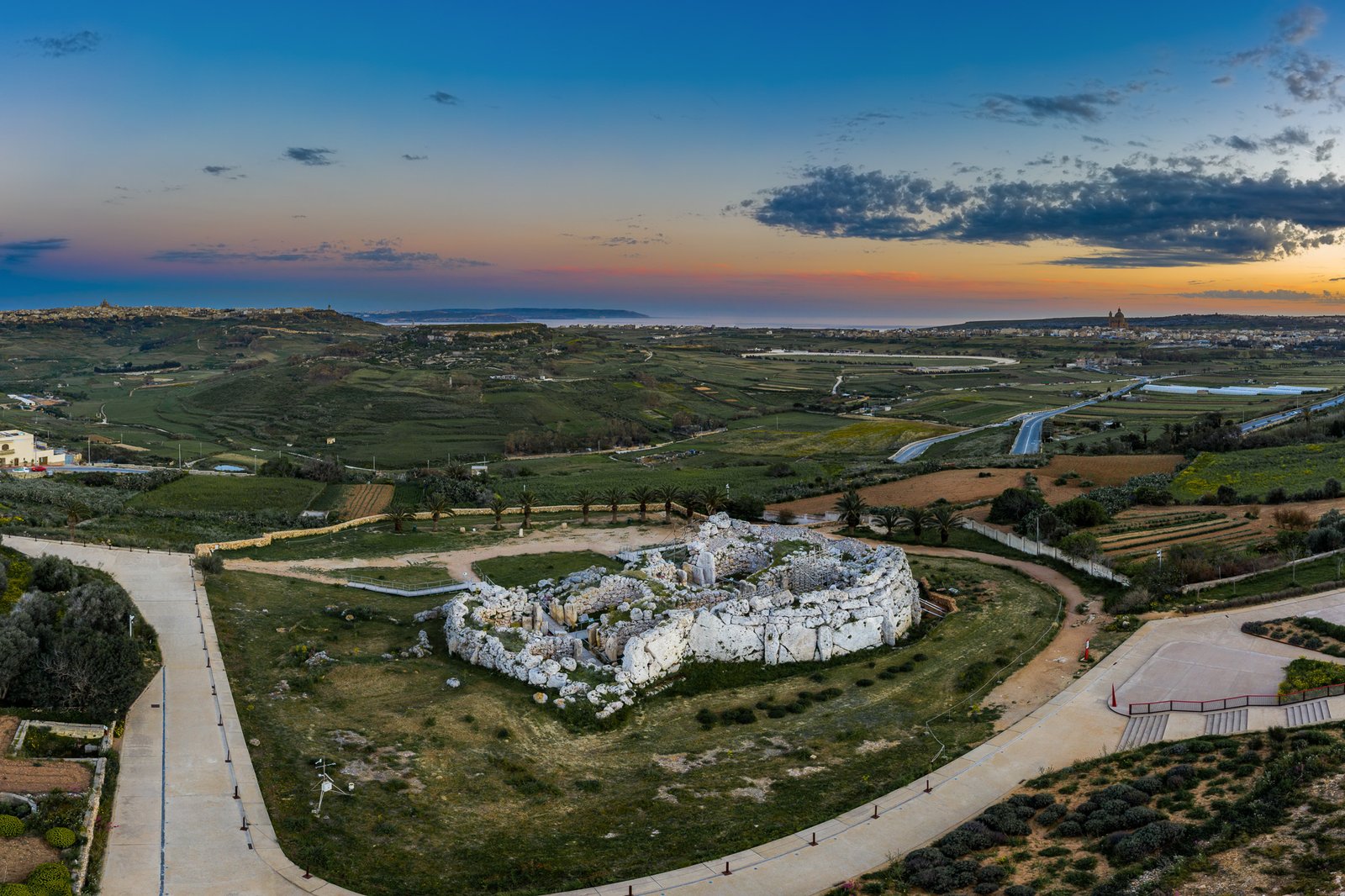
Two adjacent megalithic temples on the island of Gozo, built more than 5,600 years ago — predating both Stonehenge and the Giza Pyramids by a thousand years, and counting among the oldest freestanding stone structures on Earth.
At a glance
Ġgantija stands on a ridge above the village of Xagħra on Gozo, Malta’s smaller companion island. The two temples — a larger southern structure and a smaller northern one, sharing a common outer enclosure wall — were built between approximately 3600 and 3000 BC using two distinct types of limestone. The outer walls, constructed from hard coralline limestone, rise to nearly 6 metres in some sections and are composed of individual blocks weighing up to 50 tonnes. The inner spaces and decorative elements use softer, more workable globigerina limestone. The entire complex was erected by a population without metal tools, wheeled vehicles, or draught animals. Running your hand along the outer wall and registering the sheer mass of each block, set so tightly that no mortar was needed, makes clear that Ġgantija is not simply old — it represents a level of collective engineering ambition that remained unsurpassed in the Mediterranean for at least a thousand years.
Key facts
- Period: c. 3600–3000 BC (Ġgantija phase, named for this site)
- UNESCO inscription: 1980 (as part of Megalithic Temples of Malta)
- Scale: Outer enclosure wall approximately 50 m long; individual stones up to 50 tonnes; outer walls standing up to 6 m
- Structure: Two adjacent temples sharing a common enclosure — south temple (larger, better preserved) and north temple
- Name: “Ġgantija” means “belonging to the giants” in Maltese; local tradition attributed the construction to a female giant
- Access: Open to visitors year-round; no strict booking caps (unlike Ħal Saflieni); managed by Heritage Malta
History
Ġgantija was the first of Malta’s megalithic temples to be formally excavated. In 1827, Colonel John Otto Bayer supervised the clearance of debris from the site on behalf of the Grandmaster of Malta, revealing the imposing outer walls and the internal apsidal chambers that had been concealed under centuries of accumulated earth. Earlier descriptions, by travellers and antiquarians in the late eighteenth century, had noted “great heaps of stone” on the ridge at Xagħra, but without excavation their significance was unrecognised. The site gives its name to an entire phase of Maltese prehistory — the Ġgantija phase (c. 3600–3200 BC) — which preceded the later and more decoratively elaborate Tarxien phase. This chronological naming reflects the degree to which Ġgantija is understood as the foundational expression of the Maltese temple-building tradition.
Archaeological investigation throughout the twentieth century recovered animal bones (predominantly sheep, goat, and ox), pottery, obsidian blades, and stone phalli — evidence of ritual feasting and offerings rather than permanent habitation. The south temple contains a series of five semicircular apses arranged on a cloverleaf plan, a design that recurs at every major Maltese temple site and is understood to reflect a consistent cosmological or ritual programme shared across the islands. Threshold stones with pitting and holes suggest the pouring of libations. A large external altar, still visible south of the main entrance, may have been accessible to worshippers who were not permitted entry into the inner sanctum.
The site remained in continuous local memory and never became entirely “lost” in the manner of sites like Pompeii. Gozitan farmers understood the walls as the work of prehistoric giants — hence the name Ġgantija — and avoided disturbing them, which accounts for the remarkable preservation of the outer enclosure walls compared to many comparable prehistoric monuments elsewhere in Europe. Today the site is managed within an enclosed visitor area with an on-site museum housing finds from the excavations.
What you see
Approaching Ġgantija from the visitor entrance, the outer enclosure wall rises before you in massive horizontal courses of coralline limestone — not dressed smooth, but fitted with the natural irregularities of each block worked to interlock with its neighbours. The scale is disproportionate to any functional requirement of shelter or defence; these walls were built to be seen, to communicate permanence. The south temple’s forecourt is paved with a threshold slab flanked by low benches, suggesting a processional approach. Inside, the alternating hard and soft limestone becomes immediately apparent: the massive load-bearing uprights and lintels are coralline grey, while the carved niches and smaller facing elements are the warm cream of globigerina. Traces of red ochre are preserved in sheltered areas of the inner apses.
The inner chambers progress from the outer apse pair (larger, more open) to increasingly intimate inner apses. The central corridor between the two sets of apses is marked by a trilithon threshold — two upright stones capped by a lintel — creating a formal passage between zones of increasing ritual significance. In the innermost apse of the south temple, a large stone bowl or hearth was found in situ. The north temple, smaller and less well preserved at its rear, shares the forecourt and entrance with the south temple, suggesting that both were used simultaneously as part of a unified ceremonial programme rather than built sequentially as replacements for one another.
Practical information
- Opening hours: Daily, typically 09:00–17:00 (last entry 16:30); check Heritage Malta for seasonal variations
- Best season: Spring (March–May) and autumn (September–November) for cooler temperatures and lower crowds; the site is fully open-air
- Booking: Advance booking recommended but not strictly required; tickets available at the site and online via Heritage Malta (heritagemalta.mt)
- Duration: Allow 60–90 minutes for site and on-site museum
- Admission: Check current rates at Heritage Malta; combined tickets with other Maltese sites available
Getting there
Ġgantija is located on Gozo, Malta’s smaller island, above the village of Xagħra. From Malta: the Gozo Channel ferry runs frequently from Ċirkewwa (north Malta) to Mġarr harbour on Gozo; crossing time approximately 25 minutes. From Mġarr, Gozo has a bus network operated by Malta Public Transport, with Xagħra served from Victoria (the island capital). A taxi or rideshare from Mġarr to Xagħra takes approximately 15 minutes. The site is clearly signed from the Xagħra village square. Total journey time from Valletta is approximately 90 minutes. Gozo is also directly accessible by helicopter from Malta International Airport (GozoAir) for visitors with limited time.
Nearby
- Xagħra Stone Circle — another prehistoric site adjacent to Ġgantija, with important burial deposits; same ridge
- Ggantija Heritage Site Museum — on-site, holds original finds from the temples including carved stones and altar fragments
- Ħal Saflieni Hypogeum, Malta — the underground necropolis on the main island; reachable via Gozo ferry + bus (90-minute journey total)
- Tarxien Temples, Malta — elaborately decorated temples of the later Tarxien phase (c. 3150–2500 BC), on the main island
- Dwejra, Gozo — dramatic coastal landscape with the Azure Window collapse site; 12 km west of Xagħra
Sources
- Wikipedia: Ġgantija
- UNESCO World Heritage Centre: Megalithic Temples of Malta — whc.unesco.org/en/list/132
- Heritage Malta (site manager): heritagemalta.mt
- Pace, A. (2000). The Maltese Temples: A Visual Introduction. Heritage Malta.
Find it on the map
See this place and what’s around it →📷 Become a Cultural Heritage Online photographer
Share your photos of places: they stay published under your name as the author. The more they're seen, the more you get noticed — and soon a contest will reward the most appreciated photos.
Log in or sign up free to add a photoIs this page about you?
This page is read by travellers and heritage enthusiasts who find it on Google. Tell us how you are connected to this place and we will take it from there.