
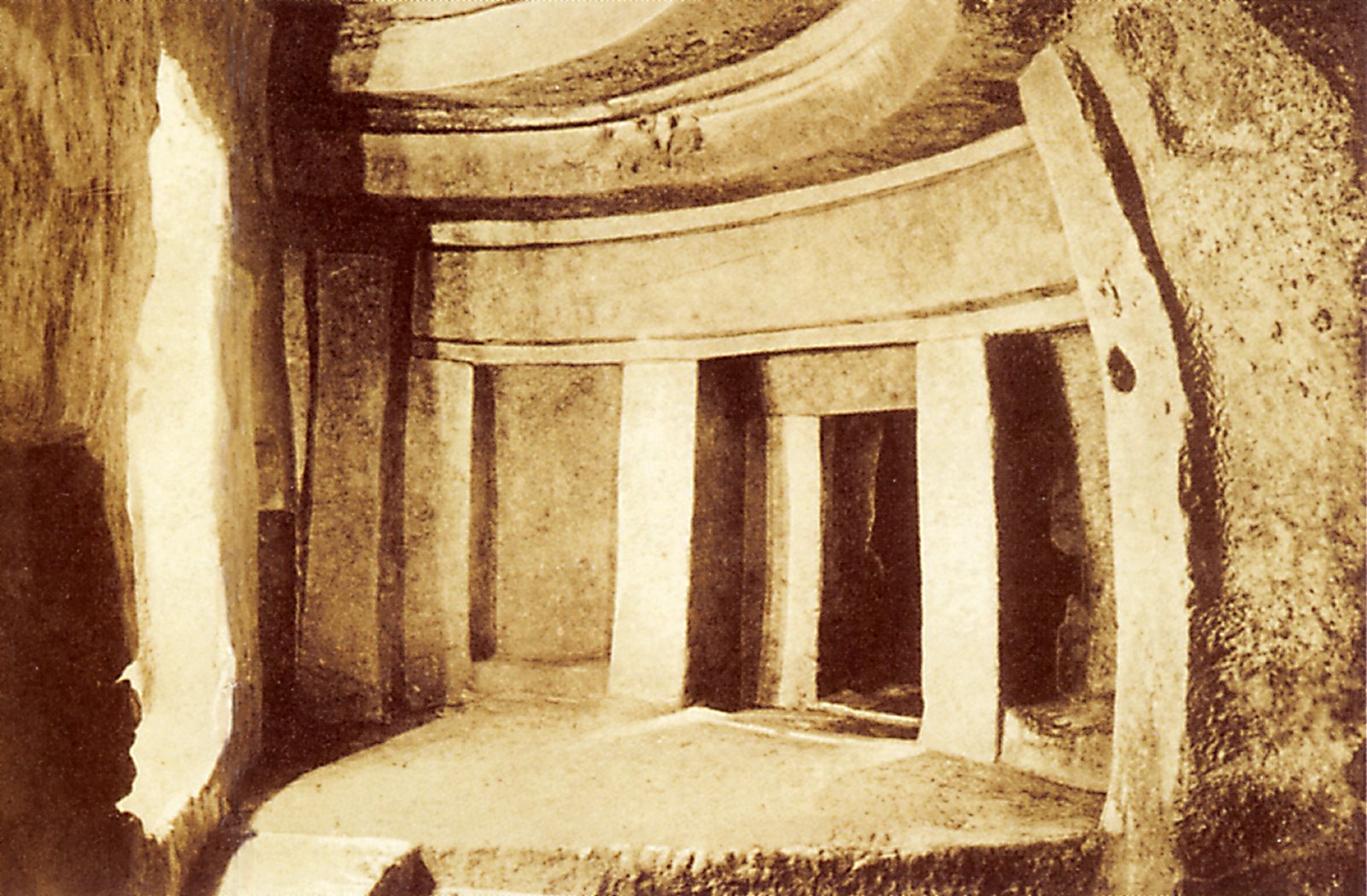
A subterranean prehistoric necropolis carved entirely by hand into soft limestone in Paola, Malta — one of the rarest and most acoustically extraordinary sacred spaces ever created by human hands.
At a glance
Discovered by accident in 1902 and excavated over the following decade, the Ħal Saflieni Hypogeum is a three-level underground complex spanning approximately 500 square metres, entirely hewn from the living rock without metal tools. Its carved chambers served simultaneously as a temple and a collective burial place for around 7,000 individuals. What makes it singular is not merely its age — construction began around 3600 BC — but the degree of deliberate acoustic engineering built into its walls. The “Oracle Room,” a small corbelled chamber no larger than a closet, amplifies a male voice at roughly 110 Hz into a resonance that fills the entire hypogeum with deep, enveloping vibration. Modern acoustic researchers have identified this frequency as one associated with altered states of consciousness. No other prehistoric site in the world combines this level of architectural refinement with such measurable acoustic intentionality.
Key facts
- Period: c. 3600–2500 BC (Żebbuġ, Ġgantija, and Tarxien phases)
- UNESCO inscription: 1980 (as part of Megalithic Temples of Malta)
- Scale: Approximately 500 m² across three underground levels; deepest point c. 10 m below surface
- Human remains: Approximately 7,000 individuals deposited over more than a millennium
- Discovery: 1902, by construction workers digging a cistern in Paola; first reported by Fr. Emmanuel Magri
- Access: Strictly limited to 80 visitors per day; advance booking often required months ahead; children under 6 not permitted
History
The hypogeum came to light by chance in 1902 when construction workers in the town of Paola, excavating a cistern beneath a new residential block, broke through the roof of an ancient chamber. The site was initially investigated by the Maltese Franciscan priest Fr. Emmanuel Magri, who began preliminary documentation before his death in 1907. Systematic excavation was then conducted between 1903 and 1911 by Themistocles Zammit, the archaeologist who also excavated the Tarxien Temples, and who recognised the hypogeum as one of the most significant prehistoric discoveries in Mediterranean history. Among the finds recovered during these early campaigns was the celebrated “Sleeping Lady” — a terracotta figurine of a reclining female figure, approximately 12 centimetres long, now displayed at the National Museum of Archaeology in Valletta. Its precise meaning remains debated, but it is widely interpreted as representing a figure in ritual sleep or incubation, possibly connected to practices of dream oracles.
The hypogeum was constructed in three main phases over roughly a thousand years. The Upper Level (c. 3600–3300 BC) is the oldest and most irregular, likely beginning as natural cave formations later worked by hand. The Middle Level (c. 3300–3000 BC) contains the principal ceremonial spaces, including a series of corbelled rooms whose architectural vocabulary — niches, façades with trilithon doorways, painted red ochre spirals and honeycombs — directly mirrors the free-standing megalithic temples built above ground on Malta during the same period. This architectural echo between subterranean and surface sacred architecture is unique in the prehistoric world. The Lower Level (c. 3150–2500 BC), reached by a long staircase, served primarily as a repository for the dead, eventually holding the skeletal remains of approximately 7,000 people deposited over centuries.
The site was first opened to the public in 1908 and remained accessible without restriction for much of the twentieth century. Mass tourism caused severe humidity damage to the painted surfaces and fragile limestone carvings, prompting a major restoration and conservation project in the 1990s. Since then, visitor numbers have been capped at 80 per day — a figure that remains among the lowest of any major UNESCO World Heritage Site in Europe — and environmental monitoring systems now track temperature and humidity continuously to protect what little painted decoration survives.
What you see
Descending into the hypogeum is a passage through progressively refined craftsmanship. The upper level is relatively rough-hewn; by the middle level, the unknown Neolithic builders had achieved a degree of precision that confounds straightforward explanation. The “Main Chamber” is a roughly oval space with corbelled ceiling alcoves, its walls carved to imitate the coursed masonry of Malta’s surface temples — but in reverse: the stone was removed rather than stacked, yet the visual effect of structural weight and order is identical. Red ochre spirals, circles, and spotted animal motifs persist in patches on several ceilings, faded but legible. The “Holy of Holies” is a trefoil chamber at the heart of the middle level whose silhouette precisely replicates the triapsidal plan of the above-ground temples at Ħaġar Qim and Mnajdra.
The Oracle Room — a side chamber roughly 2 metres wide and 1.5 metres deep — contains a small rectangular niche cut into the right-hand wall at roughly chest height. When a man speaks into it in a low, chest-resonant voice, the sound does not simply echo: it fills the entire complex simultaneously, arriving from multiple directions without perceptible delay, as if the rock itself is speaking. Acoustic measurements by researchers including Rupert Till and Aaron Watson recorded resonant peaks near 110 Hz across multiple chambers of the site. The effect is not accidental; the dimensions of the niche and its connecting passages appear tuned to amplify and distribute that precise frequency. Standing in the Main Chamber while a guide demonstrates the effect is, for most visitors, the single most unsettling and memorable experience that any prehistoric site offers.
Practical information
- Opening hours: Tuesday–Sunday, guided tours at fixed intervals (check Heritage Malta website for current schedule)
- Best season: Year-round; underground temperature remains constant at approximately 18–19°C regardless of season
- Booking: Advance reservation mandatory; demand far exceeds supply — book as early as possible (Heritage Malta online booking, heritagemalta.mt)
- Duration: Guided tour approximately 50 minutes; no independent access permitted
- Admission: Check current rates at Heritage Malta; combined tickets with other Maltese sites available
- Photography: Flash photography prohibited; low-light photography permitted
Getting there
Malta International Airport (MLA) is approximately 4 km from the hypogeum in Paola. From Valletta (the capital), buses operated by Malta Public Transport serve Paola directly; journey time is approximately 20–30 minutes. Taxis and rideshare services are widely available from the airport. The site is located on Burial Street (Triq iċ-Ċimiterju) in Paola and is clearly signposted. There is no on-site parking; street parking is available in the surrounding neighbourhood. The site is not suitable for visitors with severe mobility limitations due to steep staircases and low clearance in some passages.
Nearby
- Tarxien Temples — Neolithic megalithic complex, c. 3600–2500 BC, approximately 1.5 km from the hypogeum; same UNESCO inscription
- National Museum of Archaeology, Valletta — holds the “Sleeping Lady” figurine, temple altar fragments, and the full collection of hypogeum finds; 8 km
- Ħaġar Qim and Mnajdra Temples — UNESCO-listed megalithic temples on the southwest coast of Malta, c. 3600–3000 BC; 20 km
- Ġgantija Temples, Gozo — the oldest freestanding stone structures in the world, reachable by ferry from Ċirkewwa (90-minute journey total)
Sources
- Wikipedia: Ħal Saflieni Hypogeum
- UNESCO World Heritage Centre: Megalithic Temples of Malta — whc.unesco.org/en/list/130
- Heritage Malta (site manager): heritagemalta.mt
- Till, R. & Watson, A. (2001). “Archaeology and Acoustics of Rock Art Sites.” Acoustics of Ancient Theatres conference proceedings.
Find it on the map
See this place and what’s around it →📷 Become a Cultural Heritage Online photographer
Share your photos of places: they stay published under your name as the author. The more they're seen, the more you get noticed — and soon a contest will reward the most appreciated photos.
Log in or sign up free to add a photo