
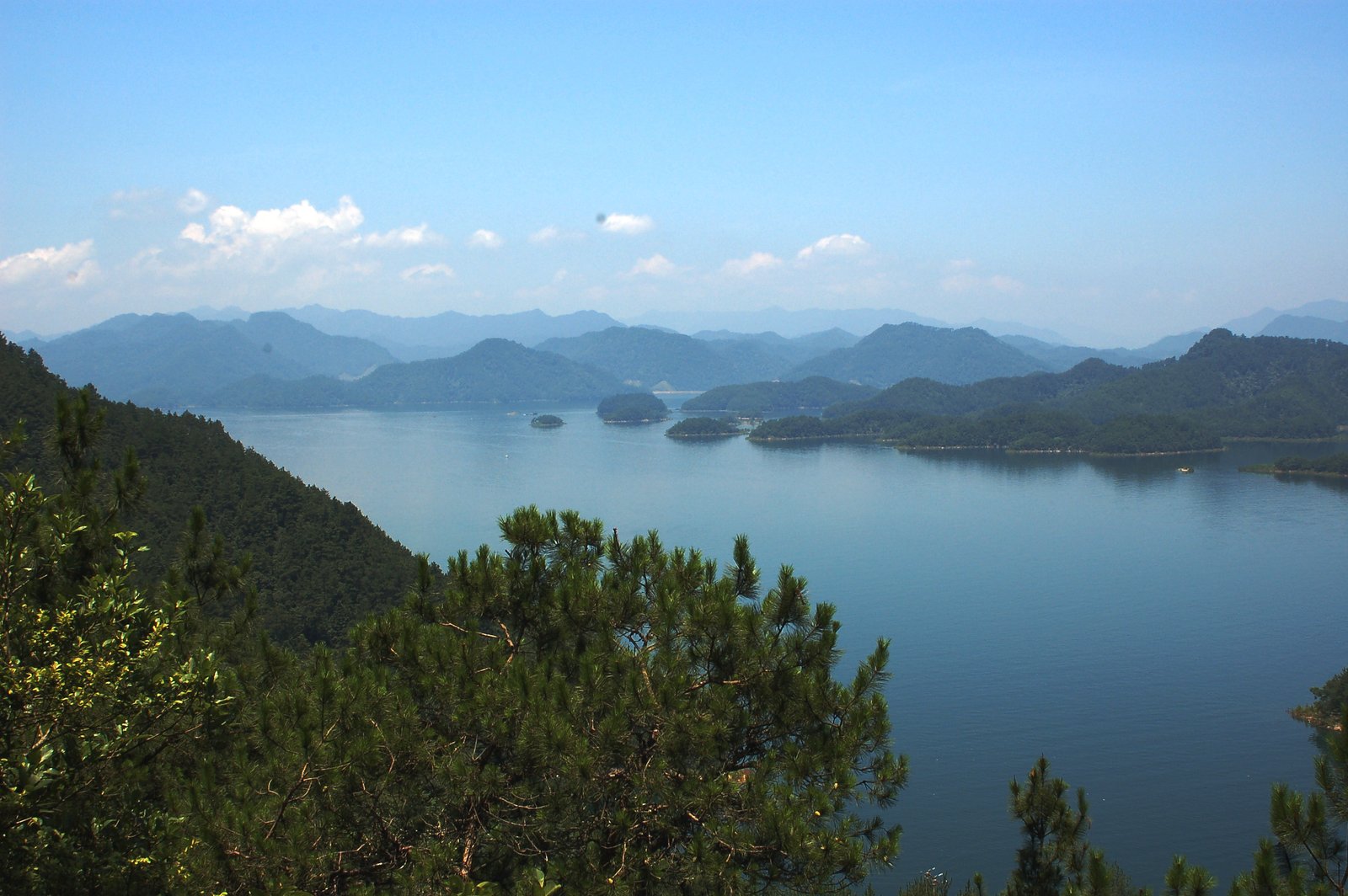
In 1959, the Chinese government flooded an entire valley to build Qiandao Lake, deliberately submerging the 1,400-year-old city of Shicheng — “Lion City” — along with its 265 memorial arches, five city gates, and stone-carved decorations that remain intact today, 26 to 40 metres below the surface.
At a glance
Shicheng — Lion City, named for the Lion Mountain behind it — was a county seat in what is now Zhejiang Province, China. Founded in 621 AD during the Tang Dynasty, rebuilt substantially during the Ming and Qing dynasties, and home to over 300,000 residents at the time of its submersion, the city was abandoned and flooded in 1959 when the Xin’an River was dammed to create the Xin’an River Hydroelectric Power Plant. The reservoir that formed, Qiandao Lake (Thousand Island Lake), is one of China’s most scenic tourist destinations — while the entire city lies preserved below it in cold, still, sediment-free water that has kept its stone carvings in extraordinary condition for more than six decades.
Key facts
- Period: Founded 621 AD (Tang Dynasty); main structures from Ming (1368–1644) and Qing (1644–1912) dynasties; submerged 1959
- Submersion: Deliberate, as part of the Xin’an River hydroelectric project; over 300,000 residents relocated
- Depth / Scale: 26–40 metres; city area approximately 62 km²; five city gates, 265 memorial arches
- Status: National heritage site; protected for managed dive tourism since the early 2000s
- Access: Guided scuba diving through licensed operators based at Qiandao Lake; glass-bottom boat tours also available
History
Shicheng was established as an administrative centre of She County in 621 AD during the Tang Dynasty, when the valleys of Zhejiang were being settled and organised under the new imperial system. For over 1,300 years it served as a local centre of commerce, education, and governance, its main streets lined with shops and residences, its great ceremonial arches — paifang — marking the achievements of distinguished officials and celebrated families. The city walls, rebuilt substantially during the Ming Dynasty, enclosed an area of about 62 square kilometres. Its eastern gateway opened onto the Xin’an River, the city’s commercial lifeline.
The decision to flood the valley was made in the context of China’s first Five-Year Plan. The Xin’an River Hydroelectric Power Plant, designed with Soviet technical assistance, required a reservoir of approximately 580 square kilometres. Shicheng sat directly in the flood zone. In 1959, after a relocation programme that moved more than 300,000 people — the largest civilian resettlement in Chinese history at that time — the dam was closed and the valley filled over a period of several months. The lake submerged not only Shicheng but also a second, smaller county seat, Wencheng, along with 27 towns and nearly 1,000 villages.
The city was largely forgotten until the early 2000s, when Chinese diving enthusiasts began to explore the lake. The discovery of intact paifang, gateway towers, and carved stone decorations at depths of 26–40 metres attracted international media attention. In 2012, a series of Chinese government-sponsored dive surveys documented the site comprehensively, leading to its designation as a protected national heritage site and the development of a formal dive tourism programme managed by the Qiandao Lake administration.
What you see
Descending through green-tinted water, divers reach the first structures at around 26 metres: the upper courses of the city wall, built of dressed stone blocks that still bear the chisel marks of Ming-dynasty masons. The five city gates — traditional double-tower constructions — are the most photographed features of the site; their arched openings remain intact, framing rectangular columns of water through which divers can pass from one section of the city to another. In the light from underwater torches, stone lion heads, dragon reliefs, and calligraphic inscriptions carved into the gate pillars appear in sharp relief, protected by the cold, sediment-free water of the deep lake from the weathering that would have destroyed them on the surface.
The paifang — memorial archways — are the city’s defining ornamental feature. Shicheng had 265 of them, each commemorating an official’s achievements or a family’s moral virtue, their stone surfaces carved with decorative panels and inscriptions in traditional Chinese characters. Many are still standing at depth, their proportions intact. The residential streets behind the gates retain paving stones and wall foundations, giving a sense of the city’s spatial organisation that recalls a standing historic town seen through a green aquatic filter.
Practical information
- Best time to visit: April–October, when water clarity in the lake is highest and dive conditions are most comfortable
- Access method: Guided scuba diving through official operators licensed by the Chunan County government; glass-bottom boat tours for non-divers allow views of the upper structures in good conditions
- Duration: Full-day dive excursion from the lakeside resort area; allow 2–3 dives over 5–6 hours including boat transit
- Advance booking: Packages bookable through Qiandao Lake tourism operators; accommodation ranges from resort hotels on the lakeside to budget options in Chun’an town
Getting there
The nearest major airport is Hangzhou Xiaoshan International Airport, approximately 140 kilometres north-east by road. Hangzhou connects to Beijing, Shanghai, and major international hubs. From Hangzhou, a 2.5-hour drive or bus service on the G3 expressway reaches the Qiandao Lake resort area (Chun’an County). High-speed rail to Hangzhou is available from Shanghai in under 45 minutes, with connecting bus or car hire to the lake.
Nearby
- Qiandao Lake — the reservoir itself, with 1,000 forested islands and water clarity that makes it one of China’s cleanest lakes; boat tours and waterside hiking available
- Hangzhou — West Lake UNESCO World Heritage Site and Song Dynasty heritage, 140 km north-east
- Huangshan (Yellow Mountain) — UNESCO World Heritage granite peaks, 120 km south-west
Sources
- Wikipedia: https://en.wikipedia.org/wiki/Shicheng,_Zhejiang
- Chunan County Tourism Administration: qdl.gov.cn
- Chinese National Heritage Administration records on Zhejiang submerged heritage
Find it on the map
See this place and what’s around it →📷 Diventa un fotografo di Cultural Heritage Online
Condividi le tue foto dei luoghi: restano pubblicate con la tua firma come autore. Più vengono viste, più ti fai conoscere — e presto un concorso premierà le foto più apprezzate.
Accedi o registrati gratis per aggiungere una foto