
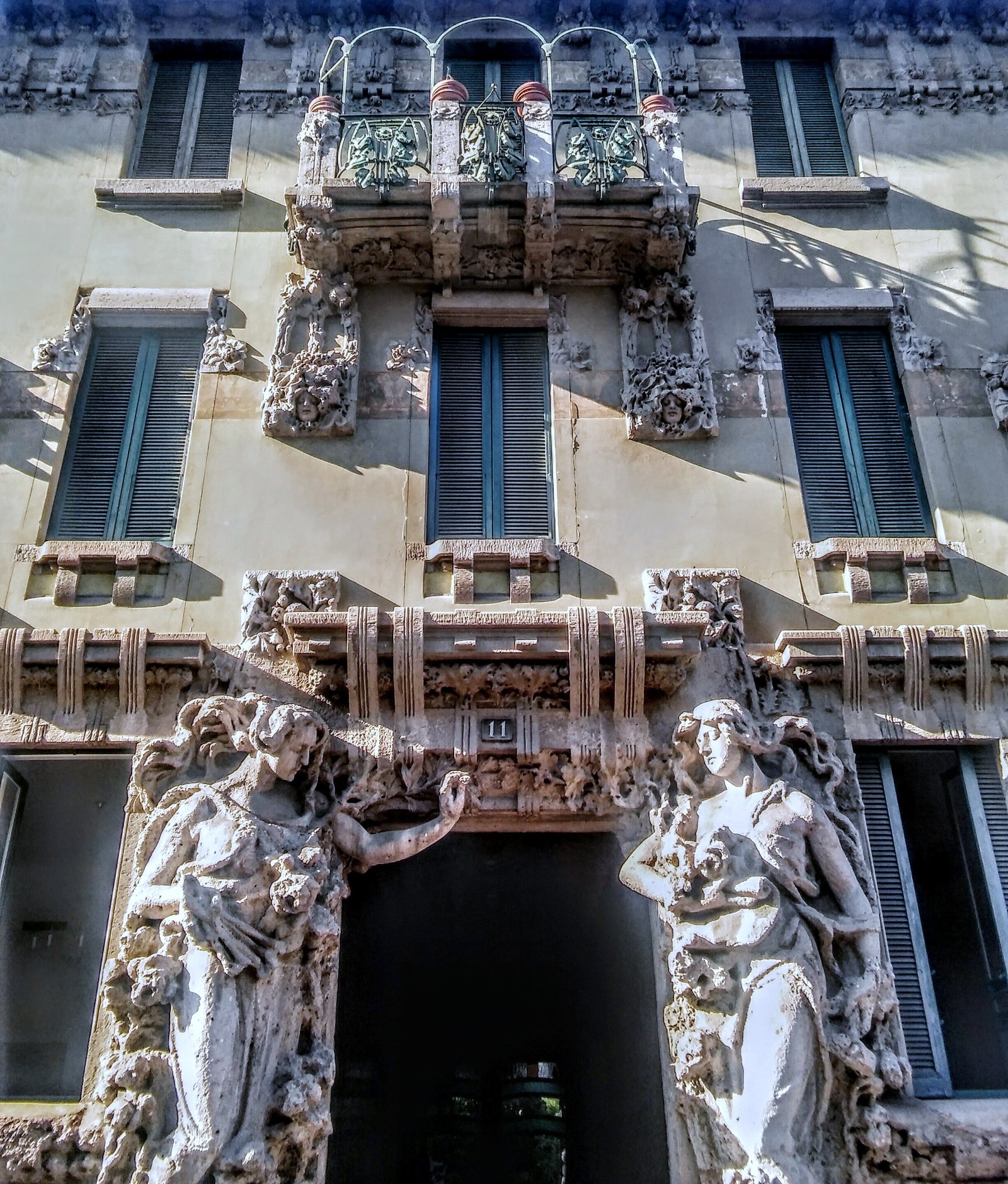
Art Nouveau and Liberty are the same movement under two names — curving, floral, around 1890–1915 — while Art Déco is the later, geometric style of the 1920s and 1930s. Curves and nature mean Nouveau; angles and symmetry mean Déco. This is a short, sourced guide from Cultural Heritage Online.
Liberty is Italian Art Nouveau
The first thing to settle is that Liberty and Art Nouveau are not two styles. Liberty is simply the Italian name for Art Nouveau, taken from Arthur Liberty’s London shop. Other countries used their own names — Jugendstil in Germany, Secessionsstil in Vienna, Modernisme in Catalonia — for the same international wave. So the real comparison is between Art Nouveau (Liberty) and Art Déco.
Art Nouveau / Liberty: curves and nature, c.1890–1915
Art Nouveau took its forms from the natural world. Its signature is the curve: floral and plant motifs, the “whiplash” line, asymmetry, ornament that seems to grow across a surface. In Italian Liberty this appears as polychrome ceramic, hammered botanical ironwork, and sculpted stone that bends where an academic facade would stay straight, as on Milan’s Palazzo Castiglioni. The style favoured houses, villas, and hotels over civic monuments.
Art Déco: geometry and the machine age, 1920s–1930s
Art Déco emerged after the First World War and took its name from the 1925 Paris Exposition des Arts Décoratifs. It is the opposite instinct: geometry instead of growth. Its signatures are straight lines and zigzags, symmetry, stepped and streamlined forms, sunbursts and chevrons, and a taste for luxe, machine-age materials. Where Art Nouveau looked to the flower, Déco looked to the machine and the skyscraper.
How to tell them apart at a glance
- Line: Art Nouveau curves; Art Déco runs straight and angular.
- Source: Nouveau draws on plants and the human figure; Déco on geometry and machines.
- Composition: Nouveau is often asymmetric; Déco is symmetric and ordered.
- Date: Nouveau/Liberty roughly 1890–1915; Déco the 1920s–1930s.
Italian Liberty had no clean ending: it shaded into later, more eclectic work such as Rome’s Coppedè District (1915–1927), which already mixes its ornament with other quotations. For the full movement, see our complete guide to Italian Liberty.
Frequently Asked Questions
What is the difference between Art Nouveau and Art Déco?
Art Nouveau (c.1890–1915) is curving, floral, and nature-based, often asymmetric. Art Déco (1920s–1930s) is geometric, symmetric, and streamlined, inspired by the machine age. The quickest test is the line: curves mean Nouveau, angles mean Déco.
Is Liberty the same as Art Nouveau?
Yes. Liberty is the Italian name for Art Nouveau, taken from Arthur Liberty’s London shop. It is also called Stile Floreale. Germany called the same movement Jugendstil, Vienna Secessionsstil, and Catalonia Modernisme.
Which came first, Art Nouveau or Art Déco?
Art Nouveau came first, flourishing from about 1890 to 1915. Art Déco followed after the First World War, taking its name from the 1925 Paris Exposition des Arts Décoratifs and dominating the 1920s and 1930s.
How can I recognise Italian Liberty architecture?
Look for curving floral ornament in polychrome ceramic, hammered botanical wrought iron in balconies and gates, and sculpted stone that bends and flows. It appears mostly on apartment houses, villas, and hotels built between about 1900 and 1915.
Sources used in this article
- CHO magazine Italian Liberty: the complete guide.
- CHO place_card Palazzo Castiglioni — Sommaruga, Milan, 1900–1903.
- CHO place_card Coppedè District — Rome, 1915–1927.


