
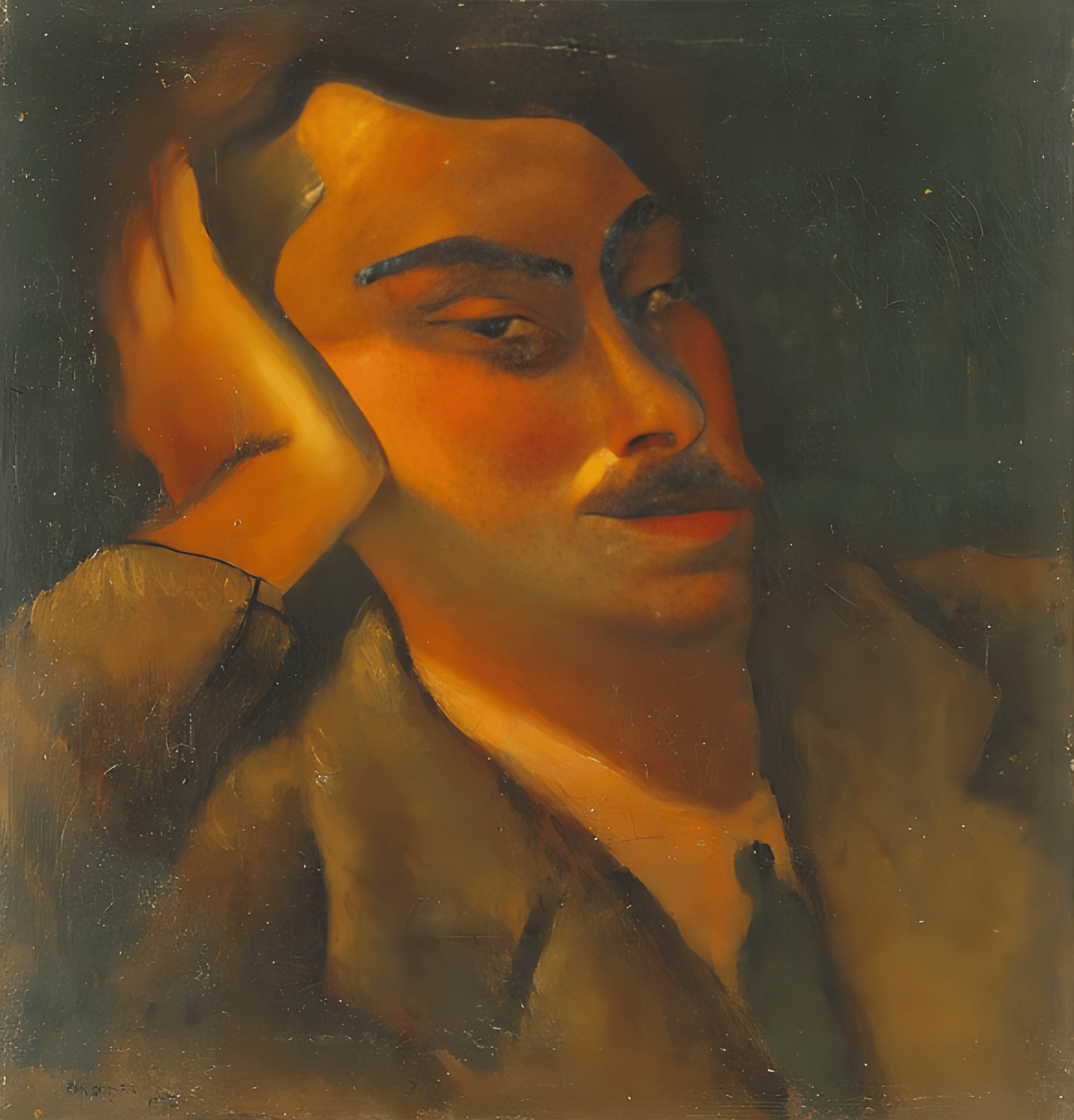
This self-portrait was painted by Mario Mafai in 1928, the same year his daughter Simona was born. Mafai was an Italian painter and co-founder, with his wife Antonietta Raphaël, of the Scuola Romana—a pivotal modern art movement that emerged from Rome’s artistic circles.
Mafai had eschewed formal academic training early in his career, instead choosing to study at the Scuola Libera del Nudo (Free School of the Nude) at the Accademia di Belle Arti di Roma alongside painter Scipione. His artistic formation was shaped by the city’s galleries, museums, and cultural institutions including the Fine Arts Library at Palazzo Venezia. The artist’s work is characterized by a deeply personal style marked by melancholic sensibility, qualities that would define his contribution to twentieth-century Italian art.
About Mario Mafai
Born on 12 February 1902, Mafai became a critical figure in modern Italian painting. He married Antonietta Raphaël in 1925, and together they shaped the Scuola Romana’s artistic direction. Mafai died on 31 March 1965.
Details
- Artist: Mario Mafai
- Year: 1928
- Movement: Scuola Romana
- Type: Oil on canvas self-portrait
Explore more: 509 heritage places in Roma
Frequently asked questions
Who was Mario Mafai?
Mario Mafai (1902–1965) was an Italian painter who co-founded the Scuola Romana with his wife Antonietta Raphaël, establishing one of the twentieth century’s significant modern art movements based in Rome.
What was the Scuola Romana?
The Scuola Romana was a modern art movement founded by Mafai and his wife. It emerged from Rome’s artistic milieu and represented a distinctly Italian approach to modernism during the interwar period.
Why is this self-portrait significant?
Painted in 1928, this work exemplifies Mafai’s personal and melancholic painting style, offering insight into the artist’s character during a formative period of the Scuola Romana’s development.


