
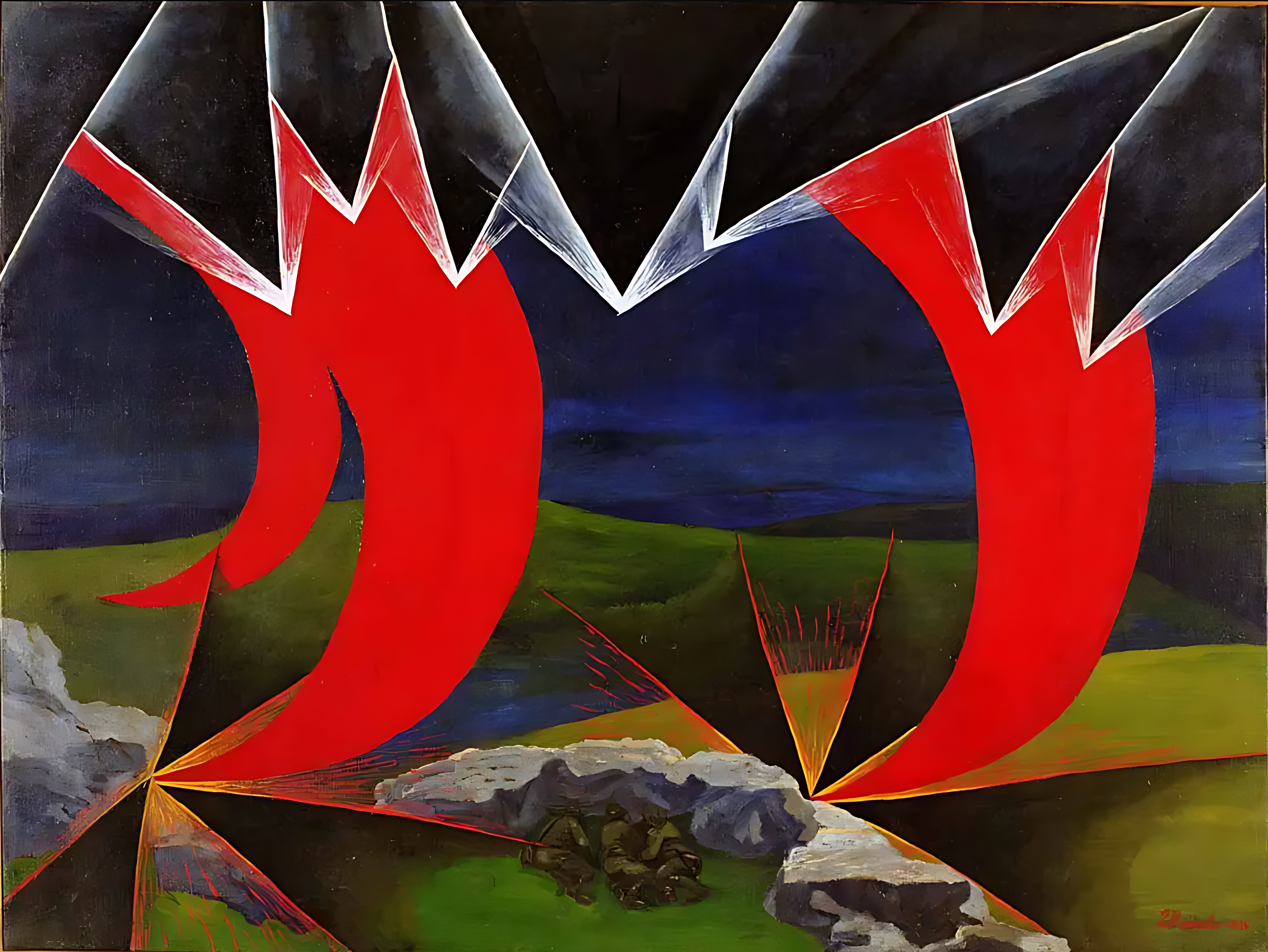
Impressioni di un bombardamento is a painting by Italian Futurist Luigi Russolo, completed in 1926. The work captures artistic impressions of bombardment, aligning with Russolo’s pioneering investigations into noise, chaos, and the sensory dimensions of modern violence.
Russolo’s career spanned painting, music composition, and experimental instrument design. Best known as the author of The Art of Noises (1913), he emerged as a foundational figure in noise music, staging experimental performances in 1913–14 and again after the First World War, notably in Paris in 1921. Throughout his practice, he designed and built Intonarumori—noise-generating devices that embodied his theoretical commitment to sound as an artistic medium beyond traditional music.
Impressioni di un bombardamento belongs to the period when Russolo was consolidating his Futurist vision across multiple disciplines. The painting channels his preoccupation with representing the intensity and sensory overload of modern experience, translating concepts from noise composition into visual form.
About Luigi Russolo
Luigi Russolo (1885–1947) was an Italian painter, composer, and instrument builder central to the Futurist movement. After early artistic training, he moved to Milan and became immersed in avant-garde circles. His 1913 manifesto redefined music and art through the aesthetics of industrial and mechanical sound, positioning noise as a legitimate artistic material.
Details
- Artist: Luigi Russolo
- Year: 1926
- Title: Impressioni di un bombardamento
- Movement: Futurism
Frequently asked questions
Who was Luigi Russolo?
Luigi Russolo was an Italian Futurist painter, composer, and experimental musician known for his 1913 manifesto The Art of Noises and his design of noise-generating instruments called Intonarumori.
What is the subject of this painting?
The painting depicts impressions of bombardment, capturing visual and sensory responses to violence and chaos in the modern era.
When did Russolo exhibit his noise music?
Russolo staged experimental noise music performances in 1913–14 and again after World War I, most notably in Paris in 1921.
Sources
- S1 — Russolo, Luigi. The Art of Noises. Pendragon Press, 1986. ISBN 978-0-918728-57-9.
- S2 — Tisdall, Caroline, and Angelo Bozzolla. Futurism. Thames and Hudson, 1977. ISBN 978-0-500-20159-6.
Spotted an error? Write to editorial@culturalheritageonline.com and we correct it the same day.


