
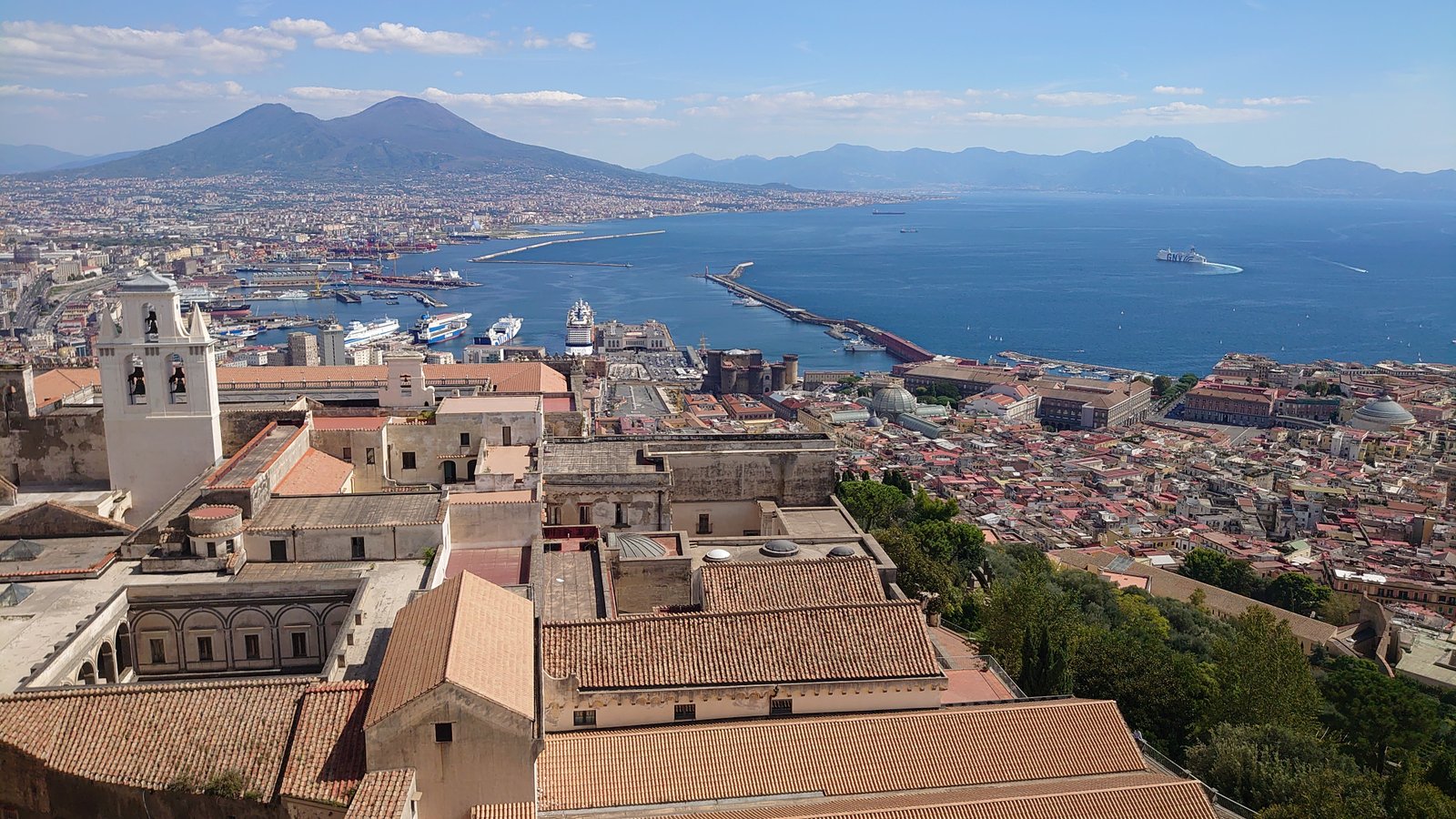
The Greeks named it Neápolis, the “new city,” and twenty-six centuries later Naples still walks on the street grid they drew. Few places on earth have been lived in this long without pause.
At a glance
Naples sits on its bay in Campania, the third-largest city in Italy, with Vesuvius standing over the water to the east. Cumaean Greeks refounded it as Neápolis in the 6th century BC, and the old centre still follows the dead-straight lines they laid down. On top of that grid sit thirty centuries of building — Roman, medieval, Angevin, Aragonese, Bourbon — stacked so densely that the historic core was listed by UNESCO in 1995. You come for that depth: a layered city where each era left its stone in place rather than clearing the last.
Key facts
- Region: Campania · Province: Naples
- Founded: as Neápolis by Cumaean Greek settlers, 6th century BC; one of the oldest continuously inhabited urban areas in the world
- UNESCO: Historic Centre of Naples (inscribed 1995, ref. 726)
- Ruled by: Greeks, Romans, Normans, the Angevins from 1266, the Aragonese from 1442, then the Bourbons
- Signature work: Giuseppe Sanmartino’s Veiled Christ (1753), marble carved so thin it reads as wet cloth
History
An earlier Greek settlement, Parthenope, grew on the islet of Megaride; the Cumaeans refounded the site as Neápolis in the 6th century BC. The name held. Under Rome it became a Greek-speaking resort of the wealthy, and through the centuries that followed it was rarely abandoned, which is why so little of the ancient plan was ever erased.
The decisive shift came in 1266, when Charles I of Anjou moved his capital from Palermo to Naples and began building it into a royal seat. The cathedral rose under his patronage, and the great fortress of Castel Nuovo went up in his reign. Aragonese rule arrived when Alfonso I took the city in 1442, recasting the same buildings in a new idiom.
Later the Bourbons made Naples one of the largest capitals in Europe and left their mark on its squares and palaces. Each dynasty rebuilt rather than replaced, and the result is a centre where Greek, Roman, Gothic and Baroque sit within a few streets of one another.
What you see
- Castel Nuovo (Maschio Angioino) — built 1279–1282 to a design by Pierre de Chaulnes, then rebuilt for Alfonso V between 1453 and 1479 by the Catalan architect Guillem Sagrera; its triumphal marble arch marks the Aragonese entry into the city.
- Sansevero Chapel — a private chapel begun in 1590, holding Sanmartino’s Veiled Christ of 1753, a recumbent figure under a marble shroud so fine the body seems to press through the cloth.
- Naples Cathedral (Duomo) — begun in Gothic style under Charles I; home of San Gennaro, whose dried blood is brought out to liquefy each year on 19 September.
- Castel dell’Ovo — the city’s oldest standing fortress, raised on the islet of Megaride where the first Greek settlers landed, jutting into the bay.
- Spaccanapoli — the long, ruler-straight street that splits the old town in two, following one of the Greco-Roman decumani; walking it is reading the ancient grid with your feet, between walls of stacked tufa.
Practical information
- Time needed: two full days for the historic centre and its churches; a third if you go underground.
- Underground: Napoli Sotterranea opens the tufa city below the streets — Greek quarries and Roman aqueduct channels cut into the soft stone the city was built from.
- When to go: spring and autumn are best; summer in the bay is hot and crowded.
Getting there
High-speed trains reach Napoli Centrale from Rome in about 1 hour 10 and from Florence in roughly 3 hours. Naples International Airport (NAP) lies a short ride from the centre. Inside the old town, walk: the decumani are narrow, dense and made for feet, not cars.
Nearby
- Pompeii and Herculaneum lie under Vesuvius to the south-east, reachable by local train.
- The bay opens west to the Phlegraean Fields and the islands of Capri and Ischia.
See the place
Sources
- Wikipedia, Naples, Castel Nuovo, Sansevero Chapel.
- UNESCO World Heritage List, Historic Centre of Naples, ref. 726 (inscribed 1995).
Find it on the map
See this place and what’s around it →Historical events at this place (17)
- 2017 Mediterraneo in piano solo - Alberto Pizzo
- 2017 Franco Battiato - Luce del sud
- 2017 Arte che cura - I linguaggi della creatività tra scienza, arte e formazione
- 2018 Il Caravaggio di Manara all'Archivio Storico del Banco di Napoli
- 2018 L'esercito di terracotta
- 2018 Mostra sul Futurismo al Maschio Angioino di Napoli
- 2019 Manuel Antonio Rodriguez - Oh spettatore
- 2019 Visite guidate gratuite al Complesso Monumentale di Carminiello ai Mannesi
- 2019 Branding Dalì. La costruzione di un mito in mostra a Napoli
- 2019 Mostra su Andy Warhol
- 2020 KataElla Festival del Cinema e della Letteratura
- 2021 Cerimonia di Premiazione di accordi @ DISACCORDI – 17ma Edizione a Napoli
- 2021 Mostra Virtuale di Klimt nella Casina Pompeiana in villa Comunale a Napoli
- 2022 Italy at Hand - MICE - CAMPANIA - NAPOLI
- Open House Napoli
- 2026 Art Nouveau Week 2026 – events in Naples
- 2026 Dall'uovo alle mele. La civiltà del cibo a Ercolano
📷 Become a Cultural Heritage Online photographer
Share your photos of places: they stay published under your name as the author. The more they're seen, the more you get noticed — and soon a contest will reward the most appreciated photos.
Log in or sign up free to add a photo