
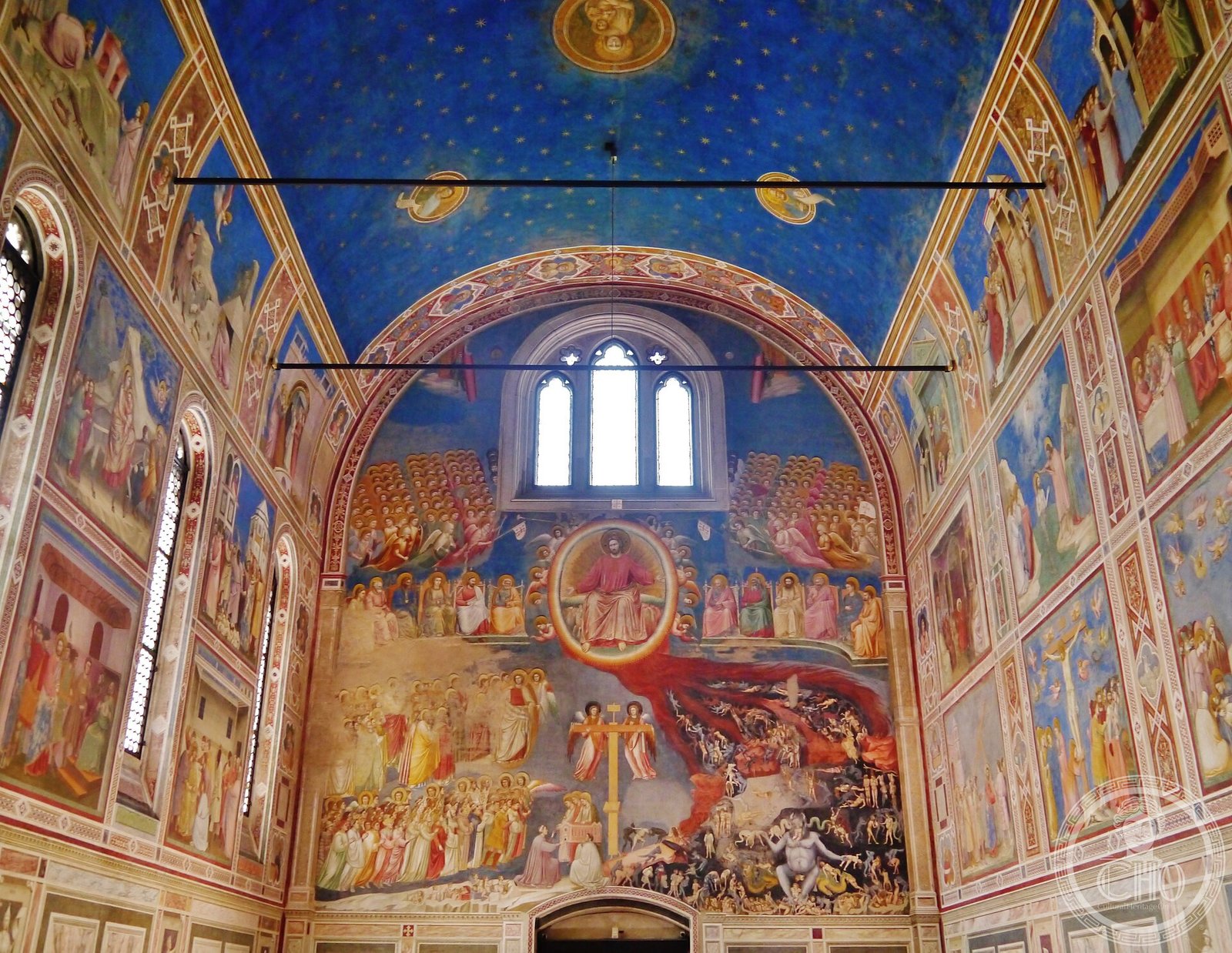
In a small brick chapel on the edge of the city, Giotto finished a fresco cycle around 1305 that broke a thousand years of flat medieval painting and pointed art toward the Renaissance. A few streets away stands a university founded in 1222, where Galileo Galilei lectured for eighteen years. Padua keeps both stories close.
At a glance
Padua sits about 40 kilometres west of Venice, in the Veneto region of northern Italy. It is one of the oldest cities in the area, with settlement evidence reaching back to the early Iron Age. The historic centre runs on arcaded streets, market squares and a dense layer of medieval and Renaissance building.
Its draw is concentrated. The Scrovegni Chapel holds Giotto’s frescoes. The Basilica of Saint Anthony brings pilgrims year round. The university and its anatomical theatre shaped European science. Three sights, three different reasons to come.
Key facts
- Region: Veneto, northern Italy
- University founded: 1222
- Scrovegni Chapel frescoes: completed by Giotto around 1305
- UNESCO listing: Padua’s fourteenth-century fresco cycles, inscribed 2021; Orto botanico inscribed 1997
- Coordinates: 45.4078°N, 11.8733°E
History
Local tradition tied the city’s origins to the Trojan prince Antenor, but archaeology points to a settlement on the Bacchiglione river by the 11th to 10th centuries BC. By the late Middle Ages Padua was a wealthy commune, and that wealth paid for art.
Around 1305 Giotto completed the walls of the Scrovegni Chapel, commissioned by the banker Enrico Scrovegni. The cycle traced the lives of Joachim, Anna, the Virgin and Christ in deep ultramarine and clear human gesture. Painters across Italy studied it for generations.
The University of Padua opened in 1222, the second oldest in Italy after Bologna. Galileo Galilei held its chair of mathematics from 1592 to 1610, the years of his work on motion and the telescope. He later called them the happiest of his life.
What you see
- Scrovegni Chapel — Giotto’s fresco cycle, completed around 1305, runs across every wall beneath a vault of deep ultramarine scattered with gold stars. Timed entry protects the climate inside.
- Basilica of Saint Anthony — begun about 1232, the domed pilgrimage church holds Donatello’s bronze high altar and equestrian work from the 15th century.
- Prato della Valle — an elliptical square of around 90,000 square metres, laid out in the late 18th century by Andrea Memmo, ringed by a canal and lines of statues.
- Palazzo della Ragione — the medieval town hall, built between 1172 and 1219, whose great hall measures roughly 81 metres long under a single keel-shaped roof.
- Orto botanico — founded in 1545 as a teaching garden for the university, the world’s oldest in its original location, on the UNESCO list since 1997.
Practical information
The Scrovegni Chapel requires a booked, timed ticket, and visitors usually wait in a climate-controlled room before a short session inside. Buy ahead in high season. The Basilica of Saint Anthony is a working church; modest dress is expected.
The historic centre is compact and walkable. Most major sights lie within twenty minutes on foot of one another.
Getting there
Padua sits on the main rail line between Venice and Milan. Trains from Venezia Santa Lucia take under half an hour. Venice Marco Polo is the nearest large airport. From the station the historic centre is a short walk or tram ride south.
Nearby
Venice lies 40 kilometres east, reachable by frequent train. Vicenza, with its Palladian architecture, is a similar distance west. The Euganean Hills rise just south of the city, dotted with thermal spa towns such as Abano Terme.
Sources
Find it on the map
See this place and what’s around it →Events here — now on & upcoming
- Mercato Antiquariato Padova – edizioni autunno 202620 Sep 2026 — 20 Dec 2026See the event →
Historical events at this place (2)
📷 Become a Cultural Heritage Online photographer
Share your photos of places: they stay published under your name as the author. The more they're seen, the more you get noticed — and soon a contest will reward the most appreciated photos.
Log in or sign up free to add a photo