
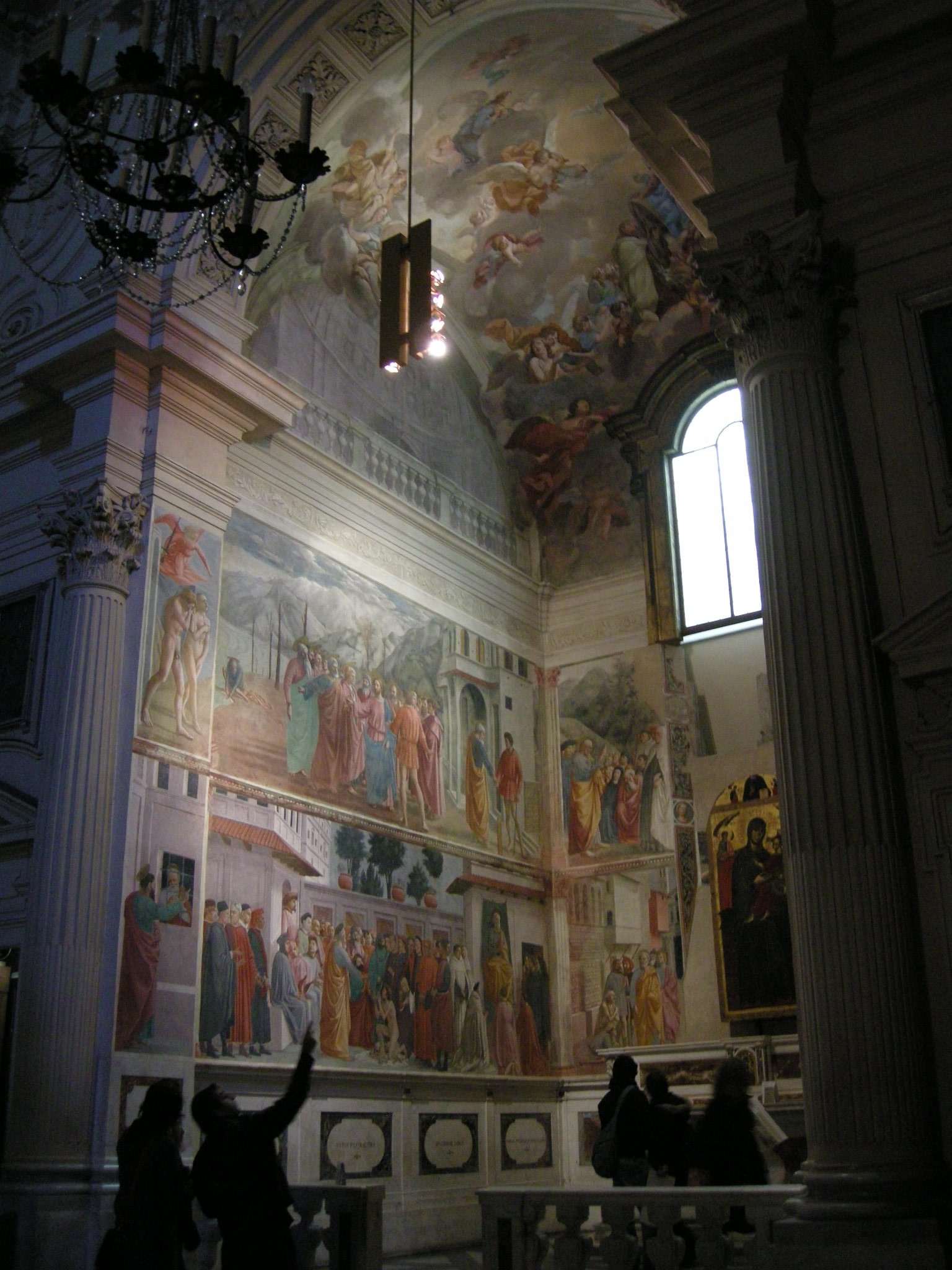
A masterpiece of early Renaissance fresco painting located in Santa Maria del Carmine, the Brancacci Chapel showcases the transformative work of Masaccio, Masolino da Panicale, and Filippino Lippi across scenes from the life of St. Peter.
At a glance
Housed within the transept of Florence’s Santa Maria del Carmine, this chapel preserves one of the most influential fresco cycles of the Florentine Renaissance. The work spans roughly fifty years and represents a collaborative effort across generations of masters, making it essential to understanding the development of Renaissance painting.
History
The chapel was commissioned in 1424 to celebrate the life of St. Peter. Masaccio and Masolino da Panicale began the frescoes, but the project was interrupted. Around 1480, nearly fifty years later, Filippino Lippi was called to complete the remaining scenes, unifying the compositions with his own hand.
In 1771, a devastating fire destroyed much of the church’s interior and furnishings. The Brancacci Chapel, along with the ancient Sacristy and Corsini Chapel, survived. The church was subsequently rebuilt in late Baroque style by architect Giuseppe Ruggieri, assisted by painters Giuseppe Romei and Domenico Stagi.
What you see
The chapel’s frescoes depict scenes from Genesis and the apostolic ministry of St. Peter. Masaccio’s works include the Expulsion of Adam and Eve, The Tribute Money, the Resurrection of the Son of Theophilus, St. Peter in the Chair, the Baptism of Neophytes, the Resurrection of Tabitha, the Distribution of Goods, and the Death of Ananias.
The three artists’ distinct styles—Masaccio’s sculptural figures and dramatic perspective, Masolino’s refinement, and Filippino’s graceful completion—create a visual record of Renaissance artistic evolution. The compositions demonstrate advanced understanding of space, anatomy, and narrative clarity that revolutionized painting.
Cultural significance
The Brancacci Chapel profoundly influenced generations of Renaissance and later artists. Michelangelo himself frequently visited as a young man to study the figures and master their construction. The chapel exemplifies how fresco technique and figural innovation shaped the course of Western art.
Its survival of the 1771 fire preserved a crucial link between the early Renaissance experiments of Masaccio and the mature achievements of the High Renaissance.
Key facts
- Address: Piazza del Carmine, 14, 50124 Florence
- Coordinates: 43.7681985, 11.2438283
- Commissioned: 1424
- Phone: 055 212331
- Official website: http://museicivicifiorentini.comune.fi.it/brancacci/
Practical information
The chapel is housed in Santa Maria del Carmine and is accessible to visitors during church hours. Guided visits are recommended to fully appreciate the technical mastery and iconographic content of the frescoes. Check the official website for current opening hours and any restrictions on viewing.
Getting there
The chapel is located in the Oltrarno district on the south bank of the Arno. From the city centre, cross Ponte Vecchio and head south. The church sits on Piazza del Carmine, served by local buses and easily reached on foot from central Florence.
See the place
Sources & resources
Find it on the map
See this place and what’s around it →📷 Become a Cultural Heritage Online photographer
Share your photos of places: they stay published under your name as the author. The more they're seen, the more you get noticed — and soon a contest will reward the most appreciated photos.
Log in or sign up free to add a photoIs this page about you?
This page is read by travellers and heritage enthusiasts who find it on Google. Tell us how you are connected to this place and we will take it from there.