
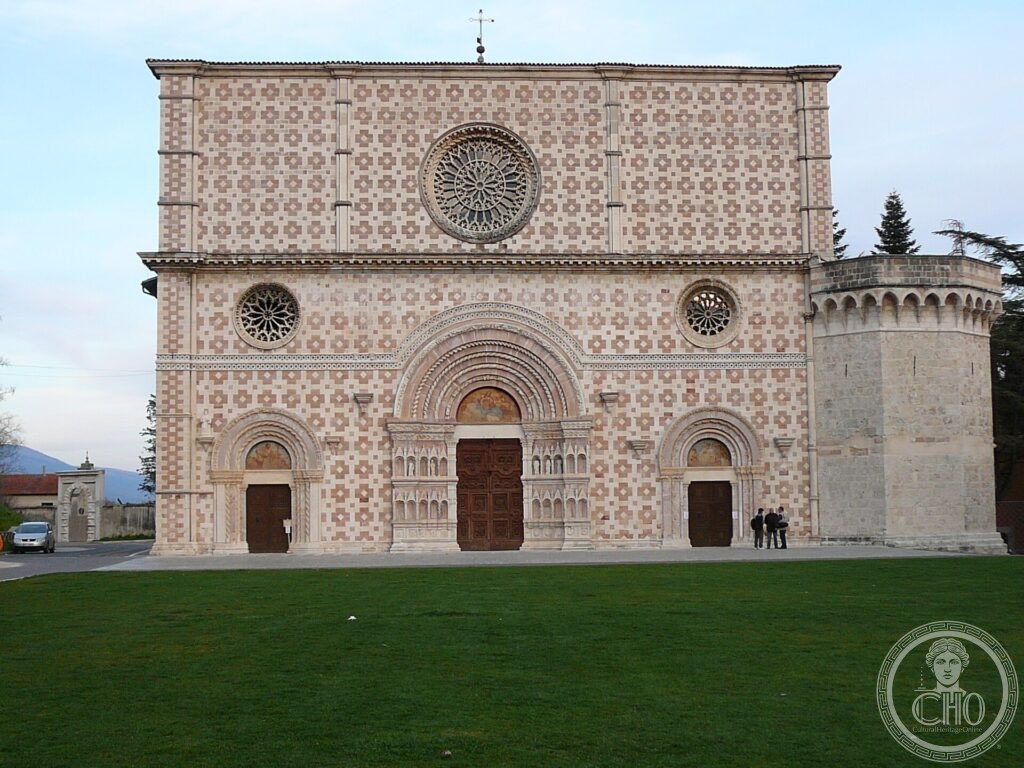
Above L’Aquila, a facade chequered in white and red with three rose windows holds up the memory of the city on its own. Here a hermit was crowned pope, here he invented the first jubilee in history, and here — when the earthquake of 2009 brought down the dome, the transept and the apse — it was the facade that stayed standing, the symbol of a city that does not fall.
At a glance
The Basilica of Santa Maria di Collemaggio stands on a green hillside just outside the walls of L’Aquila, in Abruzzo. It is the spiritual and civic heart of the city: the place where the hermit Pietro da Morrone was crowned Pope Celestine V in 1294, and where, weeks later, he issued the bull that created the first jubilee of forgiveness in Christian history — the Perdonanza, still celebrated every August and inscribed on UNESCO’s list of Intangible Cultural Heritage in 2019. Its chequered white-and-red stone facade, with three portals and three rose windows, is one of the masterpieces of Italian medieval architecture. Severely damaged by the 2009 earthquake, the basilica was rebuilt and returned to the city in 2017.
Key facts
- Founded: 1287, on the initiative of the hermit Pietro da Morrone
- Celestine V: crowned pope here on 29 August 1294; he issued the Bolla del Perdono on 29 September 1294, creating the first “jubilee of forgiveness”
- Perdonanza Celestiniana: held every year since 1294; inscribed on the UNESCO Representative List of Intangible Cultural Heritage in 2019
- Facade: bicoloured white-and-red local stone (L’Aquila’s civic colours), with geometric inlay, three portals and three rose windows
- Mausoleum of Celestine V: Renaissance tomb carved from 1517 by Girolamo da Vicenza; national monument since 1902
- Restoration: reopened 20 December 2017 after the 2009 earthquake; awarded the Europa Nostra Grand Prix in 2020
History
Pietro da Morrone, a Benedictine hermit famous across central Italy for his austerity, commissioned the basilica in 1287. Seven years later, in one of the strangest episodes of medieval church history, the conclave deadlocked for over two years turned to the elderly hermit and elected him pope. He was crowned in Collemaggio as Celestine V on 29 August 1294. Within weeks he issued the Bolla del Perdono (29 September 1294), granting a plenary indulgence to anyone who, repentant and confessed, passed through the basilica’s Holy Door on that day — the first jubilee of its kind, decades before the Roman Jubilee of 1300.
Celestine resigned the papacy after only a few months — the renunciation Dante alludes to as “il gran rifiuto” — and died soon after. His body was brought to Collemaggio, where from 1517 it was placed in a monumental Renaissance mausoleum. The church was repeatedly damaged and rebuilt after earthquakes, accumulating Baroque additions later stripped away. Declared a national monument in 1902, it remains the focus of the Perdonanza, when the city’s procession ends at the Holy Door each 28–29 August.
What you see
The facade is the basilica’s signature: a flat rectangular screen faced in white and pink-red stone laid in a geometric chequer, pierced by three deep portals and three rose windows, the central one especially fine. It reads less like a building front than like an illuminated page. Inside, the restoration that followed the 2009 earthquake returned the nave to a stripped, luminous medieval clarity, removing later accretions; the Holy Door (Porta Santa) on the long left flank marks the ritual entrance of the Perdonanza.
The 2009 earthquake brought down the transept, the dome and the apse vault, while the facade famously survived. The reconstruction — funded by Eni and carried out with the Superintendency and three Italian universities, using advanced structural and diagnostic methods — reopened the basilica on 20 December 2017 and won the Grand Prix of the European Heritage Awards / Europa Nostra in 2020 for the quality of its scientific approach.
Practical information
- Address: Piazzale di Collemaggio, L’Aquila
- Perdonanza: 28–29 August, when the Holy Door is opened; the basilica is busiest then
- Visiting: open for worship and visits; check the official basilica website for current hours
- Time needed: 30–45 minutes
Getting there
The basilica stands just outside L’Aquila’s historic centre, on Collemaggio hill, with parking nearby at Piazzale di Collemaggio. L’Aquila is reached by car from Rome via the A24 motorway (about 1h15), or by bus from Rome (Tibus) and Pescara. GPS: 42.3427° N, 13.4047° E.
Nearby
- Fontana delle 99 Cannelle — L’Aquila’s medieval 99-spout fountain, emblem of the city’s foundation
- Basilica di San Bernardino — Renaissance basilica with the tomb of San Bernardino da Siena
- Forte Spagnolo — 16th-century Spanish fortress, home to the Museo Nazionale d’Abruzzo
See the place
Sources
- MiC — Catalogo generale dei beni culturali, “Basilica di Santa Maria di Collemaggio” (catalogo.beniculturali.it)
- Eni — press dossier on the 2017 restoration of Collemaggio
- European Heritage Awards / Europa Nostra — 2020 Grand Prix citation
- UNESCO — Representative List of the Intangible Cultural Heritage, “Celestinian forgiveness celebration” (2019)
Find it on the map
See this place and what’s around it →Historical events at this place (2)
📷 Become a Cultural Heritage Online photographer
Share your photos of places: they stay published under your name as the author. The more they're seen, the more you get noticed — and soon a contest will reward the most appreciated photos.
Log in or sign up free to add a photoIs this page about you?
This page is read by travellers and heritage enthusiasts who find it on Google. Tell us how you are connected to this place and we will take it from there.