
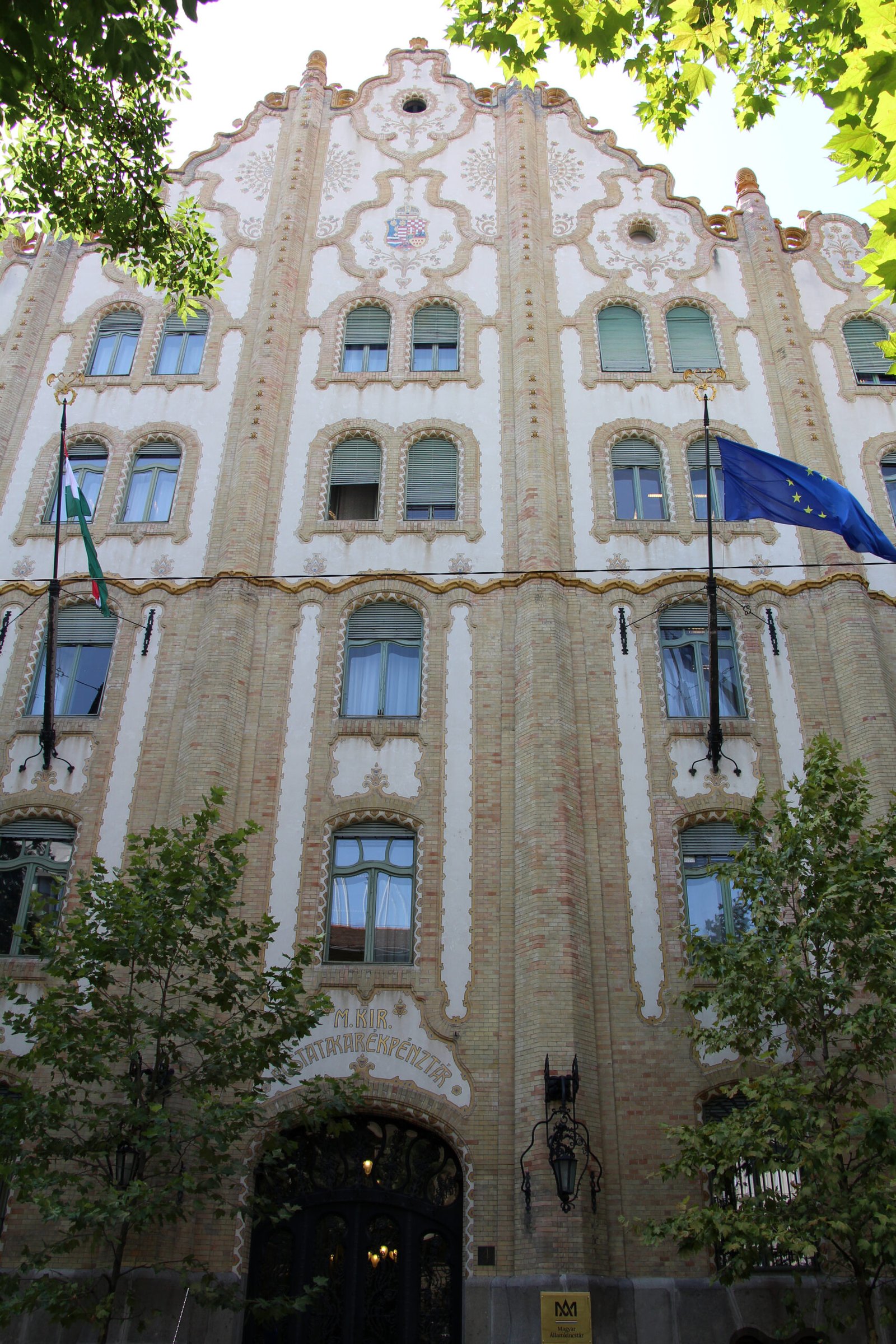
Ödön Lechner’s most personal building: a savings bank crowned with a golden ceramic roof of bees climbing toward their hives, ornament he placed where almost no one on the street could see it.
At a glance
The former Hungarian Royal Postal Savings Bank stands on Hold utca, a narrow street in the fifth district, a short walk from the Parliament. Built between 1899 and 1901 to designs by Ödön Lechner, it is, with the Museum of Applied Arts, the high point of his search for a Hungarian national architecture. Lechner wrapped a thoroughly modern brick building in folk-derived ornament and crowned it with a roof of Zsolnay ceramics — golden bees ascending toward hives, the emblem of thrift. The building today houses part of the Hungarian State Treasury.
Key facts
- Built: 1899–1901
- Architect: Ödön Lechner (1845–1914)
- Style: Hungarian Secession (Art Nouveau)
- Original use: Hungarian Royal Postal Savings Bank
- Address: Hold utca 4, 1054 Budapest, Hungary
- GPS: 47.504343, 19.052301 — Open in Google Maps
- Today: Hungarian State Treasury (Magyar Államkincstár); roof and façade are protected
History
By the late 1890s Lechner was the leading voice in a movement to give Hungary an architecture of its own, distinct from the historicist styles imported from Vienna and Germany. The Postal Savings Bank, a state institution founded to encourage small savers, gave him a prominent commission in the government quarter. He completed it in 1901, drawing on Hungarian folk embroidery and ceramics rather than classical orders, and using the products of the Zsolnay factory in Pécs to make the decoration weatherproof.
A story long attached to the building concerns its extravagant roof. Asked why he lavished such ornament where pedestrians below could barely see it, Lechner is said to have replied that the birds would enjoy it. Whether or not he said it, the line captures his intent: the roof is the building’s crown. After the bank was absorbed into the state finance system, the building passed to the institutions that became today’s State Treasury, which still occupies it.
What you see
From the street the façade is a flat, almost austere brick front, enlivened by bands of cream-coloured majolica, floral motifs and undulating lines drawn from Magyar folk art. The real display is overhead. The roofline breaks into gables, pinnacles and curving forms covered in Zsolnay pyrogranite, glazed in gold, green and ochre: ceramic bees climb the surfaces toward hives set at the summits, serpents coil along the ridges, and flowers spread across the tiles.
The symbolism is deliberate — the bee and the hive stand for industry and saving, the bank’s own message rendered in architecture. Because the ornament concentrates at roof level, the building rewards anyone who steps back across the street or looks down on it from a nearby terrace.
Practical information
- Access: A working government building (State Treasury); the interior is not generally open to the public
- Exterior: The façade and roof are visible from Hold utca at any time, free of charge
- Best view: The roof reads best from across the street, or from the terrace of the nearby Hold Street Market building when accessible
- Time needed: 15–20 minutes for the exterior
Getting there
The building is on Hold utca in the fifth district, between the Parliament and St Stephen’s Basilica. The nearest metro is Kossuth Lajos tér (Line M2), about five minutes’ walk; Arany János utca (Line M3) is a similar distance. From the Parliament, walk south-east through the government quarter and Hold utca opens to the right.
Nearby
- Hungarian Parliament Building and Kossuth Square, a short walk north-west
- St Stephen’s Basilica, to the south-east
- Gresham Palace and the Danube embankment — more Budapest Art Nouveau
- Museum of Applied Arts — Lechner’s other Secession masterpiece
Sources
- Hungarian cultural heritage authority — listed monument record
- Magyar Államkincstár (Hungarian State Treasury) — building history
- Zsolnay Manufactory, Pécs — documentation on the building’s ceramics
Find it on the map
See this place and what’s around it →Record researched and written by Luigi De Marchi for Cultural Heritage Online, 2026.
📷 Become a Cultural Heritage Online photographer
Share your photos of places: they stay published under your name as the author. The more they're seen, the more you get noticed — and soon a contest will reward the most appreciated photos.
Log in or sign up free to add a photoIs this page about you?
This page is read by travellers and heritage enthusiasts who find it on Google. Tell us how you are connected to this place and we will take it from there.