
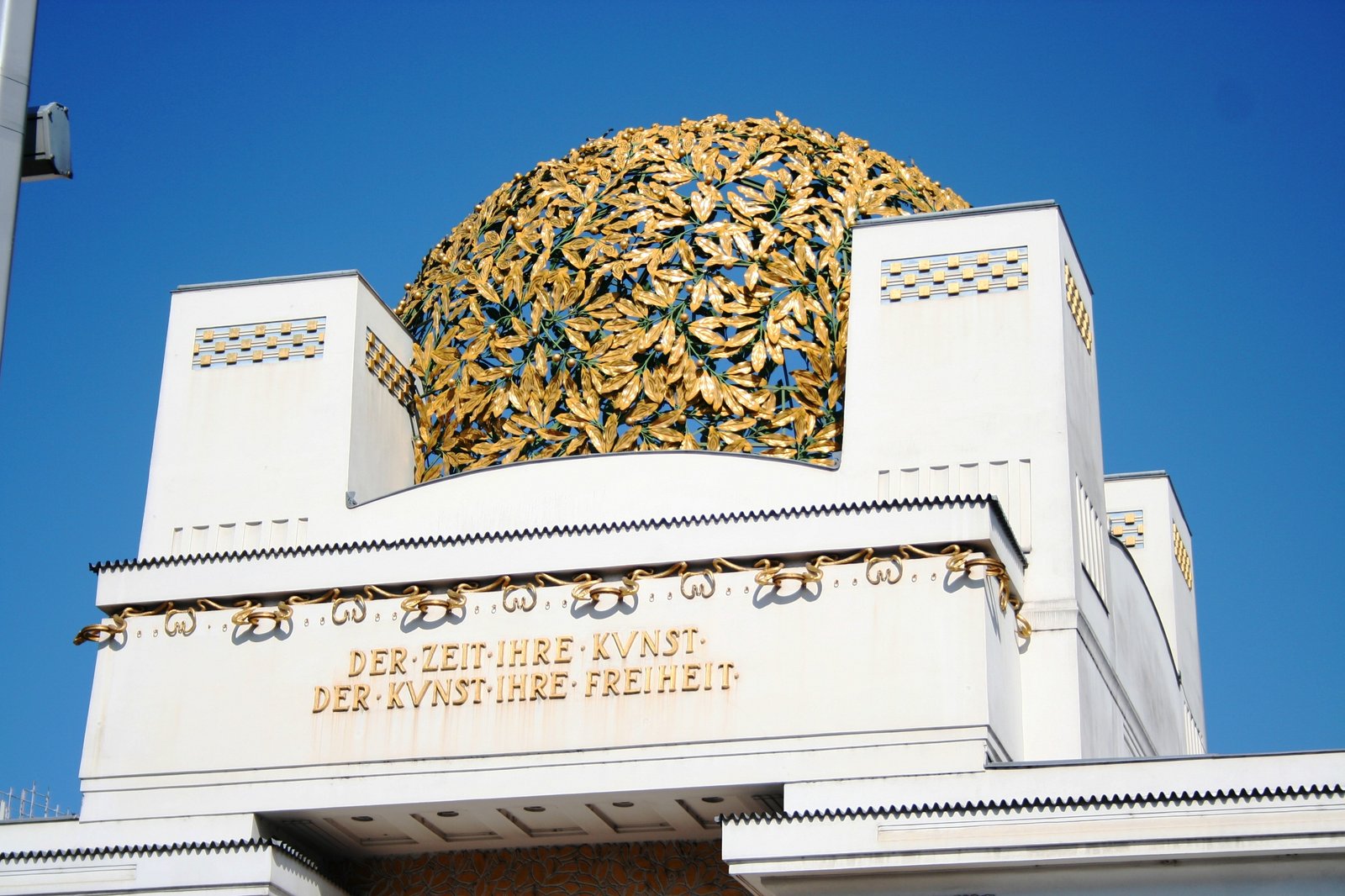
Joseph Maria Olbrich’s white cube crowned by a gilded laurel-leaf dome: the building that declared Vienna’s break with academic tradition and gave an entire movement its home.
At a glance
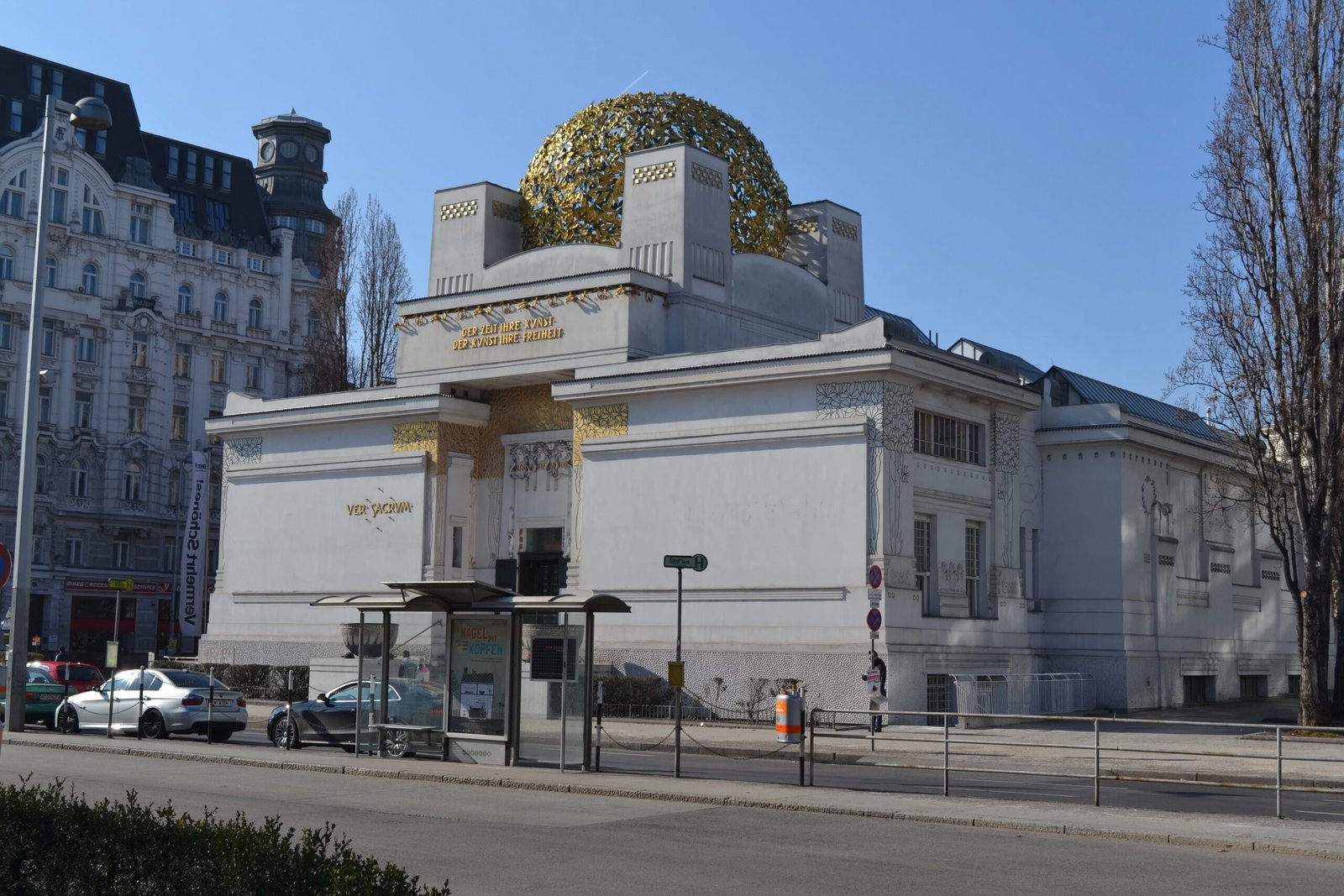
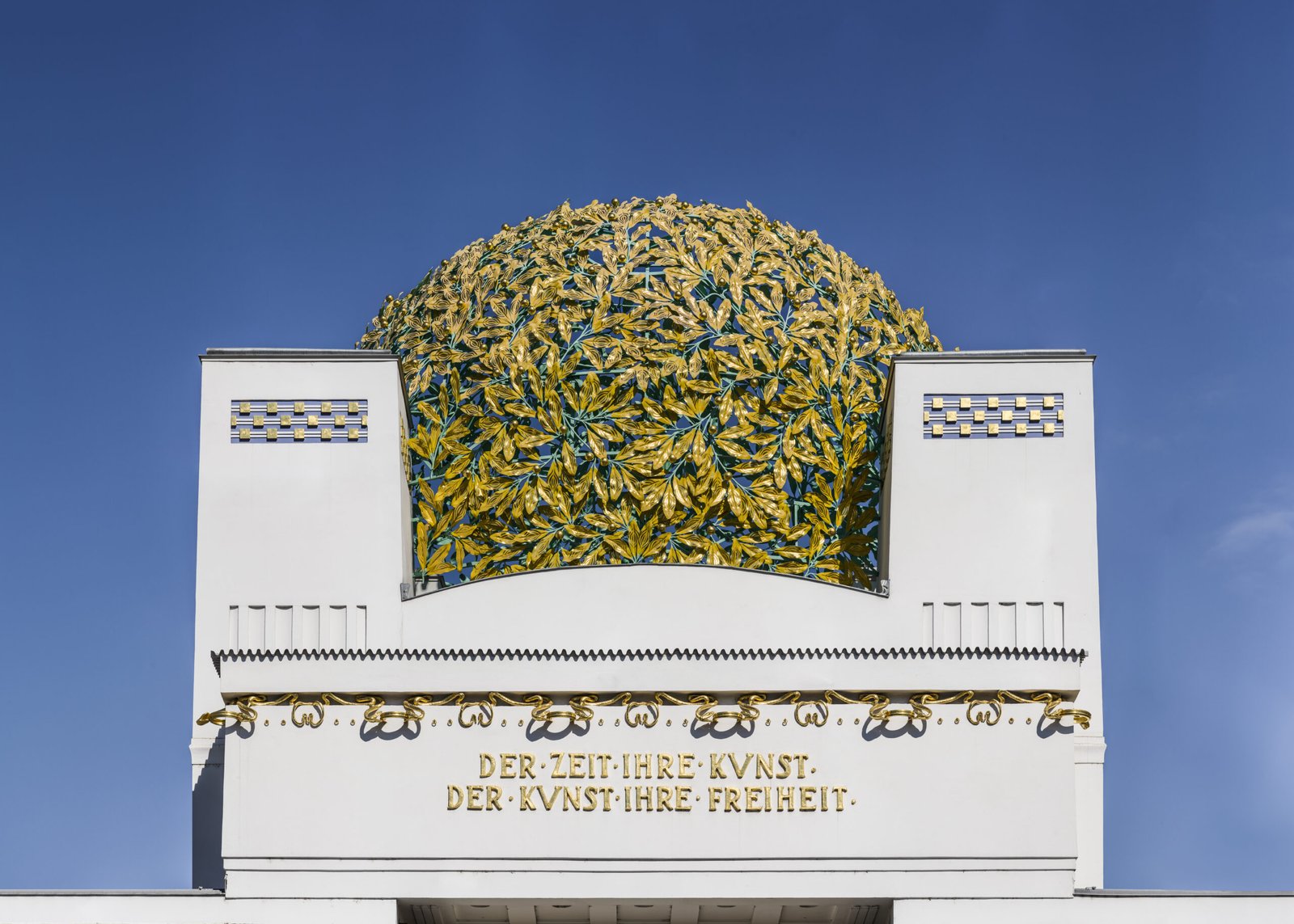
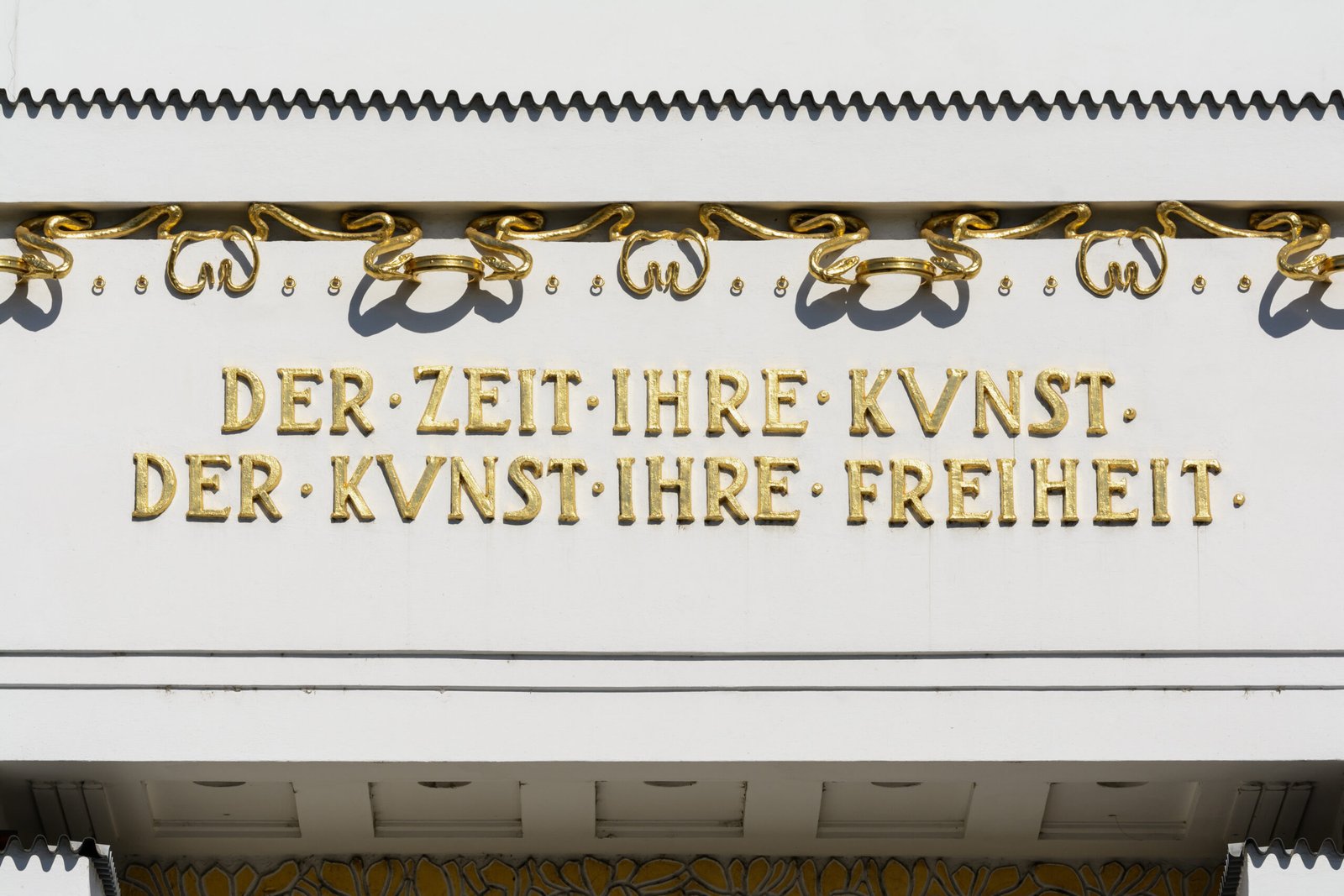
The Secession Building opened in October 1898, less than a year after construction began, on a site south of the Naschmarkt gifted by the city. Olbrich was twenty-nine when he won the commission. The building housed the first exhibitions of the breakaway Vereinigung bildender Künstler Österreichs — artists who had resigned from the conservative Künstlerhaus to pursue a total-art vision linking painting, sculpture, architecture and the applied arts. The gilded dome of cast-iron laurel leaves and berries and planted on a cube of white render, earned the nickname “Krauthappel” (golden cabbage) from Viennese who were not convinced. The motto above the portal — “Der Zeit ihre Kunst. Der Kunst ihre Freiheit” (To every age its art. To every art its freedom) — remains legible in gilded letters to any visitor who looks up.
Key facts
- Completed: 1897–1898
- Architect: Joseph Maria Olbrich (1867–1908)
- Style: Vienna Secession (Gesamtkunstwerk variant of Jugendstil / Art Nouveau)
- Address: Friedrichstraße 12, 1010 Vienna, Austria
- GPS: 48.200395, 16.365934 — Open in Google Maps
- Notable interior: Beethoven Frieze by Gustav Klimt (1902), permanently installed in the basement
- Status: Active exhibition space; listed cultural monument
History
In April 1897, nineteen artists resigned from the Künstlerhaus, Vienna’s dominant official art society, and formed the Secession under the presidency of painter Gustav Klimt. The new association needed its own exhibition hall: the city of Vienna provided the Friedrichstraße site at a token rent. Olbrich, then working in the office of Otto Wagner, drew the plans in collaboration with Klimt and sculptor Max Klinger. The building went up in six months at a cost of 60,000 florins, funded largely through private donations.
The fourteenth Secession exhibition of 1902 centred on Max Klinger’s polychrome Beethoven sculpture. Klimt painted a 34-metre frieze across three walls of one gallery interpreting Beethoven’s Ninth Symphony through Wagnerian themes of struggle and redemption. Temporarily covered after the exhibition, the Beethoven Frieze was rediscovered in 1973 and is today a permanent work on the lower level, accessible from the main hall.
The building survived the Second World War with partial damage to the dome, restored by 1951. Ownership passed to the Secession association itself after Austria’s post-war reconstruction, ensuring institutional continuity. The building and the Beethoven Frieze were listed as national monuments in the twentieth century.
What you see
The plan is essentially a cube — white rendered walls broken only by the three owls on the portal (carved by Othmar Schimkowitz) and a shallow relief frieze of gorgon heads and acanthus by the same sculptor. The dome, set at the very top of the cube rather than rising from a drum, reads as a separate object — a botanical specimen in bronze sitting on the building rather than growing from it. The entry hall behind the portal opens into a flexible internal volume designed to be reconfigured for each exhibition; the Beethoven Frieze is the only permanent installation.
The relationship to the Naschmarkt and the Karlsplatz station (also Otto Wagner, completed one year later) is deliberate: all three form a Jugendstil ensemble anchoring the southern end of the Ringstraße axis at a civic scale. The Secession’s low, horizontal silhouette reads as a counterweight to the vertical ornament of the nearby Karlskirche Baroque dome across the open square.
Practical information
- Opening hours: Tuesday–Sunday 10:00–18:00 (closed Monday); check secession.at for temporary exhibition schedules
- Admission: General entry fee includes the Beethoven Frieze; reduced for students and groups
- Time needed: 45–75 minutes, including time in front of the Klimt frieze
- Photography: Permitted in the main galleries; restrictions may apply for specific exhibitions
- Footwear: No restrictions; the Beethoven Frieze gallery is partly low-lit
Getting there
The Secession Building is at Friedrichstraße 12, at the intersection with Linke Wienzeile, 500 metres west of the Naschmarkt. The nearest U-Bahn stop is Karlsplatz (U1/U2/U4), a four-minute walk north along Friedrichstraße. From Vienna Hauptbahnhof, take the U1 two stops to Karlsplatz. The Majolikahaus at Linke Wienzeile 40 is a ten-minute walk south along the same street, making a natural pairing for an Otto Wagner afternoon.
Nearby
- Majolikahaus — Otto Wagner’s majolica-tiled apartment building (1899), Linke Wienzeile 40, 10 min on foot
- Karlsplatz Stadtbahn Pavilions — Otto Wagner’s paired rail station pavilions (1898–99), visible from Karlsplatz, 5 min on foot
- Albertina Museum — graphic arts collection including Jugendstil and Secession period works, 8 min on foot north along Friedrichstraße
Sources
- Secession official site: secession.at — exhibition history, Beethoven Frieze documentation
- Wien Museum collection archive: documentation on Olbrich and the 1897–1898 construction period
- Austria Forum (AEIOU encyclopedia): entry on Joseph Maria Olbrich and the Secession Building
- Bundesdenkmalamt Austria: monument designation records for Friedrichstraße 12
Partner Ambassador
This is an independent editorial entry, compiled by Cultural Heritage Online from public, openly-licensed sources as part of our Founding Partner pilot. The institution shown has not joined, endorsed, or paid for the programme, and is under no obligation. Secession is welcome to claim, expand, correct, or request removal of it at any time. If you represent this institution, write to info@culturalheritageonline.com.
Find it on the map
See this place and what’s around it →Record researched and written by Luigi De Marchi for Cultural Heritage Online, 2026.
Historical events at this place (1)
📷 Become a Cultural Heritage Online photographer
Share your photos of places: they stay published under your name as the author. The more they're seen, the more you get noticed — and soon a contest will reward the most appreciated photos.
Log in or sign up free to add a photoIs this page about you?
This page is read by travellers and heritage enthusiasts who find it on Google. Tell us how you are connected to this place and we will take it from there.