
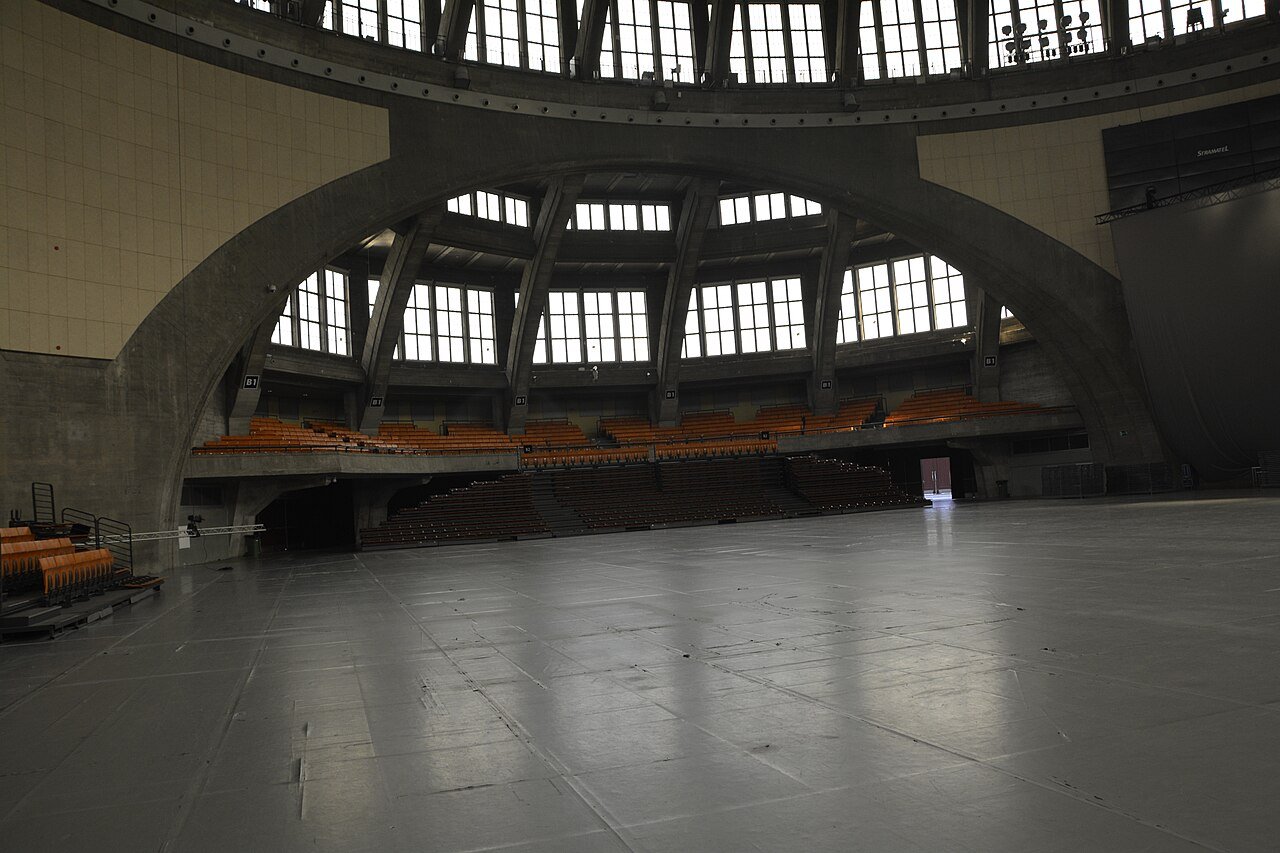
In the German city of Breslau, now Polish Wrocław, Max Berg poured one of the boldest concrete domes of its age. The result reads today as a manifesto for the century that followed.
At a glance
Wrocław holds one of the founding monuments of modern construction. Between 1911 and 1913 the municipal architect Max Berg built the Centennial Hall, a vast reinforced-concrete rotunda whose ribbed dome spans an interior of roughly sixty-nine metres, the largest of its kind when it opened. Inscribed by UNESCO as a World Heritage Site in 2006, the hall sits in the green setting of Szczytnicki Park and still works as an exhibition and concert venue. Wrocław’s modernist story does not end there. In 1929 the Silesian branch of the Deutscher Werkbund staged the WUWA housing exhibition nearby, and in the early 1930s Erich Mendelsohn reshaped the city’s commercial face with the Petersdorff department store. Together these works make Wrocław a compact lesson in how European architecture moved from monumental engineering to functional living.
Key facts
- Country: Poland (formerly German Breslau)
- Key period: 1911–1929
- Key architect: Max Berg (1870–1947)
- UNESCO: Centennial Hall, inscribed 2006
- Essential sites: Centennial Hall, WUWA estate, former Petersdorff department store (Erich Mendelsohn)
History
Max Berg (1870–1947) trained in Berlin and arrived in Breslau in 1909, when he was appointed the city’s senior building official. The commission that would define his career came soon after: a great hall to mark the centenary of the 1813 wars against Napoleon. Berg proposed not a masonry pavilion but a reinforced-concrete structure on a scale that had no real precedent, and the city backed him. Construction ran from 1911 to 1913, and the building opened on 20 May 1913.
The hall survived the Second World War, which left much of Breslau in ruins, and passed with the city into Poland in 1945. Renamed Hala Stulecia, it continued in public use through the communist decades, when the Iron Cross motif visible at the crown of the dome was deliberately obscured for political reasons. Berg himself had largely withdrawn from architecture by then, turning toward mysticism in his later years, and died in 1947.
By the 1920s Breslau had become a testing ground for the new architecture. In 1929 the Silesian committee of the Deutscher Werkbund organised the WUWA exhibition — short for Wohnungs- und Werkraumausstellung — a permanent estate of experimental dwellings near Szczytnicki Park. Architects including Hans Scharoun, Adolf Rading, Heinrich Lauterbach and Emil Lange contributed some thirty-two building types raised in roughly three months, among them Scharoun’s residential block for single people and childless couples. A few years later Erich Mendelsohn (1887–1953) added the Petersdorff department store of 1932–1933, its curved corner a clear statement of his dynamic functionalism.
What you see
The Centennial Hall is built around its dome. From inside, the eye climbs concentric rings of reinforced-concrete ribs that step inward and upward to a lantern at the summit, the interior reaching some forty-two metres in height across a span of about sixty-nine metres. The structure carries its own loads through this ribbed cage rather than hiding them, so the engineering is the architecture; little is added for decoration. The effect is closer to a piece of bridge-building turned skyward than to a traditional ceremonial hall.
Outside, the rotunda is wrapped by tiered galleries and lower volumes, set within the landscaped grounds of Szczytnicki Park alongside the later pergola and pond. Visitors can tour the hall and its surroundings; the building remains in active use for fairs, concerts and sporting events, so access to the interior depends on the event calendar. A short walk leads to the WUWA estate, whose flat-roofed villas and apartment blocks can be viewed from the street.
Practical information
- The Centennial Hall stands at Wystawowa 1, in the eastern Szczytniki district beside Szczytnicki Park.
- The interior is used for events; check the official programme before visiting to confirm public access on a given day.
- A multimedia visitor centre, “Discovery Centre,” operates on the site and is open most of the year.
- The WUWA modernist estate is a short walk away and can be explored on foot at any time from the public streets.
- Allow at least half a day to combine the hall, the surrounding park and the WUWA houses.
Getting there
Wrocław is served by Copernicus Airport (WRO), about twelve kilometres west of the centre, with bus and taxi links into the city. From the historic Market Square the Centennial Hall lies to the east; trams running toward the Szczytniki district stop close to Hala Stulecia, and the journey takes roughly twenty minutes. The site is also reachable by car, with parking near the grounds.
Related in CHO
- Berlin & Dessau — Gropius, the Bauhaus and German Modernism
- Brno — Villa Tugendhat and Czech Functionalism
- Vienna — Capital of the Vienna Secession
Sources
Find it on the map
See this place and what’s around it →
📷 Become a Cultural Heritage Online photographer
Share your photos of places: they stay published under your name as the author. The more they're seen, the more you get noticed — and soon a contest will reward the most appreciated photos.
Log in or sign up free to add a photo