
Bandung — Paris van Java and Tropical Art Déco
High on a volcanic plateau in West Java, Bandung wears the architecture of a colonial dream that was never finished. Its 1920s and 1930s buildings translate European Art Déco into a tropical idiom.
At a glance
Bandung sits at roughly 700 metres above sea level, about 135 kilometres southeast of Jakarta, ringed by the volcanoes of West Java. The Dutch knew it as Bandoeng, and as the colonial administration grew restless with the heat and crowding of Batavia, they began to imagine moving the capital of the Dutch East Indies here. That ambition never arrived, but the building boom it triggered did. Between the world wars, architects working in Bandung produced one of the densest concentrations of Art Déco and New Indies Style architecture anywhere in Asia: government palaces, hotels, villas and the shopfronts of Jalan Braga. The result earned the city its enduring nickname, Parijs van Java — Paris of Java.
Key facts
- Country: Indonesia
- Key period: 1920s–1930s (Dutch East Indies)
- Key architect: C.P. Wolff Schoemaker (1882–1949), professor at the Technische Hoogeschool Bandoeng (now ITB)
- Essential sites: Villa Isola, Gedung Sate, Savoy Homann Hotel, Jalan Braga, Hotel Preanger
- Elevation: approximately 708 metres above sea level
History
Bandung was founded on 25 September 1810 and incorporated as a municipality, a gemeente, on 1 April 1906. The railway that linked Batavia to Bandung, completed in 1880, turned a highland town into a reachable retreat, and the cool climate drew Dutch planters, officials and tourists. Luxury hotels and upscale shops followed, and the city gradually styled itself as a resort — the origin of the Paris of Java sobriquet.
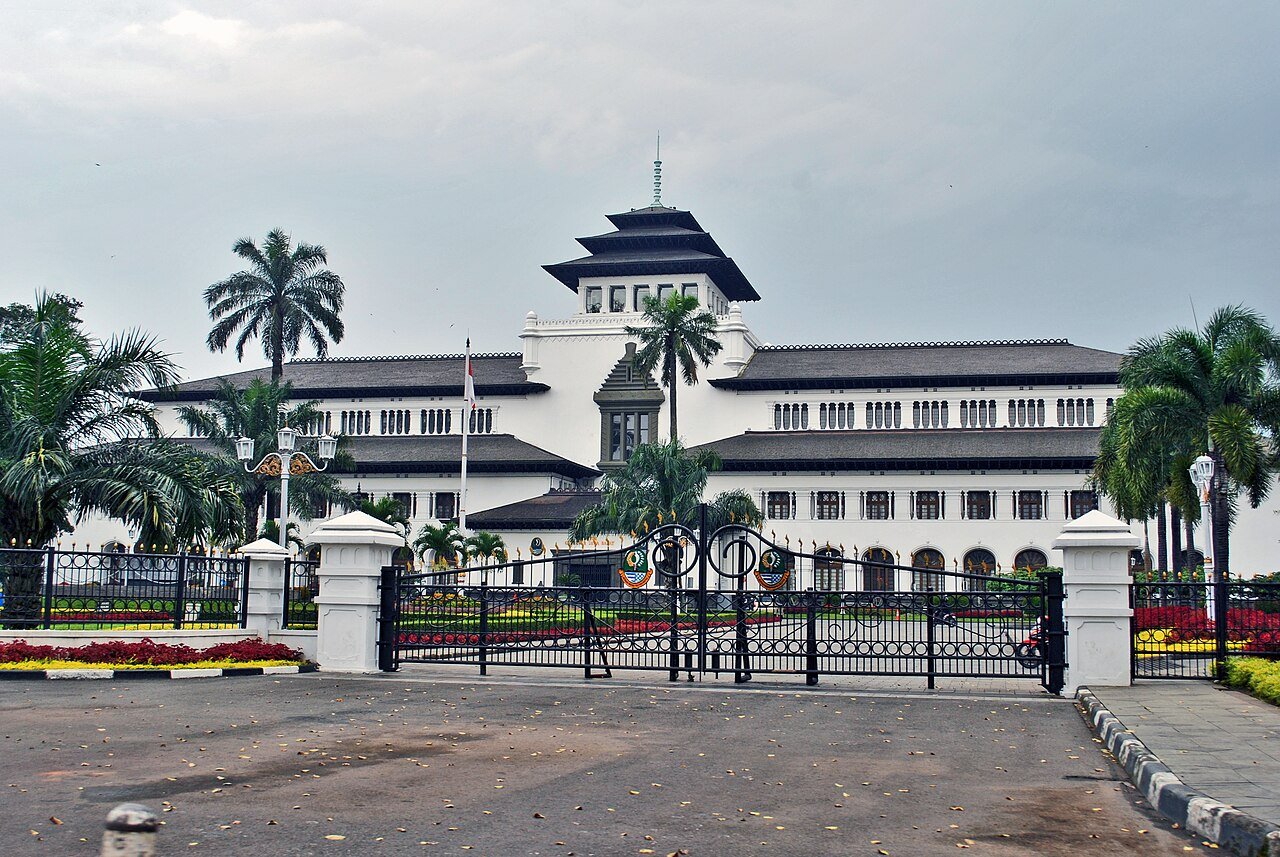
The decisive moment came in the 1920s, when Dutch administrators drew up plans to relocate the colonial capital from Batavia to Bandung. The scheme called for a new government quarter, and its centrepiece, the Department of Government Industries building later known as Gedung Sate, rose between 1920 and 1924. The move was ultimately disrupted by the Second World War and never completed, but the infrastructure and the architectural confidence remained.
Through the 1930s the city saw a building boom in which Dutch architects experimented with designs that blended European modernism with local traditions. Wolff Schoemaker, who had been described as “the Frank Lloyd Wright of Indonesia” and who taught the young Sukarno, anchored this generation. After independence Bandung kept its colonial fabric largely intact, and in 1955 the Savoy Homann and nearby Gedung Merdeka hosted the Asian-African Conference, giving the city’s Déco interiors a second life as the backdrop to a new political era.
What you see
The signature of Bandung Déco is adaptation. Gedung Sate, designed by J. Gerber, sets a neoclassical massing under a central pinnacle of six spheres — the skewered ornament that gave the building its nickname — and folds in Hindu-Buddhist and Sundanese motifs, a hybrid often labelled New Indies Style. A short distance away, Wolff Schoemaker’s Villa Isola (completed March 1933) is pure streamline Art Déco: a white composition of curved volumes and ribbon lines oriented along a north-south axis, facing Mount Tangkuban Perahu on one side and the city on the other. Built for the press magnate Dominique Willem Berretty, it now serves as the rectorate of the Indonesia University of Education.
Down on Jalan Asia-Afrika, Albert Aalbers rebuilt the Savoy Homann Hotel in 1939 in a curved, streamlined Art Déco that still functions as a hotel today. The neighbouring Jalan Braga preserves a run of Déco shopfronts, and Schoemaker’s own Hotel Preanger (1929) and Gedung Merdeka (1921) complete a compact, walkable circuit. Visiting rewards attention to detail: the way deep eaves and ventilation answer the tropical climate, the streamline curves that soften severe geometry, and the recurring play between imported modernism and Javanese ornament.
Practical information
- Gedung Sate stands at Jalan Diponegoro No. 22 and houses the office of the governor of West Java, with a museum open to visitors.
- Villa Isola is the rectorate of the Universitas Pendidikan Indonesia; the grounds and exterior are the main draw for visitors.
- The Savoy Homann on Jalan Asia-Afrika remains an operating four-star hotel — a coffee in its lobby is the easiest way inside.
- Jalan Braga is best explored on foot, ideally in the cooler morning or late afternoon.
- Bandung’s elevation keeps temperatures mild year-round; rain is heaviest roughly November to March.
Getting there
Husein Sastranegara International Airport (BDO) lies close to the centre of Bandung, and Kertajati International Airport opened farther east in 2018. Many visitors arrive overland instead: the historic Batavia–Bandung railway, completed in 1880, still carries frequent trains from Jakarta, and the journey through the highlands is part of the experience.
Related in CHO
- Shanghai — The Bund and the Art Déco of the East
- Mumbai — Marine Drive and the Art Déco Ensembles
- Miami — South Beach and Tropical Art Déco
Sources
Find it on the map
See this place and what’s around it →📷 Diventa un fotografo di Cultural Heritage Online
Condividi le tue foto dei luoghi: restano pubblicate con la tua firma come autore. Più vengono viste, più ti fai conoscere — e presto un concorso premierà le foto più apprezzate.
Accedi o registrati gratis per aggiungere una foto