
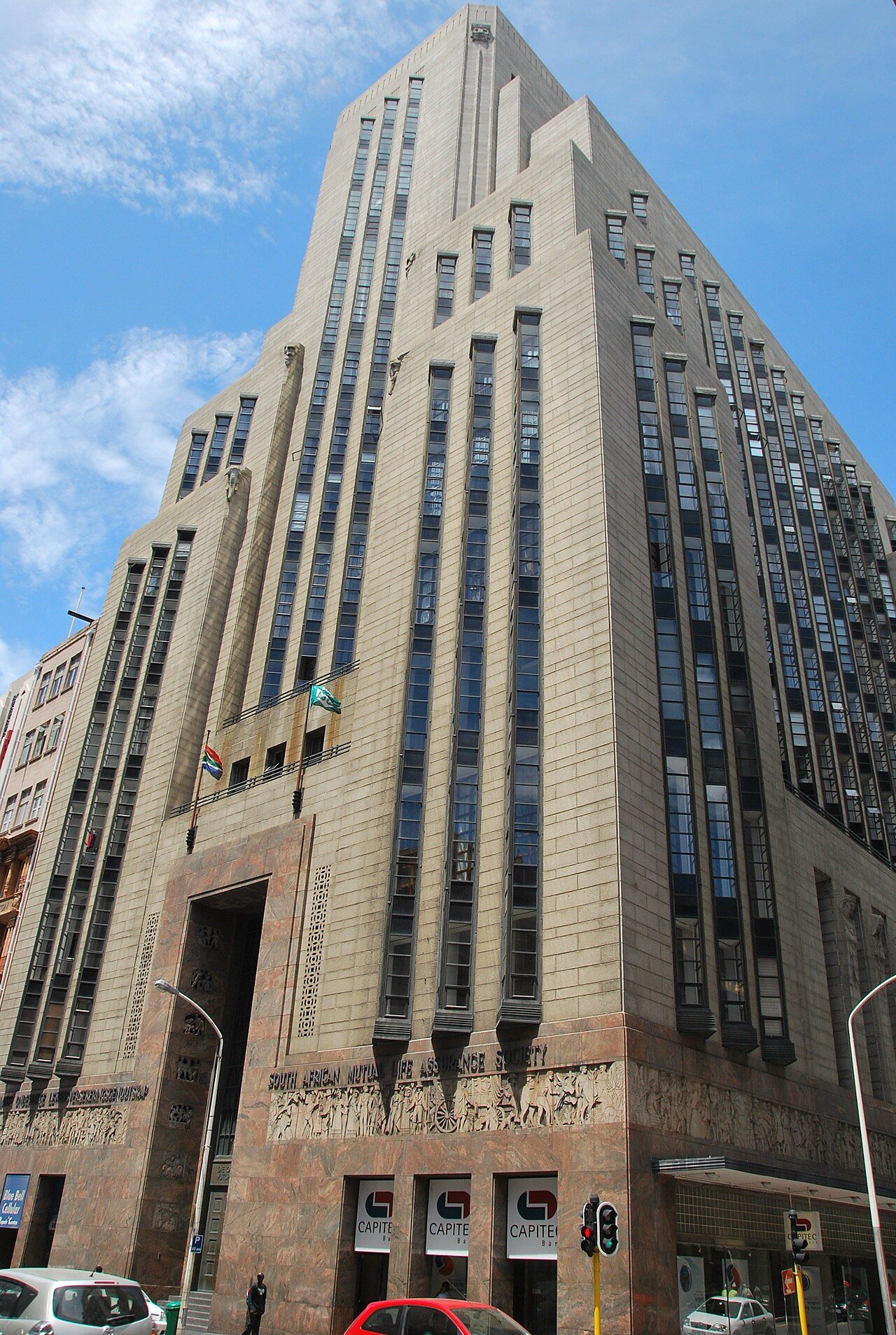
At the foot of Table Mountain, Cape Town’s old commercial core holds one of the southern hemisphere’s most assured Art Déco landmarks. Granite, setbacks and carved stone tell a 1930s story in the City Bowl.
At a glance
Cape Town’s central business district, the City Bowl, is South Africa’s oldest urban area and a dense, walkable grid of nineteenth- and twentieth-century facades. Among them, the Art Déco of the late 1930s stands out for its ambition. The Mutual Building on Darling Street, completed in 1939 and opened early in 1940, was the headquarters of the South African Mutual Life Assurance Society and, at 84 metres, the tallest building in the country at the time. Designed by the Cape Town firm Louw & Louw, it combines a stepped ziggurat profile, tall prismoid windows and a continuous carved granite frieze. Converted to apartments in the mid-2000s and renamed Mutual Heights, it anchors a compact district that rewards slow walking on foot.
Key facts
- Country: South Africa
- Key period: 1930s
- Key building: Mutual Building / Mutual Heights, 14 Darling Street (completed 1939, opened 1940) — architects Louw & Louw
- Height: 84 metres, ten storeys above ground
- Essential sites: Mutual Building (Darling Street), the City Bowl commercial grid around Darling Street, St George’s Mall and Long Street
History
The South African Mutual Life Assurance Society commissioned a new headquarters at the close of the 1930s, and the Cape Town firm Louw & Louw delivered a building completed in 1939 and opened early in 1940. With a height of 84 metres and ten storeys above ground, plus three basement levels for parking, it became the tallest building in South Africa, a distinction it held for more than two decades until the Sanlam Centre overtook it in 1962.
The design was a deliberate statement of corporate confidence. Fred Glennie is credited with much of the detailed work, while the sculptor Ivan Mitford-Barberton, born in Somerset East in 1896, shaped both the external granite decoration and the interior carving. The granite cladding was hewn from a single boulder on the Paarl Mountain, north-east of the city, an unusual feat of stone-working that gave the facades their uniform, monumental surface.
By the late 1950s the company was already shifting operations to a new office at Mutual Park in Pinelands, and the Darling Street building gradually emptied. After the last tenants left in May 2003, a conversion to residential apartments began, led by the renovation architect Robert Silke of Louis Karol Architects and completed in 2005. The developers renamed it Mutual Heights, a choice that did not please every owner and resident in the new community.
What you see
From across Darling Street the building reads as a series of stepped setbacks rising to a central tower, the ziggurat massing that Art Déco borrowed from American skyscrapers and ancient precedent alike. Tall prismoid windows, triangular in section, run up the facade and catch the Cape light along their angled edges. The granite skin, drawn from that single Paarl boulder, lends the whole composition a heavy, deliberate solidity.
The signature feature is the carved exterior frieze, one of the longest of its kind, running roughly 118 metres around three sides of the building. Designed by Ivan Mitford-Barberton and executed by an Italian team led by Adolfo Lorenzi, its fifteen panels depict scenes from colonial South African history. Visitors should note that the frieze presents a colonial-era narrative of its time, and reading it critically is part of understanding the building. Inside, the directors’ board room holds a separate carved stinkwood frieze of animal and floral motifs. The interiors are now private apartments, so the exterior and its stonework are what most visitors will experience.
Practical information
- Address: 14 Darling Street, City Bowl, Cape Town.
- The building is now private residential apartments; the facades and frieze are viewed from the street.
- Best appreciated on foot as part of a City Bowl walk taking in Darling Street, St George’s Mall and Long Street.
- Morning light favours the Darling Street frontage; bring a wide lens for the full tower.
- The surrounding CBD is busy on weekdays and quieter at weekends; keep normal city awareness.
Getting there
Cape Town International Airport is the main gateway, with metered taxis, ride-hailing and the MyCiTi bus service linking it to the City Bowl. From the central station and the Grand Parade area, the Mutual Building on Darling Street is a short walk, set within the compact grid of the old commercial centre.
Related in CHO
- Johannesburg — The Art Déco Skyline of the Gold City
- Miami — South Beach and Tropical Art Déco
- Napier — The Art Déco Town Rebuilt After the Earthquake
Sources
Find it on the map
See this place and what’s around it →Record researched and written by Luigi De Marchi for Cultural Heritage Online, 2026.
📷 Become a Cultural Heritage Online photographer
Share your photos of places: they stay published under your name as the author. The more they're seen, the more you get noticed — and soon a contest will reward the most appreciated photos.
Log in or sign up free to add a photo