
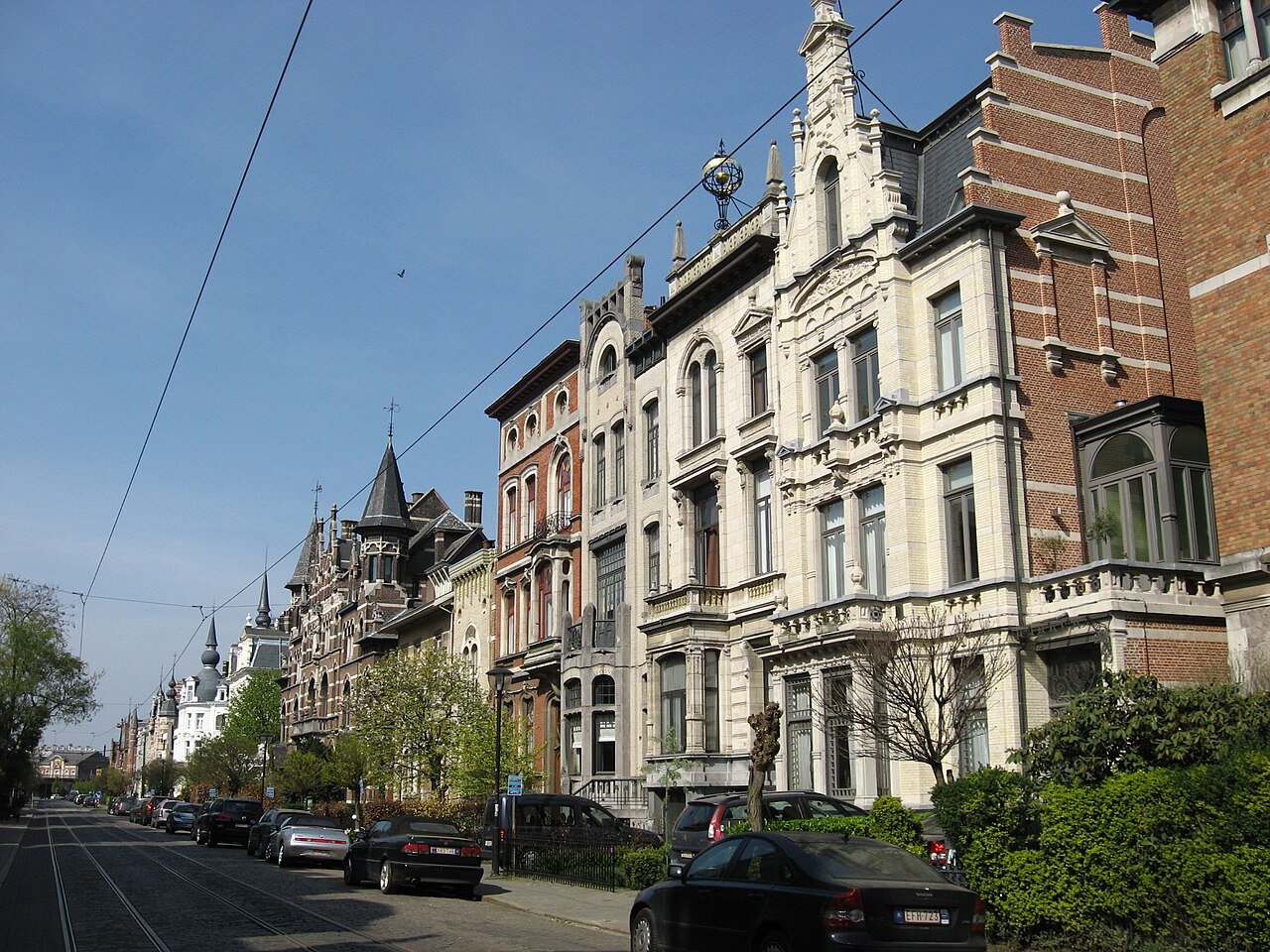
In the south-east of Antwerp, the Zurenborg district preserves one of Europe’s densest concentrations of turn-of-the-century townhouses. Its avenues turned speculative building into open-air theatre.
At a glance
Zurenborg is a residential quarter on the boundary between the city of Antwerp and the district of Berchem, largely built up between 1894 and 1906. Where most cities of the period produced uniform terraces, the developers here encouraged variety, and the result is a parade of styles crowded into a few streets. The undisputed showpiece is Cogels-Osylei, an avenue whose houses were given names and themes — flowers, times of day, the seasons, historical episodes — and dressed in everything from Art Nouveau to Neo-Renaissance and Gothic Revival. The neighbourhood is residential and freely walkable, which makes it one of the most rewarding architecture strolls in Flanders.
Key facts
- Country: Belgium
- City: Antwerp (district boundary with Berchem)
- Key period: c. 1894–1906
- Essential sites: Cogels-Osylei, Waterloostraat, Transvaalstraat, Generaal van Merlenstraat
- Styles: Art Nouveau and other fin-de-siècle currents (Neo-Renaissance, Gothic Revival, Neoclassical)
History
Zurenborg took shape in the closing decade of the nineteenth century, when land on the south-eastern edge of Antwerp was opened to development. Rather than impose a single architectural language, the promoters allowed and even encouraged stylistic competition between plots. Between 1894 and 1906 the empty fields filled with townhouses commissioned by a prosperous middle class eager to display its taste, and the speculative scheme became a showcase of the era’s eclecticism.
The architect most closely associated with the quarter is Joseph Bascourt, who designed some twenty-five houses across the neighbourhood, including the ensemble of the four seasons on Generaal van Merlenstraat and the house known as Boreas on Transvaalstraat. Alongside him worked other designers who left signature buildings: Jules Hofman completed the Art Nouveau house De Zonnebloem (The Sunflower) at Cogels-Osylei 50 in 1900, while Frans Smet-Verhas was responsible for the house evoking the Battle of Waterloo on Waterloostraat.
The thematic naming of houses was part of the appeal. Coordinated groups were conceived as narratives in masonry — the De Tijd (Time) ensemble on Waterloostraat ran through the hours of the day, and corner buildings depicted the seasons. After decades in which fin-de-siècle architecture fell out of fashion and parts of Zurenborg were threatened with demolition, the quarter was recognised as heritage and has since become a protected and much-visited example of Belgian eclectic and Art Nouveau design.
What you see
The pleasure of Zurenborg is in the detail. Facades carry colourful mosaics, sgraffito panels, stained glass, wrought-iron balconies and carved stone, and no two neighbouring houses repeat the same idea. Cogels-Osylei concentrates the finest examples, with De Zonnebloem and the houses numbered in the lower stretches forming a near-continuous gallery; the adjoining Waterloostraat and Transvaalstraat extend the display with the seasons, the times of day and the historical set pieces.
Because the district is still lived in, the best way to experience it is on foot and at a slow pace, looking up at the gables and reading the house names that explain each design. Begin at Cogels-Osylei, loop through Waterloostraat and Generaal van Merlenstraat, and allow time simply to stand at the crossroads where the corner houses face one another. There is no admission and no fixed route — the streets themselves are the monument.
Practical information
- Free to visit: the houses are private residences seen from the public street.
- Allow one to two hours for an unhurried walk of the main avenues.
- Best light for photography is mid-morning or late afternoon along Cogels-Osylei.
- Respect residents’ privacy; do not enter gardens or doorways.
- Combine with central Antwerp, a short tram or train ride away.
Getting there
Antwerp is about 40 km north of Brussels and is easily reached by train: Antwerpen-Centraal, itself a celebrated Beaux-Arts station, is the main gateway, with frequent services from Brussels and onward connections across Belgium and the Netherlands. From the city centre, Zurenborg lies a short distance to the south-east and is served by local trams and by the nearby Antwerpen-Berchem station. International visitors usually fly into Brussels Airport and continue by direct train; the smaller Antwerp Airport (ANR) also serves the city.
Related in CHO
- Brussels — Victor Horta and Art Nouveau Architecture
- Nancy — The École de Nancy and French Art Nouveau
- Paris — Belle Époque, Art Nouveau & Modernism
Sources

Find it on the map
See this place and what’s around it →Record researched and written by Luigi De Marchi for Cultural Heritage Online, 2026.
📷 Become a Cultural Heritage Online photographer
Share your photos of places: they stay published under your name as the author. The more they're seen, the more you get noticed — and soon a contest will reward the most appreciated photos.
Log in or sign up free to add a photo