
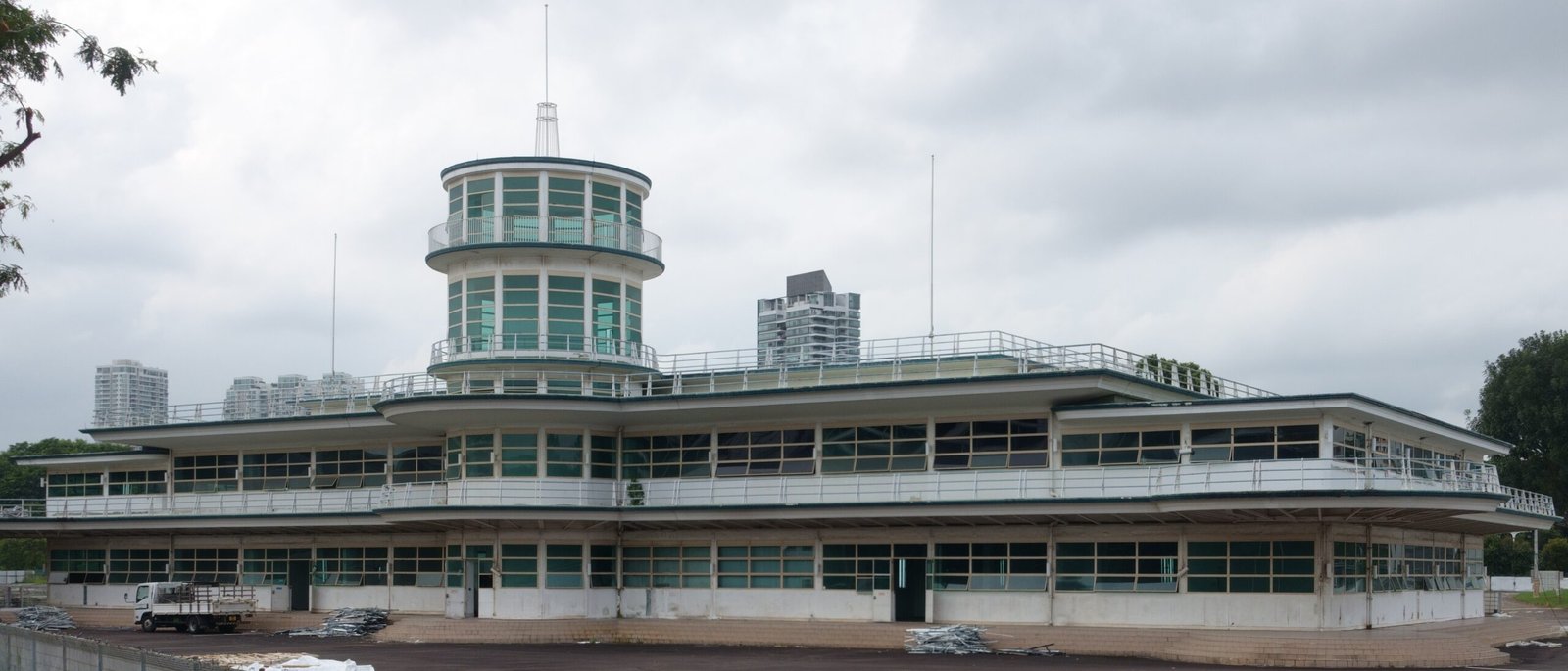
Contemporary press called it “the finest airport east of Suez.” Today Singapore’s first purpose-built civil air terminal stands as a gazetted national monument on Kallang Airport Way.
At a glance
Opened on 12 June 1937 by the Governor of the Straits Settlements, Kallang Airport was Singapore’s inaugural purpose-built civil aerodrome. Its Streamline Moderne terminal was among the most celebrated airport buildings in Asia at the time. It operated as the colony’s principal civil airport until 21 August 1955, when Paya Lebar Airport succeeded it. The main terminal building, control tower, two hangars, and original lampposts survive and are conserved under Singapore’s Urban Redevelopment Authority. The building was gazetted for conservation in 2008 and continues to host cultural events and exhibitions.
Key facts
- Address: 9 Kallang Airport Way, Singapore 397750
- Construction: began 1931, completed 1935; opened to civil traffic 12 June 1937
- Design: Colonial Public Works Department (PWD), Straits Settlements
- Style: Streamline Moderne / Art Déco
- Closed as airport: 21 August 1955
- Heritage status: Gazetted for conservation by the Urban Redevelopment Authority, 2008
- Peak ranking: Second-busiest airport in Southeast Asia, c. 1950
History
Construction on Singapore’s first purpose-built civil airport began in 1931 on reclaimed land along Kallang Basin, then a swampy estuary on the colony’s eastern fringe. The project was overseen by the colonial Public Works Department and represented a deliberate statement of imperial modernity: Singapore was establishing itself as a hub on the long-haul air routes linking Britain to Australia. The terminal was structurally complete by 1935, when three Hawker Hart biplanes from HMS Hermes made the first recorded landings on 21 November of that year.
The official inauguration came on 12 June 1937, when Governor Sir Shenton Thomas formally declared the airport open. The timing was deliberate — Imperial Airways had begun operating a trunk route between London and Singapore, and the colonial government wanted a terminus worthy of the occasion. The terminal’s smooth curved facade, horizontal banding, and streamlined tower spoke a design language that was self-consciously forward-looking: the Streamline Moderne idiom translated into reinforced concrete for a tropical climate.
Within months of the opening, Kallang attracted some of the most celebrated aviators of the era. The American pioneer Amelia Earhart, who stopped in Singapore during her ill-fated 1937 round-the-world attempt, reportedly described the airport as “the aviation miracle of the East” — a phrase reported in contemporary Straits Times accounts, though the exact circumstances of her visit remain imprecise in the surviving record. Whether or not the precise wording is hers, the contemporary press reception in Singapore was rapturous.
By 1950 Kallang was ranked the second-busiest airport in Southeast Asia, handling an ever-expanding range of carriers. Its single runway of 1,676 metres, originally grass-surfaced and later paved in concrete, increasingly strained against the demands of the postwar generation of larger aircraft. On 21 August 1955, civil operations transferred to the new Paya Lebar Airport; Kallang was repurposed by the Royal Air Force until British forces departed in the early 1970s. The terminal then fell into partial disuse before a conservation effort returned parts of it to public use in 1994. The Urban Redevelopment Authority formally gazetted the building for conservation in 2008, securing its principal structures in perpetuity.
What you see
The terminal presents a low, horizontal silhouette that reads immediately as interwar Streamline Moderne. The facade is smooth rendered concrete with continuous banding that wraps around curved corners — a deliberate visual device to suggest speed and forward motion, the defining preoccupation of the style. The control tower rises cleanly from the centre, its cylindrical crown and porthole windows recalling the vocabulary of ocean-liner design that influenced Streamline Moderne across the world in the 1930s. Unlike the more ornate classical or Baroque government buildings elsewhere in colonial Singapore, Kallang Airport was unapologetically of its moment.
Behind the main terminal, two original hangars survive alongside a courtyard ringed by period lampposts. The ensemble gives a sense of the airport as it functioned: arrivals and departures through the terminal, aircraft sheltered in the hangars, the whole assembly oriented toward the now-vanished runway basin. The interior has been adapted for event use over the decades, but the spatial sequence — from the landside entrance through the terminal volume toward the airside — remains legible, offering a rare opportunity to inhabit a 1930s airport as a building type rather than merely as a photograph.
Practical information
- Heritage status: National monument (gazetted for conservation 2008); exterior freely viewable from public street
- Interior access: Varies by event; the terminal and hangars host periodic exhibitions and cultural events — check current programming before visiting
- Nearest MRT: Dakota (Circle Line, CC8), approximately 10 minutes on foot via Old Airport Road; Kallang (East-West Line, EW10) is also nearby, around 15 minutes on foot
- Suggested visit time: 30–60 minutes for the exterior and grounds; longer when events are scheduled
Getting there
The former terminal stands at 9 Kallang Airport Way, off Stadium Walk in the Kallang district. From Dakota MRT station (Circle Line), walk south along Old Airport Road, then turn right onto Kallang Airport Way — the terminal’s curved facade and control tower become visible from the road. Buses serving the Old Airport Road corridor stop nearby. Taxis and ride-share drop-offs are straightforward; the address “9 Kallang Airport Way” resolves correctly in all major navigation apps. There is limited street parking along Kallang Airport Way.
Nearby
- Old Airport Road Food Centre — one of Singapore’s most storied hawker centres, 10 minutes on foot
- Singapore Sports Hub — the National Stadium and its waterfront promenade, within walking distance along Stadium Walk
- Kampong Bugis waterfront — the basin where Kallang’s original seaplane facilities once operated, now a green corridor
- Geylang Serai Market — one of Singapore’s oldest Malay markets, a 15-minute ride east
Sources
- Urban Redevelopment Authority Singapore — conservation gazettement records, 2008
- The Straits Times historical archive — airport inauguration coverage, 12 June 1937; Amelia Earhart visit accounts, 1937; retrospective features, 1994 and 2017
- National Library Board Singapore, NLB Infopedia — airport history articles
- Wikimedia Commons — photographic documentation, Gaodanielbo, CC0 1.0
- OpenStreetMap / Nominatim — GPS verification: 1.307409, 103.873586
Find it on the map
See this place and what’s around it →Record researched and written by Luigi De Marchi for Cultural Heritage Online, 2026.
📷 Become a Cultural Heritage Online photographer
Share your photos of places: they stay published under your name as the author. The more they're seen, the more you get noticed — and soon a contest will reward the most appreciated photos.
Log in or sign up free to add a photoIs this page about you?
This page is read by travellers and heritage enthusiasts who find it on Google. Tell us how you are connected to this place and we will take it from there.