

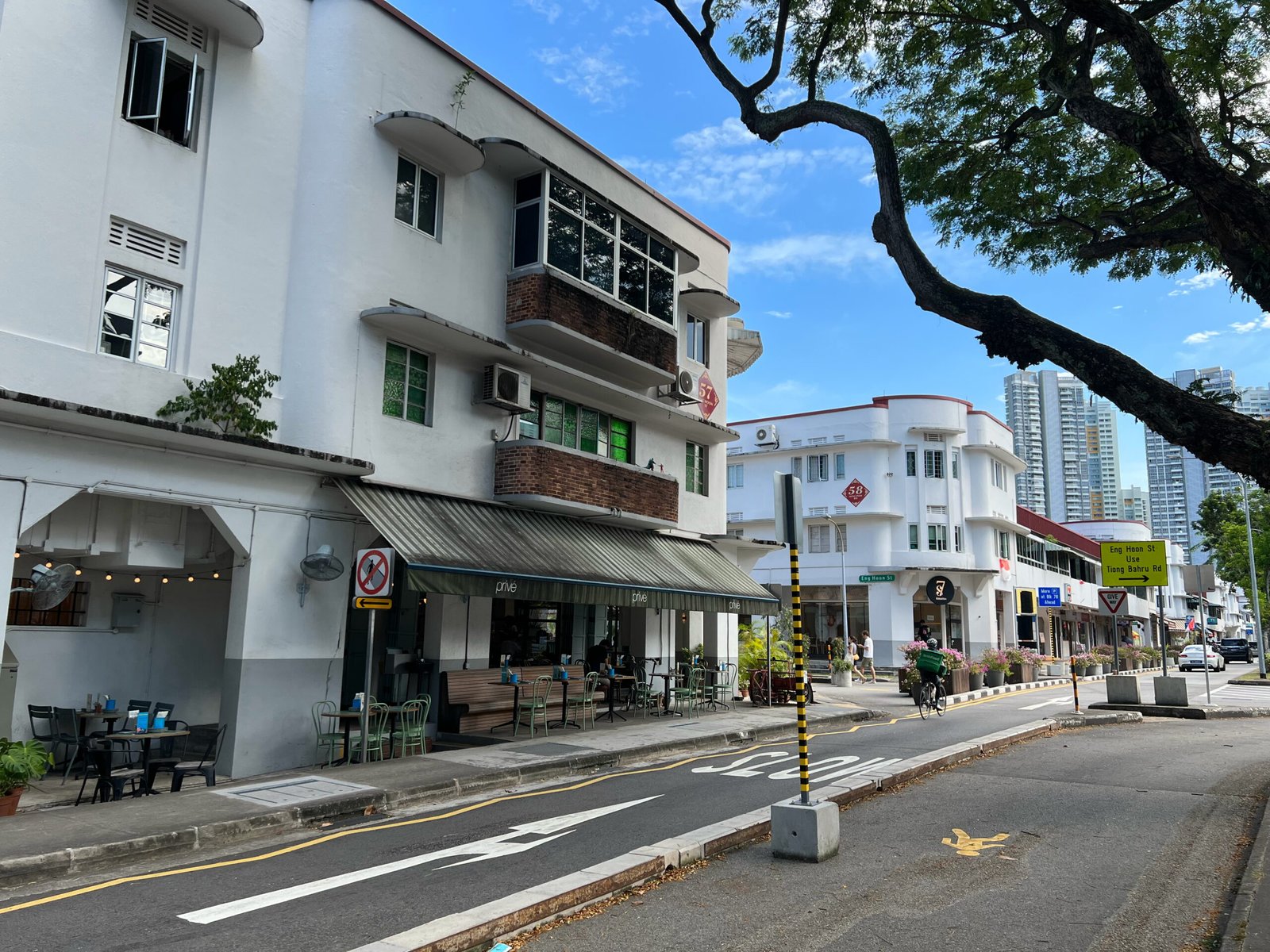
Singapore’s oldest surviving public housing estate, built by the Singapore Improvement Trust between 1936 and 1941, is a rare urban block of Streamline Moderne walk-up flats still in residential use.
At a glance
Tiong Bahru Estate occupies a compact grid of streets in Bukit Merah, a short ride from Singapore’s city centre. Its twenty pre-war SIT blocks, gazetted for conservation by the Urban Redevelopment Authority in 2003, form one of the most intact Streamline Moderne streetscapes in Southeast Asia. Residents, cafes, and local bakeries share the same curved corridors that sheltered families during the Japanese Occupation.
Key facts
- Built: 1936–1941 (pre-war phase); post-war extensions 1948–1954
- Developer: Singapore Improvement Trust (SIT), colonial public housing authority
- Architect: British architect Alfred G. Church designed the pre-war blocks
- Style: Streamline Moderne (late Art Déco movement)
- Scale: 784 flats, 54 tenements and 33 shops completed by 1941
- Conservation: 20 pre-war blocks gazetted by the Urban Redevelopment Authority, 2003
- Popular name: Fei ji lou (“aeroplane flats”) for their aerodynamic curved lines
History
In the 1930s, Singapore’s colonial government faced a housing crisis driven by rapid migration and overcrowded urban kampungs. The Singapore Improvement Trust, established in 1927, was tasked with delivering modern low-cost accommodation. The first block at Tiong Bahru—Block 55—was completed in December 1936, marking the beginning of the colony’s most ambitious public housing experiment to that date.
Between 1936 and 1941, the SIT completed 784 flats, 54 tenements, and 33 shops across a series of walk-up blocks arranged along Tiong Bahru Road, Lim Liak Street, and Seng Poh Road. The pre-war blocks were designed by British architect Alfred G. Church, whose Streamline Moderne forms—inspired by the aeronautical and industrial imagery fashionable in Europe at the time—gave the estate a character unlike any earlier residential project in Singapore.
When the Japanese invaded Malaya in late 1941, the estate’s motor garages were repurposed as air-raid shelters, providing cover for residents through the bombing raids before the fall of Singapore in February 1942. During the Occupation, the estate continued to house a large civilian population, its solid construction offering a degree of stability amid wartime disruption.
Post-war construction resumed between 1948 and 1954 under the same SIT brief, extending the estate southward. By the time the Housing and Development Board replaced the SIT in 1960, Tiong Bahru had already acquired a distinct community identity rooted in its pre-war fabric. That identity has persisted: in 2003, the Urban Redevelopment Authority gazetted twenty of the original pre-war blocks for conservation, recognising their integrity as a cohesive Streamline Moderne ensemble and one of Singapore’s few surviving examples of the style at estate scale.
What you see
Walking along Seng Poh Road or Lim Liak Street, the most arresting feature of the SIT blocks is the curvature: balconies sweep around corners in continuous horizontal bands, their rendered concrete surfaces painted in pale greens and creams that emphasise the aerodynamic silhouette. The rounded edges dissolve the boundary between façade and corner, giving each block the streamlined tension of a ship’s prow rather than a conventional residential slab.
Look upward and the roofline rewards attention. Stairwell towers project above the parapets with a slightly tapered profile—what locals called the “aeroplane” features—and louvred apertures punctuate the upper floors in symmetrical rows. At ground level, the original five-foot ways (covered walkways mandated by colonial planning) run beneath the blocks, connecting shopfronts and entryways in a shaded arcade that still functions exactly as Church intended.
Practical information
- Tiong Bahru Estate is a living residential district; all streets and footpaths are freely walkable at any time
- Nearest MRT: Tiong Bahru Station (East-West Line, EW17), approximately 5 minutes’ walk
- Allow 1–2 hours for a self-guided walk of the pre-war blocks; add 30 minutes for the market
- No admission charge; photography in public spaces is unrestricted
Getting there
From central Singapore, take the East-West MRT Line to Tiong Bahru Station (EW17). Exit via Tiong Bahru Road and walk south along Seng Poh Road to reach the core of the pre-war estate within five minutes. Taxis and ride-hailing services can drop directly on Tiong Bahru Road. Cycling from the city via the Alexandra Canal Linear Park is a viable and scenic alternative.
Nearby
- Tiong Bahru Market — the estate’s original wet market and hawker centre, housed in a 1950s circular structure on Seng Poh Road, draws locals for breakfast from early morning
- Tanjong Pagar Conservation Area — a 15-minute walk northeast, Singapore’s largest gazetted cluster of shophouses in Chinese Baroque and late Peranakan styles
- Buona Vista area — westward along the MRT, home to Singapore’s science park cluster and the Biopolis research campus
- Haw Par Villa — a distinctive 1937 heritage theme park built by the Aw Boon Haw family, accessible via MRT one stop west
Sources
- Wikipedia, “Tiong Bahru Estate” — construction dates (Block 55 completed December 1936), architect Alfred G. Church, 784 flats by 1941, air-raid shelters, post-war 1948–1954 phase, fei ji lou nickname
- Urban Redevelopment Authority (URA), Conservation Gazette 2003 — 20 pre-war SIT blocks gazetted for conservation
- OpenStreetMap / Nominatim — GPS coords 1.2848, 103.8321 (relation 7097679, verified June 2026)
- Wikimedia Commons, File:57_and_58_Tiong_Bahru_Road_from_Seng_Poh_Road_-_2022-08-14.jpg — CC BY-SA 4.0, author Wzhkevin, depicting SIT flats at Seng Poh Road
- NLB Infopedia (eresources.nlb.gov.sg) — Tiong Bahru Estate heritage entry
Find it on the map
See this place and what’s around it →Record researched and written by Luigi De Marchi for Cultural Heritage Online, 2026.
📷 Become a Cultural Heritage Online photographer
Share your photos of places: they stay published under your name as the author. The more they're seen, the more you get noticed — and soon a contest will reward the most appreciated photos.
Log in or sign up free to add a photo