
Two European-built quarters frame Cairo’s early-twentieth-century ambitions: a desert garden suburb crowned by a Hindu-temple palace, and a Paris-styled downtown of arcaded boulevards.
At a glance
Between 1905 and the 1930s, two worlds of foreign-financed urbanism reshaped Cairo. Northeast of the old city, the Belgian baron Édouard Empain raised Heliopolis from open desert — a planned suburb of wide arcaded avenues in a hybrid “Heliopolis style” that fused Moorish, Persian and European Neoclassical motifs, presided over by his own extravagant Hindu-inspired palace. Closer to the Nile, the Khedivial downtown commissioned a generation earlier by Khedive Ismail had matured into a dense quarter of Belle Époque and, later, Art Déco apartment blocks along Talaat Harb and Qasr el-Nil streets. Together they record an age when Cairo was styled, building by building, as a cosmopolitan capital of the eastern Mediterranean.
Key facts
- Country: Egypt
- Key period: 1900s–1930s
- Key figures: Édouard Empain (1852–1929), Belgian industrialist and founder; Alexandre Marcel (1860–1928), architect of the Baron Empain Palace; Ernest Jaspar, architect associated with the Heliopolis style; Khedive Isma’il (1830–1895), patron of the downtown
- Essential sites: Baron Empain Palace, Heliopolis arcaded avenues, Downtown Cairo (Talaat Harb and Qasr el-Nil streets)
- Styles: Neo-Moorish, Art Nouveau, Beaux-Arts and Art Déco
History
In 1905 Édouard Empain, a Belgian financier already known for building railways and for winning the original contract to build the Paris Métro, bought some 2,500 hectares of inexpensive desert about ten kilometres northeast of central Cairo. Through the Cairo Electric Railways and Heliopolis Oases Company — founded with the Armenian-Egyptian businessman Boghos Nubar — he set out to build an entire suburb served by its own tram line. After a 1907 redesign, the project acquired its signature look: a planned town of broad avenues, shaded arcades and apartment blocks dressed in an invented “Heliopolis style,” in which Belgian architect Ernest Jaspar blended Persian, Moorish and European Neoclassical elements into a single decorative language.
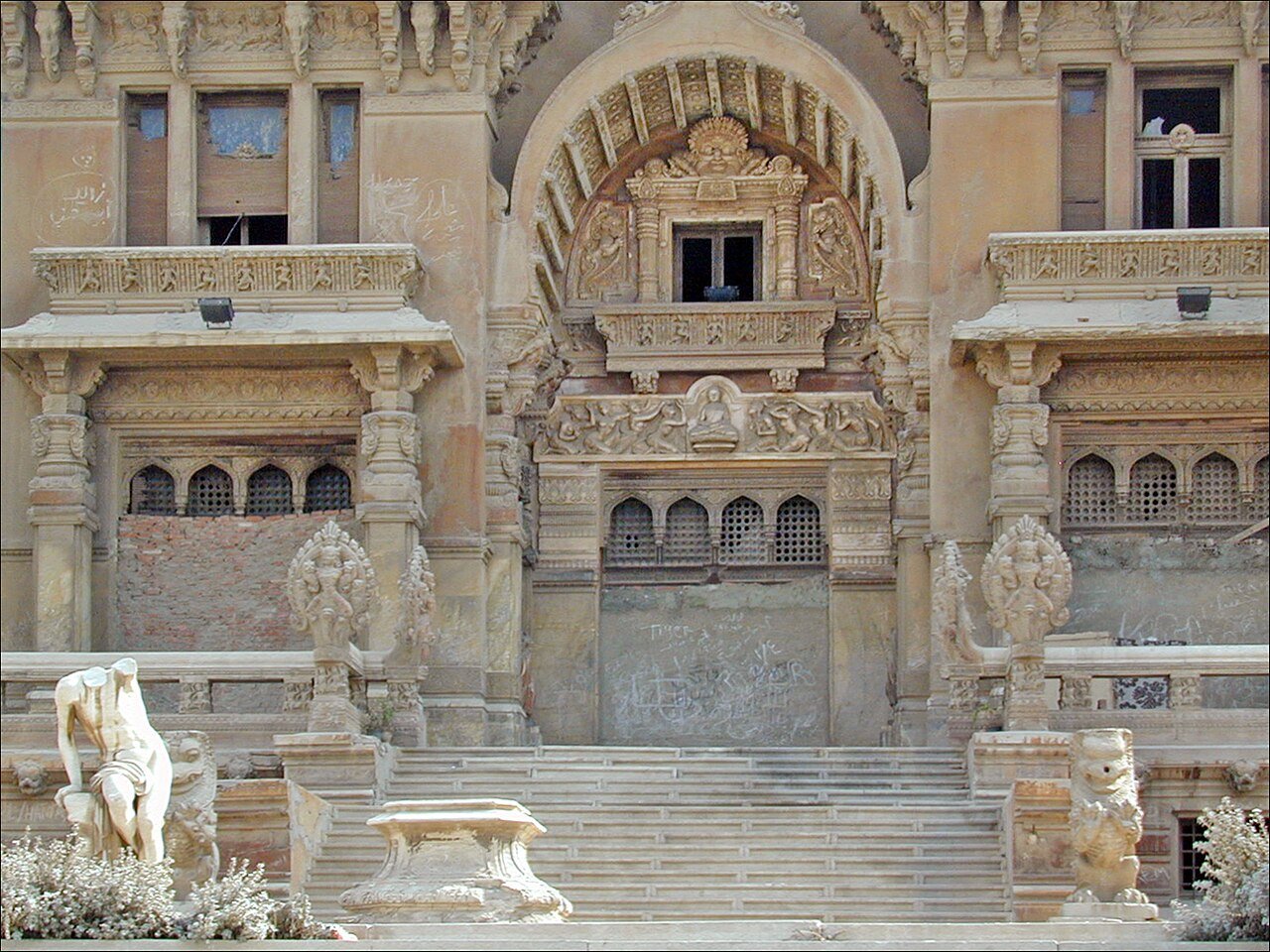
The suburb’s most theatrical building was Empain’s own residence. Designed by the French architect Alexandre Marcel and built between 1907 and 1911 in reinforced concrete, the Baron Empain Palace abandoned the Moorish vocabulary of its surroundings altogether, looking instead to the Hindu temples of Angkor in Cambodia and Orissa in eastern India. Around it rose landmarks such as the Heliopolis Palace Hotel — later a presidential residence — and the Basilica.
Downtown Cairo had a different and earlier origin. Inspired by a visit to Paris, Khedive Isma’il commissioned French planners in the 1860s and 1870s to lay out a gridded, European-style quarter west of the medieval city, complete with broad boulevards and squares. Over the following decades, and especially in the 1920s and 1930s, its plots filled with Belle Époque and Art Déco apartment houses, making the area around Talaat Harb and Qasr el-Nil the commercial and social heart of modern Cairo.
What you see
The Baron Empain Palace is the unmistakable set piece. Its towers step upward like the prasat of a Khmer temple, their surfaces crowded with carved figures — statues evoking Buddha, Shiva and Krishna — that have nothing to do with Egypt and everything to do with the eclectic appetites of the European Belle Époque. In the surrounding streets of Heliopolis the mood changes completely: long colonnaded arcades, horseshoe arches and patterned masonry give the planned avenues their distinctive Moorish-tinged uniformity.
Downtown, the texture is European rather than oriental. Talaat Harb and Qasr el-Nil are lined with five- and six-storey apartment blocks whose facades carry Beaux-Arts cornices, wrought-iron balconies and, on the later buildings, the streamlined geometry of Art Déco. The Baron Empain Palace is open to visitors as a museum; Heliopolis and downtown are best experienced on foot, looking up at the upper storeys where the original detailing survives.
Practical information
- The Baron Empain Palace, acquired by the Egyptian state and classified as a historic monument, is open to the public as a museum following its restoration; check current opening days and ticket prices before visiting.
- Allow roughly an hour for the palace and its grounds, including the rooftop and basement levels.
- Heliopolis and Downtown Cairo are separate districts about ten kilometres apart — treat them as two half-day walks rather than a single itinerary.
- Wear comfortable shoes: both quarters reward slow walking and looking upward at facades and arcades.
- Photography of building exteriors is generally welcome; interior rules at the palace may vary.
Getting there
Most visitors arrive through Cairo International Airport (CAI), which sits close to Heliopolis on the city’s northeast side — the Baron Empain Palace is only a short taxi ride from the terminals. Downtown Cairo is reached most easily by the Cairo Metro, with central stations a short walk from Talaat Harb Square; trams, buses and taxis connect the two districts across the city.
Related in CHO
- Paris — Belle Époque, Art Nouveau & Modernism
- Buenos Aires — Belle Époque, Art Déco and the Paris of South America
- Casablanca — Art Déco and the Mauresque City
Sources
_(6933684634).jpg)
Find it on the map
See this place and what’s around it →Record researched and written by Luigi De Marchi for Cultural Heritage Online, 2026.
📷 Become a Cultural Heritage Online photographer
Share your photos of places: they stay published under your name as the author. The more they're seen, the more you get noticed — and soon a contest will reward the most appreciated photos.
Log in or sign up free to add a photo