
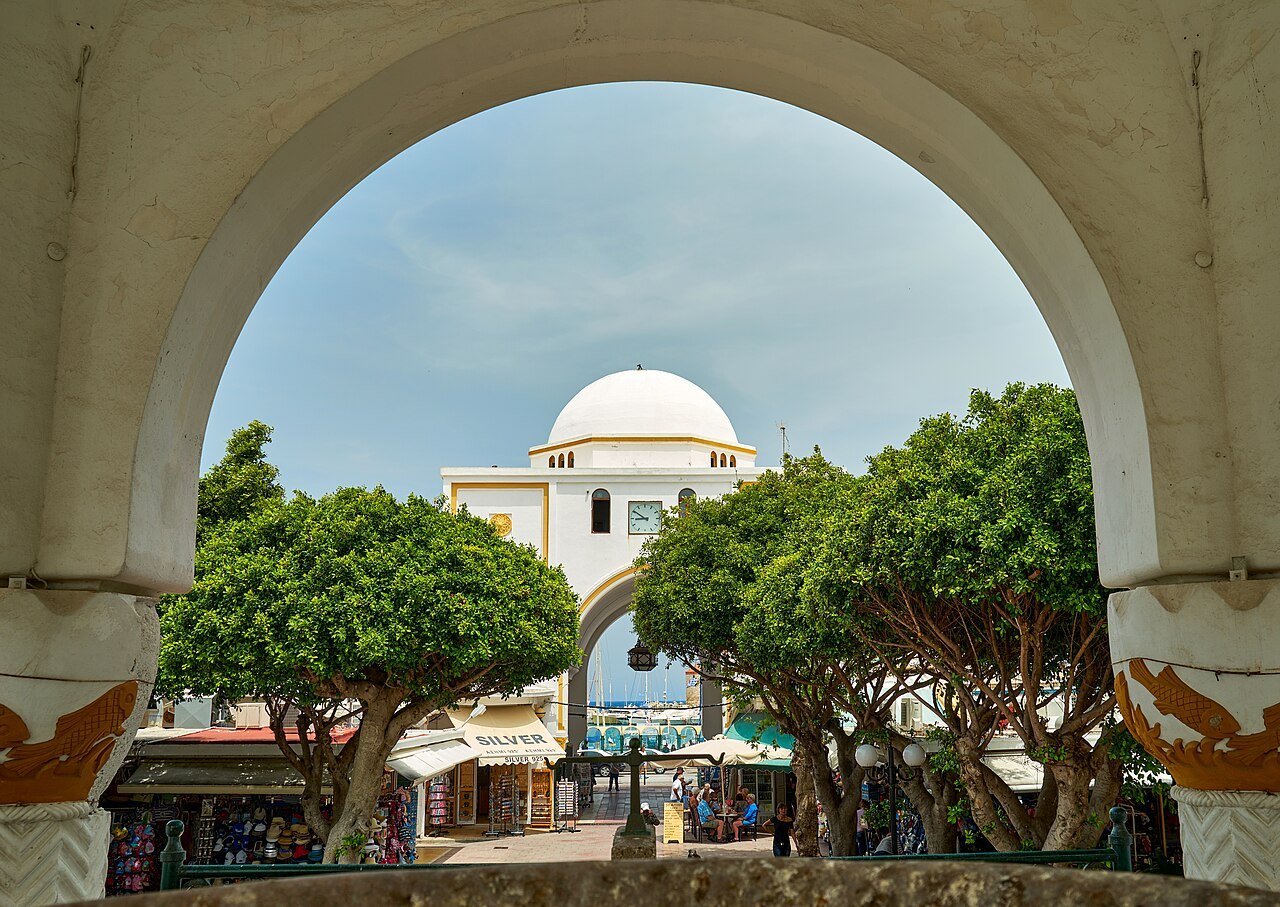
For three decades Italy ran Rhodes as the capital of its Aegean islands, lining the Mandraki harbour with palaces, markets and churches. The waterfront it built still defines the modern city.
At a glance
Rhodes is the largest of the Dodecanese islands and their historic capital. Italy took the island from the Ottoman Empire in 1912 and held it until September 1943, governing the whole archipelago from here as the Italian Islands of the Aegean. The medieval walled city of the Knights survived almost untouched, because the Italian administration chose to build its own quarter just outside the walls. Along the Mandraki harbour rose the Foro Italico: a planned ensemble of government buildings, a covered market, churches, a grand hotel and a theatre. Designed largely between the mid-1920s and the late 1930s, this waterfront is one of the most complete colonial-era townscapes left anywhere in the Mediterranean.
Key facts
- Country: Greece (Italian-administered 1912–1943)
- Key period: 1920s–1930s
- Key architect: Florestano Di Fausto (1890–1965), city planner and lead designer from 1923
- Style: eclectic colonial — Venetian Gothic, Ottoman and Renaissance motifs, shifting to stripped Rationalism by the late 1930s
- Essential sites: Governor’s Palace (Palazzo del Governo), New Market (Nea Agora), Grande Albergo delle Rose, Evangelismos church, Teatro Puccini
History
Italian troops landed on Rhodes in 1912 during the war with the Ottoman Empire, and the island remained under Italian control for the next thirty-one years. Rhodes became the capital of the Italian Islands of the Aegean, a possession that grouped the Dodecanese under a single governor. The administration set out to remake the modern town while leaving the famous walled city of the Knights as a preserved monument.
The decisive figure was the architect Florestano Di Fausto, born near Rome in 1890. He began working for the governor in 1923 and produced a city plan, completed in early 1926, that pushed new development into the Mandraki zone north of the walls, laid out partly as a garden city. Under governor Mario Lago the building programme was generous and outward-looking; the buildings borrowed freely from Venetian, Ottoman and Renaissance sources rather than imposing a single style. The Governor’s Palace of 1926 was modelled on the Doge’s Palace in Venice, in white and pink stone.
The mood hardened under Cesare Maria De Vecchi, governor from 1936 to 1940, who pressed a more aggressive fascist policy and made Italian compulsory in schools. Architecture followed: the Teatro Puccini of 1937 and the Casa del Fascio of 1939, the latter now the city hall, carry the stripped monumental language of late-1930s Italian Rationalism. Italian rule ended in September 1943 after the Armistice of Cassibile; German forces then occupied the islands, which were not finally settled until the war’s end.
What you see
The best way to read Italian Rhodes is to walk the Mandraki waterfront from north to south. The Governor’s Palace presents a pale arcaded front that deliberately echoes Venice, a reminder of the Knights and of Italy’s claim to Mediterranean heritage. A short distance away the New Market, a large polygonal arcade around an open court, leans the other way, towards an Oriental idiom of pointed arches and a central pavilion. Nearby stands the church of the Annunciation, the Evangelismos, rebuilt by Di Fausto in 1924–25 as the Catholic cathedral of Saint John and now the largest Greek Orthodox church in the city.
Further along the seafront the Grande Albergo delle Rose, designed by Di Fausto with Michele Platania, blends Arab, Byzantine and Venetian motifs into a single resort palace; it now houses a casino. Set back from the water, the Teatro Puccini and the former Casa del Fascio show the later, harder Rationalist phase. Most of these buildings remain in daily use, so the ensemble reads less as a museum than as a working civic centre that happens to date from the colonial decades.
Practical information
- Setting: the Italian-era buildings line the Mandraki harbour, an easy flat walk from the medieval Old Town.
- Access: exteriors are visible at any time; the New Market and waterfront are public and busy day and night.
- Interiors: the Evangelismos church is open to visitors; the Albergo delle Rose operates as a casino.
- Time needed: allow two to three hours to walk the waterfront and connect it to the Old Town.
- Best light: late afternoon, when the stone fronts face the western sun.
Getting there
Rhodes is reached by air through Diagoras International Airport (RHO), about 14 km southwest of the city, with frequent connections to Athens and seasonal flights across Europe. Ferries link Rhodes to Piraeus and to neighbouring Dodecanese islands, docking close to the Mandraki harbour where the Italian buildings stand. From the port or the airport bus, the waterfront ensemble and the Old Town are within walking distance of each other.
Related in CHO
- Asmara — Africa’s Modernist City and Italian Rationalism
- Tripoli — Italian Colonial Architecture on the Mediterranean
- Rome — Liberty Romano, EUR and Italian Rationalism
Sources
Find it on the map
See this place and what’s around it →📷 Become a Cultural Heritage Online photographer
Share your photos of places: they stay published under your name as the author. The more they're seen, the more you get noticed — and soon a contest will reward the most appreciated photos.
Log in or sign up free to add a photo