
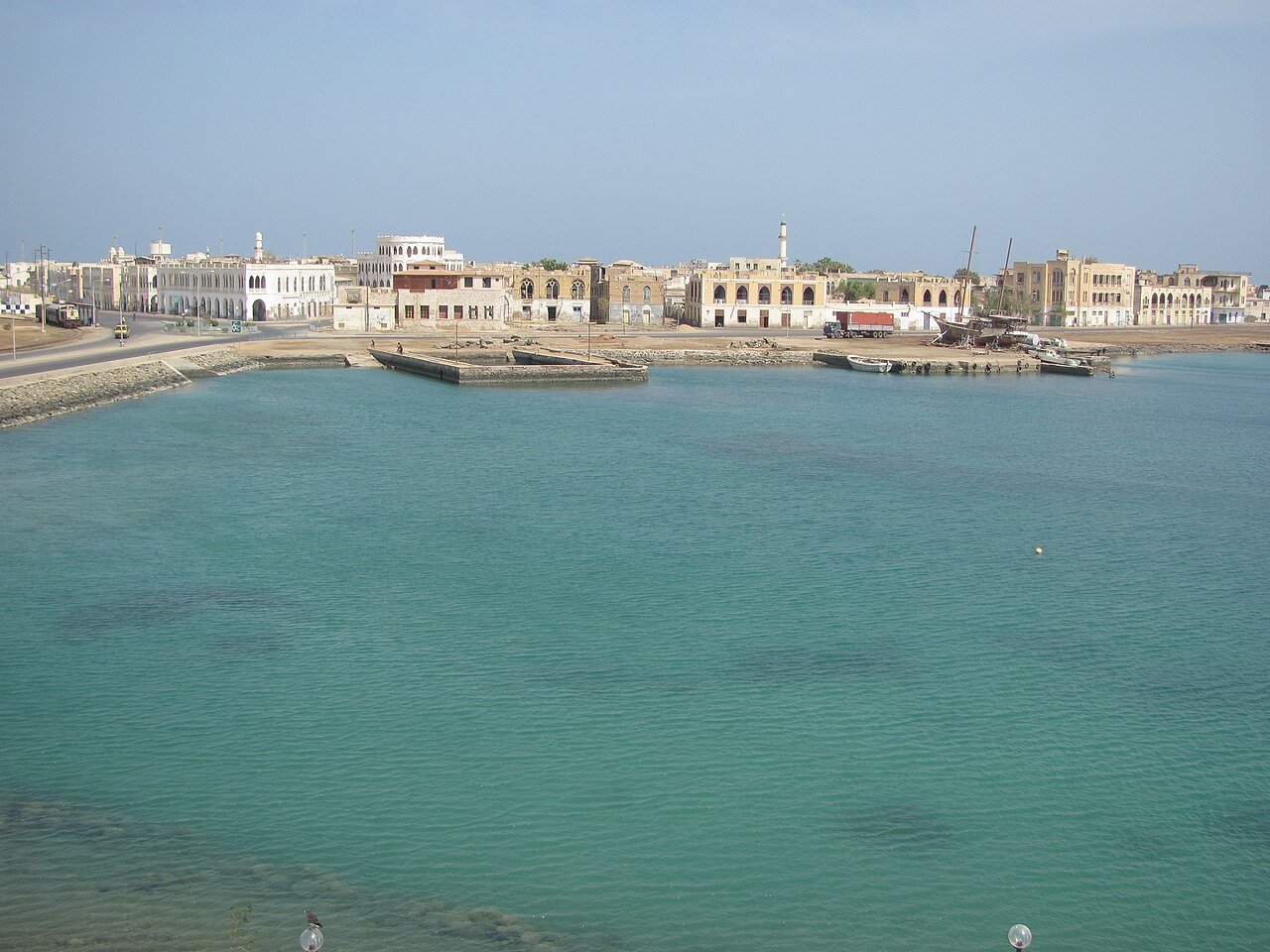
A coral-island port on the Red Sea, Massawa layers Ottoman, Egyptian and Italian colonial architecture across two islands joined by causeways. War in 1990 left much of the old town in ruins.
At a glance
Massawa stands on the Eritrean coast at the northern end of the Gulf of Zula, beside the Dahlak Archipelago. Its historic core occupies two islands, Basé and Taulud, linked to each other and to the mainland by causeways. The town passed through Ottoman, Egyptian and Italian hands, and each left its mark: coral-stone houses with carved wooden balconies, mosques, a cathedral, and the administrative buildings of Italy’s first East African colony. From 1885 to 1897 Massawa served as the capital of Italian Eritrea before the seat of government moved inland to Asmara. Much of the old town was damaged during the 1990 fighting for Eritrean independence.
Key facts
- Country: Eritrea
- Key periods: Ottoman/Egyptian, Italian colonial
- Essential sites: historic center on Basé island; the former Banca d’Italia (1920s); the Imperial Palace (1872–1874); Sheikh Hanafi Mosque (15th century); St. Mary’s Cathedral
- Capital of Italian Eritrea: 1885–1897
- Population: about 53,000 (2012)
History
Massawa is an old Red Sea trading station. The Ottoman Empire captured it in 1557 and, under Özdemir Pasha, tried to make it the capital of the Habesh Eyalet. In May 1865 the town came under the rule of the Khedive of Egypt, with Ottoman consent, and it was during this Egyptian period that the Imperial Palace was built, between 1872 and 1874, for the colonial administrator Werner Munzinger. The same palace would later serve as a winter residence for Emperor Haile Selassie.
In February 1885 Italy seized Massawa, with British acquiescence. When the Colony of Eritrea was formally established on 1 January 1890, Massawa was its principal port and served as the capital of the Italian governor from 1885 until 1897. In 1897 Governor Ferdinando Martini moved the colonial administration from the hot, low-lying coast up to Asmara in the highlands. Massawa nonetheless remained the colony’s maritime gateway, and infrastructure followed: a railway reached Sa’ati in 1888 and climbed to Asmara by 1911, later joined by an aerial cableway that was among the longest of its day before the British dismantled it as war reparations.
The town’s most violent chapter came at the end of the twentieth century. In February 1990, during Operation Fenkil, the Eritrean People’s Liberation Front captured Massawa. In response, the forces of Mengistu Haile Mariam shelled and bombed the town, destroying much of it. The scars of that bombardment remain visible in the ruined facades of the old center.
What you see
The historic core on Basé island reads as a palimpsest of empires. Coral-stone buildings carry carved wooden balconies and shuttered windows in the Ottoman–Egyptian manner, set among mosques such as the 15th-century Sheikh Hanafi Mosque and the Grand Mosque. The Italian period added administrative and commercial buildings, most notably the former Banca d’Italia of the 1920s, alongside St. Mary’s Cathedral. Across the water on Taulud island stands the Imperial Palace of the 1870s, its arcaded bulk a landmark of the earlier Egyptian era.
Today much of this fabric survives as a striking, partly ruined townscape rather than a restored monument zone. Visitors walking the old town encounter intact buildings beside shells left by the 1990 bombardment, the two states held side by side. The causeways linking Basé, Taulud and the mainland make the historic islands easy to cover on foot.
Practical information
- Eritrea requires foreign visitors to hold valid entry documents, and internal travel outside the capital can require an official travel permit; check current rules before visiting Massawa.
- The historic center is concentrated on Basé and Taulud islands, walkable via the connecting causeways.
- Many old-town buildings remain war-damaged; treat ruined structures with caution.
- The coastal climate is hot and humid for much of the year; the cooler months are more comfortable for walking the town.
- From Massawa, ferries run to the Dahlak Islands.
Getting there
Massawa lies on the Red Sea coast and is reached overland from the highland capital, Asmara, by the road that descends from the plateau to the coast; the historic Asmara–Massawa railway follows a similar route. Massawa International Airport serves the city by air, and the port itself functions as a working harbor with a naval base and dhow docks.
Related in CHO
- Asmara — Africa’s Modernist City and Italian Rationalism
- Tripoli — Italian Colonial Architecture on the Mediterranean
- Rome — Liberty Romano, EUR and Italian Rationalism
Sources
Find it on the map
See this place and what’s around it →


📷 Become a Cultural Heritage Online photographer
Share your photos of places: they stay published under your name as the author. The more they're seen, the more you get noticed — and soon a contest will reward the most appreciated photos.
Log in or sign up free to add a photo