
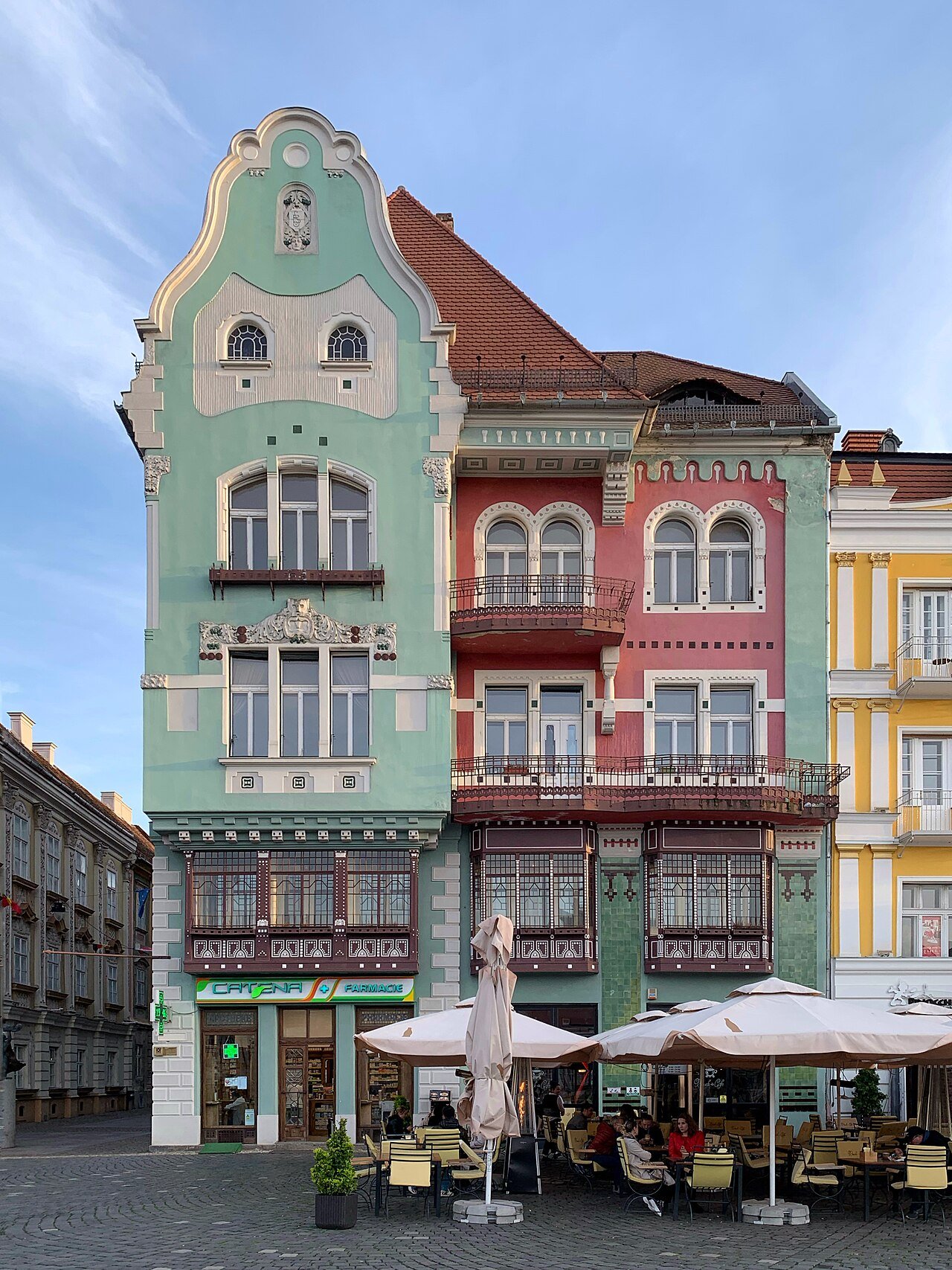
In the old Austro-Hungarian Banat, Timișoara built a dense early-twentieth-century city of Secession palaces. Its squares and outer districts still carry the ceramic and stucco vocabulary of that boom.
At a glance
Timișoara is, alongside Oradea, one of Romania’s two cities on the Art Nouveau European Route. Between 1900 and 1914, during the late decades of Austro-Hungarian rule, the city grew quickly in population and wealth, and a generation of architects clad its central square and its suburbs in the Secession idiom imported from Vienna and Budapest. The most prolific of them, László Székely, served as the city’s chief architect from 1903 to 1922 and signed a long series of apartment palaces and public buildings. The result is not a single monument but an ensemble: facades with undulating contours, glazed bow windows, floral stucco and tiles carrying Hungarian folk motifs, scattered across Piața Unirii and the Fabric and Iosefin districts.
Key facts
- Country: Romania
- Key period: 1900–1914
- Architect: László Székely (1877–1934), chief architect of Timișoara 1903–1922
- Essential sites: Piața Unirii (Brück House), Lloyd Palace on Piața Victoriei, the Fabric & Iosefin districts
- Recognition: Art Nouveau European Route (with Oradea)
History
Timișoara fell to the Habsburgs in 1716, after which the city was rebuilt and gradually opened to settlers from across the empire. The decisive phase for its architecture, however, came later. Under the Dual Monarchy established in 1867, the city entered a period of fast economic and demographic growth, and by the turn of the century it had the capital and the confidence to remake its streets in stone.
The man who shaped much of that remaking was László Székely, born in 1877 and educated in Budapest, where he absorbed the Hungarian Szecesszió and a lasting admiration for Austrian architecture. Appointed chief architect of Timișoara in 1903, he held the post until 1922 and produced a sequence of buildings that defined the city’s pre-war face. His Ștefania Palace went up in 1908–1909; the Hilt-Vogel and Széchényi palaces followed in 1911–1913; and the Neptune Public Bath, with its tiled interiors, was built between 1912 and 1914. On the central square he collaborated with Arnold Merbl on the Brück House of 1910–1911, today the most photographed Secession facade in the city.
The First World War closed the boom. Székely continued to work afterwards in a quieter register — the Palace of the Chamber of Commerce and Industry was completed in 1925, and the Hungarian House, his last building, in 1929–1930 — but the concentrated Secession era belongs to the years before 1914. In 1920 Timișoara passed from Hungary to Romania, and the Austro-Hungarian city it had been survived chiefly in its architecture.
What you see
The clearest single statement is the Brück House on Piața Unirii. Built by Székely and Merbl in 1910–1911 for the merchant Salamon Brück — whose initials sit in the pediment — it stacks four storeys behind a facade of ceramic tiles drawn from Hungarian folklore, with closed, glazed balconies on the first floor and a bow window rising across two levels. A short walk away, on Piața Victoriei, the Lloyd Palace by Lipót Baumhorn (1910–1912) closes one side of the square with rounded corners, statues and bas-reliefs that mix eclectic and Vienna Secession motifs.
Beyond the central squares, the Secession spreads into the outer districts. Fabric (the former Gyárkülváros, the “factory suburb”) and Iosefin (Józsefkülváros) preserve street after street of apartment houses from the same decades, less grand than the palaces but built in the same vocabulary of stucco garlands and tiled accents. Walking these neighbourhoods, rather than ticking off named monuments, is the way to read Timișoara as a complete turn-of-the-century city.
Practical information
- Most Secession facades are private apartment buildings or shops — admire them from the street rather than expecting interior access.
- The Brück House ground floor operates as a pharmacy and can be entered during business hours.
- Piața Unirii and Piața Victoriei are a few minutes apart on foot in the pedestrian centre.
- The Fabric and Iosefin districts reward an unhurried walk; allow a half-day to combine them with the central squares.
- Diacritics matter locally: the city is Timișoara, the main square Piața Unirii.
Getting there
Timișoara is served by Traian Vuia International Airport (IATA code TSR), a short drive northeast of the centre, with connections to several European hubs. The city is also a major railway junction in western Romania, with direct trains from Bucharest and cross-border services toward Hungary; the central squares are within walking distance of the main station.
Related in CHO
- Oradea — Romania’s Art Nouveau Capital
- Budapest — Ödön Lechner and the Hungarian Szecesszió
- Subotica — The Hungarian Secession in the Vojvodina
Sources
Find it on the map
See this place and what’s around it →Record researched and written by Luigi De Marchi for Cultural Heritage Online, 2026.
_-_IMG_01.jpg)
📷 Become a Cultural Heritage Online photographer
Share your photos of places: they stay published under your name as the author. The more they're seen, the more you get noticed — and soon a contest will reward the most appreciated photos.
Log in or sign up free to add a photo