
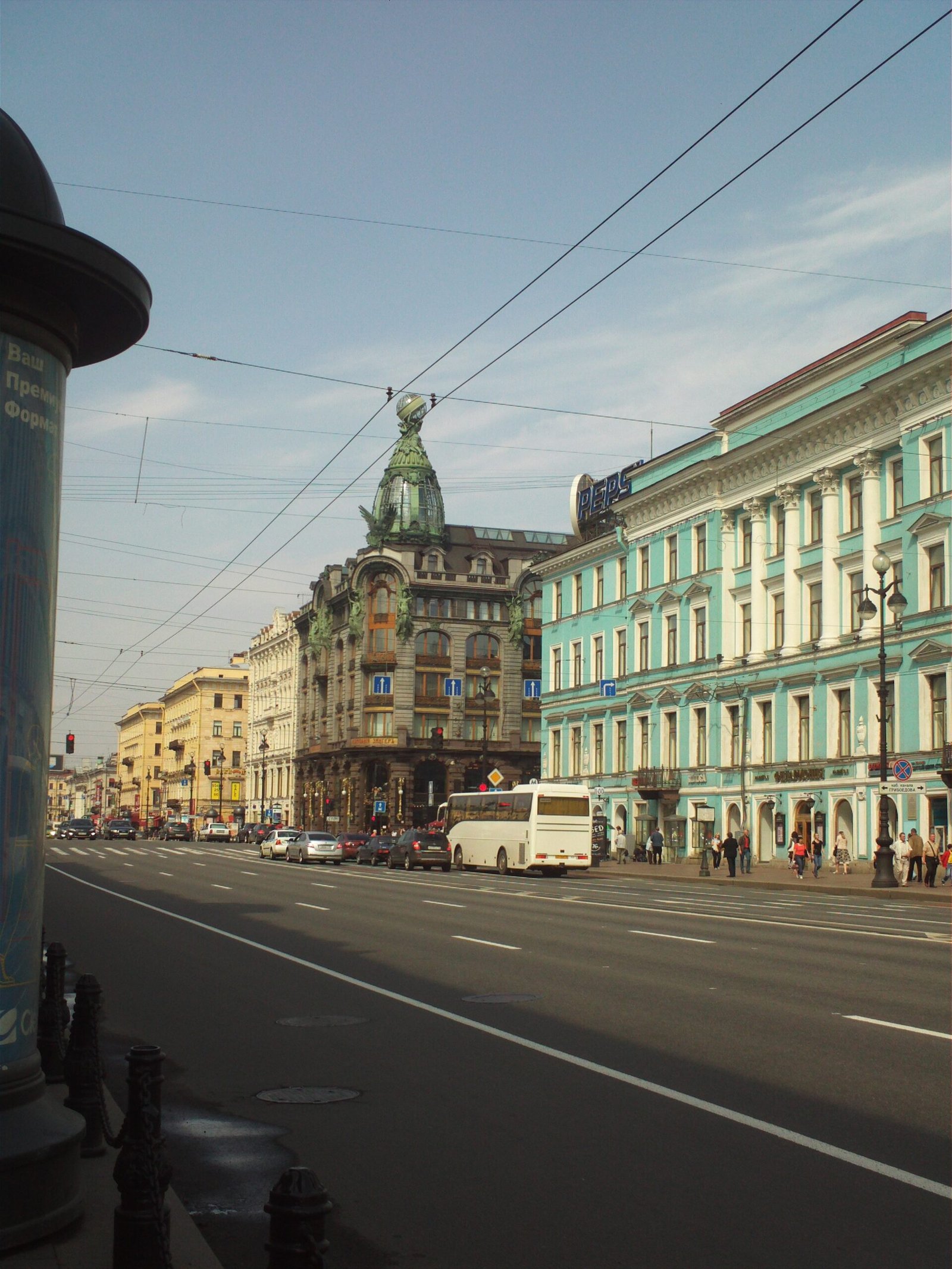
Built for the Singer Manufacturing Company on Nevsky Prospekt, this six-storey Style Moderne building is crowned by a glass globe that has guided St Petersburg readers to Dom Knigi for over a century.
At a glance
Designed by Pavel Yulievich Suzor and completed in 1904, Singer House stands at Nevsky Prospekt 28, directly opposite the Kazan Cathedral. The building pioneered metal-frame construction in the city and answered St Petersburg’s strict 23.5-metre cornice limit with a glass-and-iron tower that draws the eye skyward. Since 1919 it has housed a celebrated bookshop: the Soviet state assigned the building to Petrogosizdat, the state publishing house, that year, and the landmark Dom Knigi — House of Books — identity took shape by 1938.
Key facts
- Architect: Pavel Yulievich Suzor (Pavel Syuzor)
- Client: Singer Manufacturing Company (US sewing-machine firm)
- Built: 1902–1904
- Address: Nevsky Prospekt 28, Saint Petersburg, Russia
- Style: Russian Style Moderne (Northern Art Nouveau)
- Structural innovation: one of Saint Petersburg’s first metal-frame commercial buildings
- Current use: Dom Knigi bookshop (ground floor & upper floors) with Café Singer on the upper level
History
In 1902 the Russian branch of the Singer Manufacturing Company paid approximately one million rubles for the plot at Nevsky Prospekt 28, one of the most commercially coveted addresses in the Russian Empire. The American sewing-machine giant — then dominant across European markets — wanted a building that would function simultaneously as its regional headquarters and as a monumental advertisement for the brand. It engaged Pavel Yulievich Suzor, the leading Petersburg architect of the day and a master of large commercial commissions, to design it.
Suzor faced an immediate constraint. Saint Petersburg’s building code, in place to protect the visual dominance of the Winter Palace, prohibited any structure from exceeding 23.5 metres at the cornice line. Rather than surrendering to that limit, Suzor turned it into a formal gesture: he kept the six-storey facade within regulation height, then placed a glass-and-iron tower above the cornice that lifted the building’s silhouette without technically violating the rule. The tower is capped by a glass globe about 2.8 metres in diameter — a beacon visible from far along Nevsky Prospekt and, by night, illuminated from within. The sculpture atop the globe is attributed to Amandus Adamson, the Estonian sculptor who contributed decorative work to several landmarks of the Russian capital.
The building was completed in 1904. Structurally it was ahead of its time for Saint Petersburg: Suzor employed a metal frame rather than load-bearing masonry walls, allowing the broad shop windows and the open, light-filled interior that Singer’s retail strategy required. The ornate facade — curves, atlantes, gilded detailing, and art glass — placed the building firmly within the vocabulary of Style Moderne, the Russian inflection of the wider Art Nouveau movement then sweeping European commercial architecture from Brussels to Riga.
Singer used the building as its Russian commercial base until the First World War, during which the American Embassy briefly occupied the upper floors. After the October Revolution of 1917, the Soviet state nationalised the property. In 1919 it was assigned to Petrogosizdat, the state publishing house, and the ground-floor retail space was converted into a bookshop. The landmark name Dom Knigi — House of Books — became established by 1938. The bookshop has operated continuously ever since, surviving the Siege of Leningrad and the Soviet decades to remain one of the largest and most visited book retailers in Russia.
What you see
The facade reads as a carefully layered composition: rusticated base, tall arched windows on the piano nobile, and paired caryatid figures flanking the upper storey. Suzor’s use of industrial steel allowed those windows to open wide without intermediate columns, flooding the interior with diffuse northern light. The corner turret, rising above the Griboyedov Canal junction, gives the building its distinctive silhouette — an anchor point on one of Europe’s great urban boulevards.
Step inside Dom Knigi today and the historic bones remain legible beneath the bookshelves: the iron structural elements are still visible in the vaulted ceiling of the ground floor, and the broad staircase retains its original detailing. Café Singer on the upper level looks directly across at the Kazan Cathedral’s colonnade — a view that has changed surprisingly little in a century of turbulent history.
Practical information
- Current use: Dom Knigi bookshop (books, maps, stationery, art prints) and Café Singer on the upper floor
- Open to the public: yes, no admission charge to browse
- Nearest metro: Nevsky Prospekt station (Lines 2 and 3), approximately 300 metres
- Recommended time: 30–60 minutes (bookshop) + café optional
- Note: the building exterior is best appreciated from across the Griboyedov Canal or from the steps of the Kazan Cathedral opposite
- Travel note: check your country’s current travel advisories for Russia before planning a visit.
Getting there
Singer House sits at Nevsky Prospekt 28, at the corner of the Griboyedov Canal embankment, a ten-minute walk from Palace Square. The nearest metro station is Nevsky Prospekt (exit onto Nevsky Prospekt, then walk roughly 300 metres toward the Kazan Cathedral and the Admiralty). Trams and trolleybuses along Nevsky Prospekt stop within a short walk; the building is impossible to miss — look for the glass globe above the roofline.
Nearby
- Kazan Cathedral — directly opposite across Nevsky Prospekt; the neoclassical colonnade frames Singer House in every view from the cathedral steps
- Church of the Saviour on Spilled Blood — 400 metres along the Griboyedov Canal embankment; the extravagant Russian Revival exterior is one of the city’s most photographed landmarks
- Nevsky Prospekt — the boulevard itself, running 4.5 km from the Admiralty to the Alexander Nevsky Monastery, concentrates an extraordinary density of Style Moderne and Neoclassical commercial architecture from the same era
- Stroganov Palace — 500 metres west on Nevsky Prospekt; a Rastrelli Baroque landmark now open as a branch of the Russian Museum
Sources
- Saint Petersburg Encyclopaedia (encspb.ru): Singer Company Building, entry 2804018583 — confirms architect P. Y. Suzor, address Nevsky Prospect 28, dates 1902–04
- saint-petersburg.com: Singer Company Building / Dom Knigi — cornice height regulation, metal-frame construction, post-1917 use as state bookshop
- expresstorussia.com: Dom Knigi and the Singer Building — glass globe attribution to Amandus Adamson, brief US Embassy occupation during World War I
- Liden & Denz Language Centre (lidenz.com): The History behind the Singer House — retail history, 1919 Dom Knigi conversion
- OpenStreetMap / Nominatim: GPS coordinates 59.9358726 N, 30.3258989 E, verified against Nevsky Prospekt 28
Find it on the map
See this place and what’s around it →Record researched and written by Luigi De Marchi for Cultural Heritage Online, 2026.
📷 Become a Cultural Heritage Online photographer
Share your photos of places: they stay published under your name as the author. The more they're seen, the more you get noticed — and soon a contest will reward the most appreciated photos.
Log in or sign up free to add a photoIs this page about you?
This page is read by travellers and heritage enthusiasts who find it on Google. Tell us how you are connected to this place and we will take it from there.