
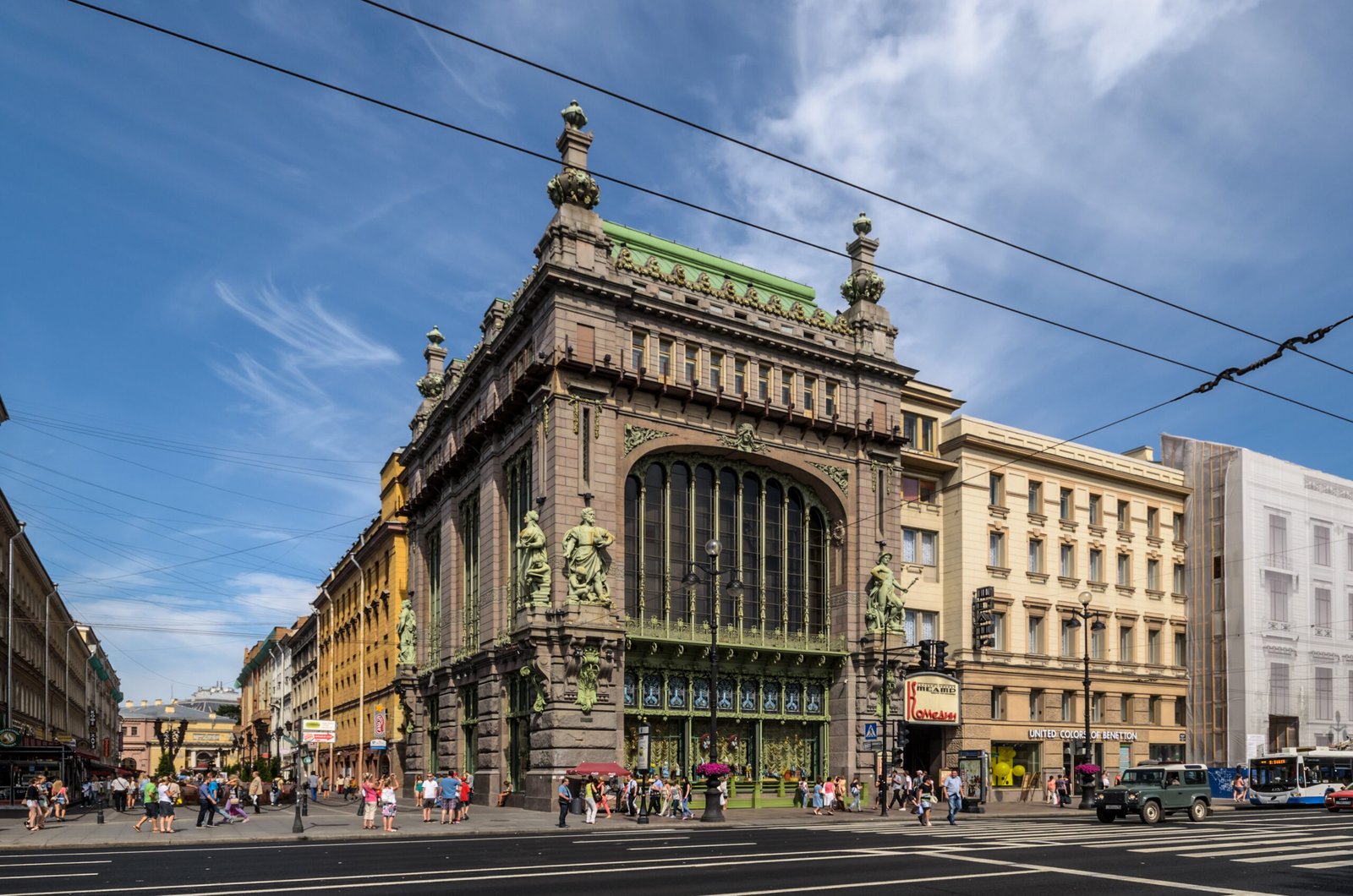
The most extravagant shop front on Nevsky Prospekt: a Style Moderne palace of glass, granite, and allegory built for the Yeliseyev merchant dynasty and still selling luxury food today.
At a glance
Designed by architect Gavriil Baranovsky and completed in 1903, the Yeliseyev Emporium at Nevsky Prospekt 56 is one of the boldest examples of Russian Style Moderne in Saint Petersburg. Its soaring plate-glass facade, ornate sculptural programme, and sumptuous interiors caused a sensation on opening and continue to draw visitors more than a century later. The building functions as a gourmet food hall and delicatessen, making it one of the few Art Nouveau commercial landmarks in Europe that remains in continuous retail use.
Key facts
- Address: Nevsky Prospekt 56, Saint Petersburg, Russia 191023
- Architect: Gavriil Vasilyevich Baranovsky (1860–1920)
- Construction: 1902–1903
- Style: Style Moderne (Russian Art Nouveau)
- Commissioned by: Grigory Grigoryevich Yeliseyev, of the Yeliseyev Brothers Trading House
- Current use: Yeliseyev Emporium — luxury food hall and delicatessen, open to the public
- Heritage status: Federal-level cultural monument, Russia
History
The Yeliseyev family fortune began with Pyotr Yeliseyev, a serf who purchased his freedom in the early nineteenth century and built a trading empire dealing in wines, spirits, and colonial goods. By the 1890s his descendants operated luxury emporiums in Saint Petersburg, Moscow, and Kiev, supplying the Russian court and urban elite with imported delicacies. When Grigory Grigoryevich Yeliseyev decided to replace the existing structure on Nevsky Prospekt 56 with a purpose-built flagship, he turned to Gavriil Baranovsky, a prolific Saint Petersburg architect whose output ranged from utilitarian warehouses to ambitious public buildings.
Construction proceeded between 1902 and 1903, an exceptionally short schedule for a project of this ambition. Baranovsky’s design was rooted in the Viennese and Belgian currents of Art Nouveau then sweeping European commercial architecture, but inflected with a distinctly Russian grandeur. The facade presented Nevsky Prospekt with three enormous plate-glass bays, at that time among the largest in the city, framed by stone piers encrusted with botanical ornament. Four allegorical sculptural groups crowning the roofline represented Industry, Trade, Art, and Science—a programme that consciously linked commercial enterprise to civilisation and progress, a rhetorical move typical of the merchant patronage of the period.
The interior matched the exterior in lavishness. Mosaic floors, gilded ceilings, stained-glass panels, and elaborate woodwork created an atmosphere closer to a palace reception room than a shop. Opening in 1903, the emporium was immediately controversial: critics accused the Yeliseyevs of vulgar ostentation, while the public was fascinated. The writer Maxim Gorky reportedly visited on opening day and left shaking his head; the diarists and memoirists of the Silver Age returned again and again to describe its excess.
After the Revolution of 1917, the Yeliseyev family lost the business and emigrated. The Soviet state renamed the premises Gastronom No. 1 and kept it as a high-grade food store—one of the few commercial interiors in Leningrad that retained its pre-revolutionary fittings, albeit reframed as a showcase of socialist abundance. Following the fall of the Soviet Union, the store returned to the Yeliseyev name and has since been restored and repositioned as a gourmet destination. The sculptural groups on the exterior were conserved and reinstated; the interior gilding was refreshed. Today the building is listed as a federal cultural monument.
What you see
The Nevsky Prospekt facade is dominated by three vast arched bays filled with plate glass, which flood the interior with light and make the building read almost as a lantern at night. The stone surround is carved with sinuous Art Nouveau foliage, and four large allegorical figures sit above the cornice line, each one representing a domain of human industry that the Yeliseyev family wished to associate with their enterprise: Industry, Trade, Art, and Science. The effect is simultaneously exuberant and monumental, a quality that distinguishes Russian Style Moderne from its more restrained Viennese or Scottish counterparts.
Inside, the main trading hall rises through two storeys beneath a coffered and gilded ceiling. Mosaic floors, oak counters, and stained-glass inserts survive from the original fit-out, restored during recent conservation campaigns. Display cases are stocked with imported cheeses, charcuterie, wines, and confectionery much as they would have been in 1903, while the mezzanine level now houses a restaurant. The spatial sequence from Nevsky Prospekt through the entrance vestibule and into the hall is deliberately theatrical, a spatial performance of wealth and taste.
Practical information
- Status: Open to the public as a functioning gourmet food hall and delicatessen
- Address: Nevsky Prospekt 56, Saint Petersburg 191023, Russia
- Nearest metro: Gostiny Dvor (Line 3), approximately 3 minutes on foot; or Nevsky Prospekt (Line 2), also within easy walking distance
- Typical visit time: 20–40 minutes to browse the hall; longer if dining in the restaurant
- Entry: Free to enter the food hall; purchases at retail prices
- Travel note: check your country’s current travel advisories for Russia before planning a visit.
Getting there
Yeliseyev Emporium sits at Nevsky Prospekt 56, between Mikhailovskaya Street and Italyanskaya Street, roughly at the midpoint of central Nevsky Prospekt. The closest metro station is Gostiny Dvor (Line 3, green), a three-minute walk east along the avenue; Nevsky Prospekt station (Line 2, blue) is also within easy walking distance. Numerous surface tram and bus routes run the length of Nevsky Prospekt. The building is immediately recognisable by its vast glass bays and allegorical roofline figures.
Nearby
- Nevsky Prospekt — the main artery of central Saint Petersburg, lined with nineteenth-century palaces, churches, and arcades within walking distance
- Alexandrinsky Theatre — Russia’s oldest dramatic theatre, a neoclassical landmark by Carlo Rossi, five minutes’ walk south on Ostrovsky Square
- Gostiny Dvor — Saint Petersburg’s historic trading arcade, an eighteenth-century neoclassical shopping gallery across the avenue
- Mikhailovsky Palace (Russian Museum) — Karl Rossi’s Empire-style palace housing the national collection of Russian art, ten minutes on foot via Arts Square
Sources
- Kirikov, B. M. Arkhitektura petersburgskogo moderna: osobnyaki i dokhodnye doma [Architecture of Petersburg Moderne]. Saint Petersburg, 2006. Standard scholarly reference on Baranovsky and Style Moderne in Saint Petersburg.
- Saint Petersburg Encyclopaedia (Entsiklopediya Sankt-Peterburga) — entry on Yeliseyevsky magazin, confirming architect, date, and address. encspb.ru
- Russian Ministry of Culture heritage register — federal monument listing for Nevsky Prospekt 56. opendata.mkrf.ru
- Wikimedia Commons — File:Eliseevs’ House SPB 01.jpg, photo by Alex ‘Florstein’ Fedorov, CC BY-SA 4.0. commons.wikimedia.org
- OSM Nominatim — GPS coordinates verified for Nevsky Prospekt 56 (Дом торгового товарищества «Братья Елисеевы»): 59.9344141, 30.3378080.

Find it on the map
See this place and what’s around it →Record researched and written by Luigi De Marchi for Cultural Heritage Online, 2026.
📷 Become a Cultural Heritage Online photographer
Share your photos of places: they stay published under your name as the author. The more they're seen, the more you get noticed — and soon a contest will reward the most appreciated photos.
Log in or sign up free to add a photoIs this page about you?
This page is read by travellers and heritage enthusiasts who find it on Google. Tell us how you are connected to this place and we will take it from there.