
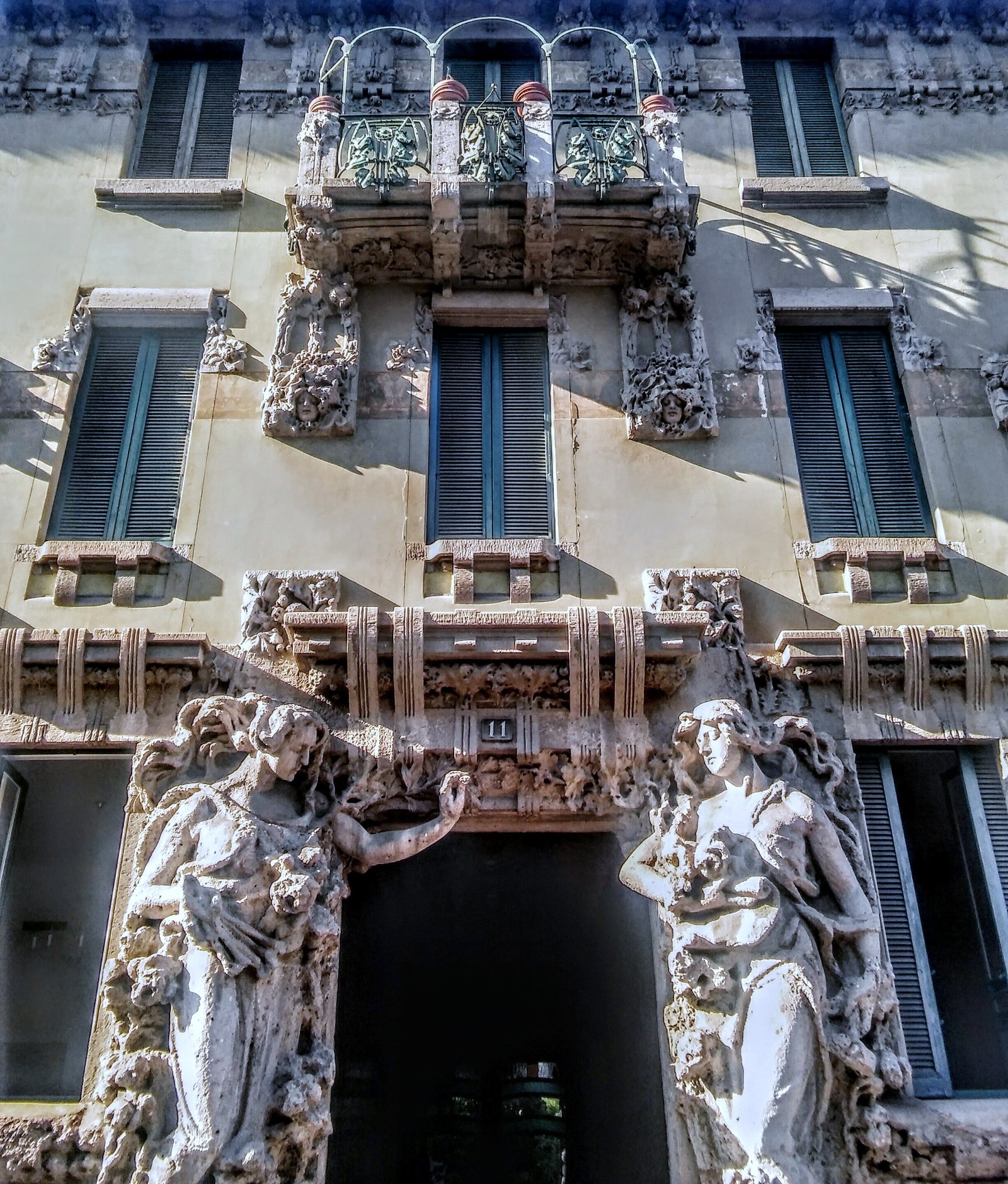
The building Alfredo Campanini designed for himself stands on Via Vincenzo Bellini 11 as one of the most assured statements of Milanese Liberty, completed between 1904 and 1906.
At a glance
Casa Campanini occupies a corner plot at Via Vincenzo Bellini 11 in central Milan, a block from the Scala opera house. Architect Alfredo Campanini built it as his own residence, giving himself the freedom to push every surface — portal, parapet, staircase — to its ornamental limit. Two allegorical figures in artificial stone frame the entrance. The wrought iron of the gate and railings, with its tangled floral vocabulary, is attributed to Alessandro Mazzucotelli, the leading ironsmith of Italian Art Nouveau. The facade has remained substantially intact since a careful restoration in the late twentieth century returned the ironwork to its original painted finish.
Key facts
- Architect: Alfredo Campanini (graduated Accademia di Brera, 1896; died 1926)
- Dates: 1904–1906
- Address: Via Vincenzo Bellini 11, 20122 Milan (corner of Via Livorno)
- Style: Liberty / Art Nouveau
- Sculptural decoration: Michele Vedani (portal caryatids, interior stucco)
- Ironwork: Attributed to Alessandro Mazzucotelli
- Status: Private residence; listed heritage building (LMD80-00318)
History
Alfredo Campanini graduated from Milan’s Accademia di Brera in 1896 and spent the following decade absorbing the currents that were transforming European civic architecture. The decisive influence was close to home: Giuseppe Sommaruga’s Palazzo Castiglioni on Corso Venezia, completed in 1904, which demonstrated that a Milanese residential block could carry the full weight of sculptural ornament without structural apology. Campanini took the lesson and applied it, with comparable ambition, to a smaller scale.
Construction of his own house began in 1904 and was finished by 1906. For the portal sculptures Campanini turned to Michele Vedani, a decorative sculptor whose two allegorical figures — representing Painting and Sculpture — stand in artificial stone and merge seamlessly into the facade cladding on either side of the entrance. The wrought iron elements, including the entrance gate, parapets, and secondary railings, are attributed to Alessandro Mazzucotelli, whose Milan workshop was the pre-eminent supplier of ornamental ironwork in the peninsula during the Art Nouveau years. Mazzucotelli’s characteristic language — tendrils and blossoms that seem to grow rather than be forged — appears here in the gate’s interlaced stems and in the stair banisters visible through the atrium glass.
The building remained a private residence after Campanini’s death in 1926. A restoration completed in the late twentieth century addressed the ironwork in particular, returning it to its original painted patina. The facade’s polychrome stained glass and surface stucco, both designed by Campanini himself, were also stabilised during that campaign. Casa Campanini is catalogued in the Lombardia Beni Culturali register (LMD80-00318) and stands as one of the defining examples of Milanese Liberty alongside the buildings Campanini himself designed on Via Carlo Pisacane between 1904 and 1907.
What you see
From the pavement on Via Vincenzo Bellini the eye is drawn first to the portal, which rises well above the ground floor cornice line. Vedani’s two caryatid-like figures bracket the opening: they are not structural in any literal sense but carry the optical weight of the archway on either side, their drapery dissolving upward into the stucco foliage of the spandrels. The artificial stone Vedani used has a warm buff tone that reads differently from the rendered facade surfaces around it. At street level, daylight catches the deep relief of stems and petals; in the late afternoon the shadows deepen and the ornament flattens into near-silhouette.
The ironwork attributed to Mazzucotelli is most legible at the entrance gate and the first-floor balcony parapet. Stems branch and re-branch without ever resolving into symmetry; the forging shows hammer marks at close range. A late-twentieth-century restoration brought back the painted ironwork finish that earlier decades of grime had obscured. Inside the atrium, visible through the glass door, the staircase banisters continue the same vocabulary at a finer gauge, and polychrome stained glass panels designed by Campanini cast coloured light across the landing at midday.
Practical information
- Access: Private residence; not open to the public. The facade, portal sculptures, and entrance ironwork are fully visible from the street.
- Best time to visit: Morning or late afternoon for raking light on the ornamental reliefs.
- Time needed: 10–15 minutes for an exterior viewing and photography stop.
- Nearest metro: Montenapoleone (M3, yellow line), 5 minutes on foot.
- Admission: Free (exterior only).
Getting there
Via Vincenzo Bellini 11 sits in Milan’s Quadrilatero della Moda district, a short walk north of Piazza della Scala. From Montenapoleone metro station (M3, yellow line) walk west along Via Manzoni and turn left into Via Bellini; the building is on the left after about 250 metres. From Duomo (M1/M3) the walk takes around 12 minutes through Galleria Vittorio Emanuele II and Via Manzoni. Trams 1 and 2 stop on Via Manzoni within five minutes’ walk.
Nearby
- Palazzo Castiglioni — Corso Venezia 47-49; Sommaruga’s 1904 Liberty landmark that directly influenced Campanini’s design.
- Teatro alla Scala — Piazza della Scala; a five-minute walk from Via Bellini.
- Liberty Milano — Our guide to Milan’s full Art Nouveau trail, including Via Pisacane and other Campanini buildings.
- Galleria Vittorio Emanuele II — One of Europe’s great nineteenth-century shopping arcades, 10 minutes south on foot.
Sources
- Lombardia Beni Culturali, scheda LMD80-00318: lombardiabeniculturali.it
- Catalogo Generale Beni Culturali, LMD80-00318_R03: catalogo.beniculturali.it
- MuseoCity Milano — Casa Campanini: museocity.it
- Italy Segreta — Alfredo Campanini: italysegreta.com
- Wikimedia Commons, File:20160829 Casa Campanini facciata.jpg (CC BY-SA 4.0, Melancholia~itwiki): commons.wikimedia.org
Find it on the map
See this place and what’s around it →Record researched and written by Carla Szathvary for Cultural Heritage Online, 2026.



📷 Become a Cultural Heritage Online photographer
Share your photos of places: they stay published under your name as the author. The more they're seen, the more you get noticed — and soon a contest will reward the most appreciated photos.
Log in or sign up free to add a photoIs this page about you?
This page is read by travellers and heritage enthusiasts who find it on Google. Tell us how you are connected to this place and we will take it from there.