
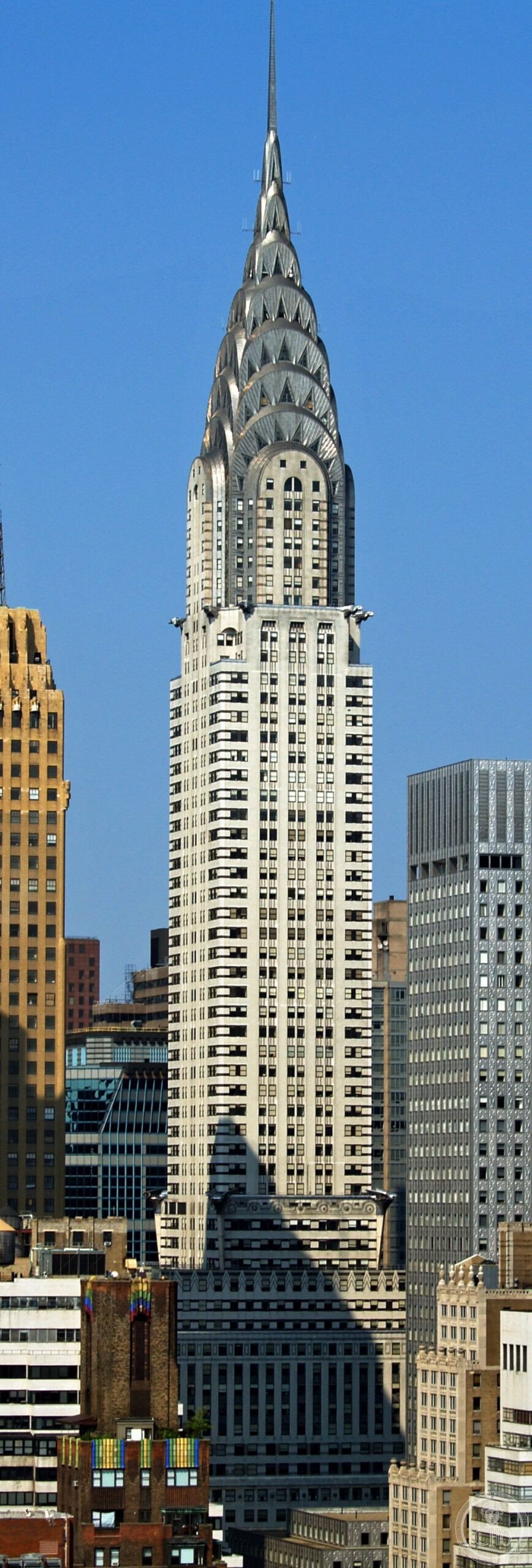
New York compressed the full arc from Gilded Age luxury to Art Déco verticality into a single generation. Louis Comfort Tiffany redefined glass as fine art for the city’s wealthiest patrons; thirty years later, William Van Alen’s Chrysler Building raised a stainless-steel crown over Midtown that still defines the skyline.
At a glance
New York’s contribution to the CHO period — roughly 1880 to 1940 — divides into two distinct aesthetic episodes. The first is the Gilded Age, when the industrial fortunes of the Vanderbilts, Morgans and Rockefellers produced a market for applied arts of extraordinary ambition. Louis Comfort Tiffany, trained as a painter but drawn to the expressive possibilities of leaded glass, became the supreme craftsman of that market: his lampshades, windows and ecclesiastical commissions transformed a workshop technique into a recognised art form. The second episode is Art Déco — the 1920s and 1930s expansion skyward that produced the Chrysler Building (1930), the Empire State Building (1931) and Rockefeller Center (1930–1939), a vertical archive of the most self-confident urban aesthetic of the modern century.
Key facts
- Country: United States of America (New York State)
- Key periods: Gilded Age (1870s–1900s), Art Déco (1920s–1940s)
- Key figure: Louis Comfort Tiffany (1848–1933) — glass designer, interior decorator, creator of the Tiffany lamp
- Essential sites: Metropolitan Museum of Art (American Wing / Tiffany collection), Chrysler Building, Empire State Building, Rockefeller Center, Seventh Regiment Armory (Veterans Room)
- Design legacy: Tiffany Studios operated until 1933; the lamp designs remain the most auctioned American decorative art objects
- Annual anniversaries: Tiffany nascita 18 febbraio, Tiffany morte 17 gennaio
History
Louis Comfort Tiffany was born in New York on 18 February 1848, the son of Charles Lewis Tiffany, founder of Tiffany & Co. He trained as a painter under George Inness and in Europe, but by 1878 had turned to interior decoration and glass. His early experiments with opalescent glass — a material he helped develop in collaboration with glassmaker John La Farge — produced windows of unprecedented tonal depth that eclipsed the flat painted glass of European Gothic revival. The Veterans Room at the Seventh Regiment Armory (1881, Park Avenue), designed with Stanford White, is the earliest surviving Tiffany interior accessible to the public.
Tiffany Studios, founded in Corona, Queens, in 1893, at its height employed 200 craftspeople and produced leaded windows, mosaics, lamps, vases and ecclesiastical metalwork. The Tiffany lamp — a bronze base with a leaded shade in nature-derived motifs (Wisteria, Dragonfly, Peony) — became the quintessential American Art Nouveau object. Tiffany died in New York on 17 January 1933, six months after the studios closed, unable to survive the Depression.
The Art Déco buildings of the following decade expressed a different New York ambition: corporate power rendered as vertical ornament. The Chrysler Building (1930, William Van Alen) used stainless steel for its crown and eagle gargoyles — automobile imagery in metal that read the building as a monument to machine-age modernity. The Empire State Building (1931, Shreve, Lamb & Harmon) followed within months, and the Rockefeller Center complex (1930–1939) integrated public plazas, murals, bas-reliefs and a skating rink into the most accomplished urban ensemble of the period.
What you see
The Metropolitan Museum of Art (1000 Fifth Avenue) holds the most important public Tiffany collection: the Charles Engelhard Court in the American Wing displays windows and architectural elements from Laurelton Hall, his Long Island estate demolished in 1957, including the extraordinary Wisteria window. The Seventh Regiment Armory (643 Park Avenue) hosts tours of the Veterans Room on certain weekends — the most intimate of surviving Tiffany interiors.
For Art Déco, the Chrysler Building lobby (405 Lexington Avenue) is freely accessible during business hours: African marble floors, amber-lit murals of transportation and industry, and elevator doors of inlaid wood veneer. The Empire State Building observation decks (34th Street entrance) require a ticket but reward with the complete Manhattan skyline. Rockefeller Center (45 Rockefeller Plaza) is best experienced as a public space — the sunken plaza, the Atlas sculpture, the NBC Studios tour — capped by the Rainbow Room observation experience at the top of 30 Rock.
Practical information
- Metropolitan Museum: suggested admission $30; closed Tuesday; metmuseum.org
- Chrysler Building lobby: free, open weekdays during business hours
- Empire State Building: observation deck tickets from $44; esb.com
- Rockefeller Center (Top of the Rock): tickets from $40; topoftherocknyc.com
- NYC Explorer Pass: bundles multiple attractions at a discount
- Time needed: 3 days minimum for Tiffany + Art Déco sites; 5 days for comfortable coverage
Getting there
John F. Kennedy Airport (JFK) is 24 km from Midtown; the AirTrain to Jamaica station connects to the E or J subway line to Manhattan (50 min total, $9.50 combined). LaGuardia (LGA, 13 km) has no direct rail link; taxi or rideshare is standard (30–60 min). Newark Liberty (EWR, New Jersey) offers the NJ Transit train to Penn Station (30 min, ~$17). All Art Déco sites are clustered in Midtown Manhattan, walkable between 34th and 53rd Streets.
Related in CHO
- Anniversario nascita: Louis Comfort Tiffany — 18 febbraio 1848
- Anniversario morte: Louis Comfort Tiffany — 17 gennaio 1933
- TEFAF New York 2026 (art fair event)
- Chicago — Wright, Mies and the Architecture of Modernity
Sources
Find it on the map
See this place and what’s around it →Record researched and written by Luigi De Marchi for Cultural Heritage Online, 2026.
Events here — now on & upcoming
- Birth Anniversary: Louis Comfort Tiffany — February 18, 184818 Feb 2027See the event →
- Death Anniversary: Louis Comfort Tiffany — January 17, 193317 Jan 2027See the event →
Historical events at this place (1)
- 2026 TEFAF New York 2026
📷 Become a Cultural Heritage Online photographer
Share your photos of places: they stay published under your name as the author. The more they're seen, the more you get noticed — and soon a contest will reward the most appreciated photos.
Log in or sign up free to add a photo