
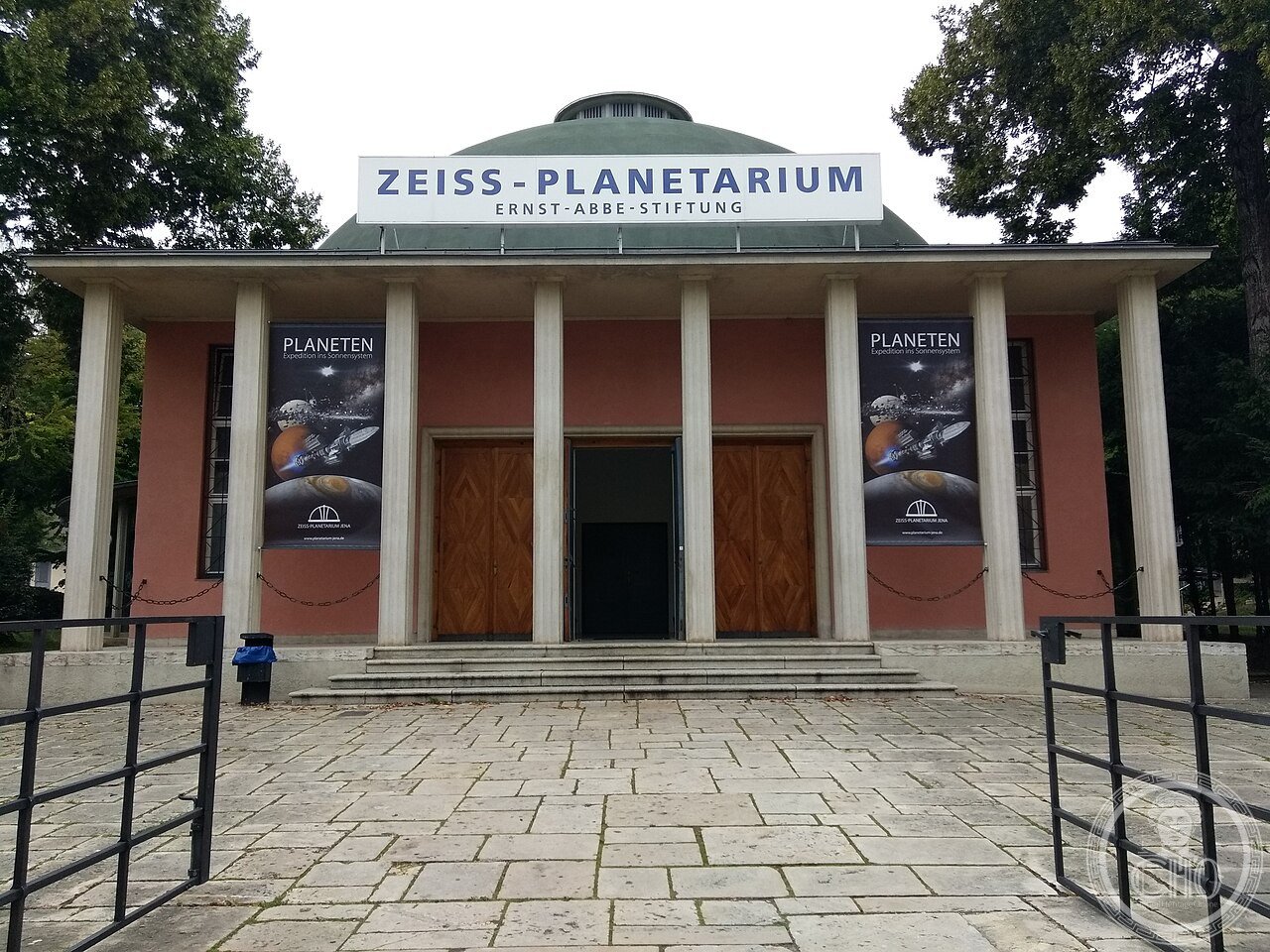
Zeiss Planetarium Jena
The world’s first public projection planetarium and the birthplace of the geodesic dome, built in 1926 by the Carl Zeiss optical company in Jena, Germany.
At a glance
- Type
- Planetarium
- Period
- 1926 (projector 1923)
- Style
- Art Deco / Industrial Modernism
- Location
- Am Planetarium 5, 07743 Jena, Thuringia, Germany
- Coordinates
- 50.9264 N, 11.5863 E
- Architect
- Walter Bauersfeld (Carl Zeiss Company engineer)
Overview
The Zeiss Planetarium in Jena is not only the world’s oldest continuously operating public planetarium, but also the site of one of the most underappreciated structural inventions of the 20th century: the geodesic dome. When engineer Walter Bauersfeld designed the 25-metre reinforced concrete dome in 1919 to house the first demonstration of the Zeiss star projector, he created a structural form that Buckminster Fuller would not popularize for another three decades. The Carl Zeiss Jena optical company had developed the mechanical planetarium projector in 1923; the Jena planetarium opened on 18 July 1926 to demonstrate the technology to the public. Both the engineering of the dome and the educational concept of the public planetarium were firsts in world architectural and scientific history.
History
The Carl Zeiss Foundation in Jena was the leading optical manufacturer in the world by the early 20th century, producing microscopes, camera lenses, and military optics. In 1913, Zeiss director Siegfried Czapski proposed building a device that could project the entire night sky onto an indoor dome ceiling. The project was paused by World War I but resumed in 1919 under engineer Walther Bauersfeld, who simultaneously solved the structural problem of how to build a dome large enough to contain the device. His solution — a lattice of small steel struts following a geodesic pattern, clad in thin concrete — was patented in 1922 and is now known as the geodesic dome. The Zeiss I projector was demonstrated on a temporary dome on the factory roof in 1923; the permanent public building opened in 1926. The planetarium survived World War II with minor damage and operated continuously through the East German period under VEB Carl Zeiss Jena. After reunification it was modernized but preserved in its historic form.
Architecture and Design
The dome is 25 metres in diameter and was constructed using Bauersfeld’s geodesic method: a lightweight steel lattice of triangulated struts, forming a hemispherical framework, covered by a thin shell of reinforced concrete approximately 3 centimetres thick. The result is a structure that is rigid despite its minimal material — the same principle later used for radar domes, aircraft hangars, and the Eden Project biomes. The exterior presents a clean industrial form, characteristic of Weimar-era modernism, with the dome sitting above a low rectangular base housing the public entrance and lobby. Inside, the curved ceiling serves as the projection surface for the planetarium system. The Zeiss Mark III and later projectors have been installed over the decades; the current installation can project approximately 9,000 stars at once.
Cultural significance
The Zeiss Planetarium Jena holds a dual importance that is unusual for a single building. Structurally, it is the origin of the geodesic dome, a form that influenced 20th-century engineering from military to environmental architecture. Scientifically and educationally, it is the birthplace of the modern planetarium as a public institution — a model replicated in hundreds of cities worldwide. The Zeiss archives, including documentation of the planetarium projector development, are inscribed on UNESCO’s Memory of the World register. The building also represents the intersection of industrial capitalism and public scientific education that characterized the Carl Zeiss Foundation’s model: a for-profit optical company that used a percentage of profits for workers’ welfare and public institutions.
Visiting today
The Zeiss Planetarium operates year-round with daily projection shows covering astronomy, laser shows, and special programmes. Shows are presented in German with some English-language sessions available; check the website for schedule. The planetarium is located in the Stadtpark, a short walk from Jena Paradies train station. Allow 1.5 hours for a standard show plus the entrance hall exhibits. Photography inside the projection hall is not permitted during shows. The Carl Zeiss Jena optical museum is a complementary visit in the city centre.
Getting there
Jena is served by frequent trains from Erfurt (25 min), Leipzig (45 min), and Frankfurt (2.5 hours). From Jena Paradies station, the planetarium is a 10-minute walk through Stadtpark. By car, use the A4 motorway (exit Jena-Goschwitz or Jena-Zentrum); parking is available at the Paradiespark car park. Tram lines 1 and 4 stop at Kastanienstrasse, a 5-minute walk from the entrance.
Sources and resources
Find it on the map
See this place and what’s around it →📷 Diventa un fotografo di Cultural Heritage Online
Condividi le tue foto dei luoghi: restano pubblicate con la tua firma come autore. Più vengono viste, più ti fai conoscere — e presto un concorso premierà le foto più apprezzate.
Accedi o registrati gratis per aggiungere una fotoDo you manage this place?
This page is read by travellers and heritage enthusiasts who find it on Google. Keep it accurate — and make it work for you. Free for non-profit heritage institutions.