
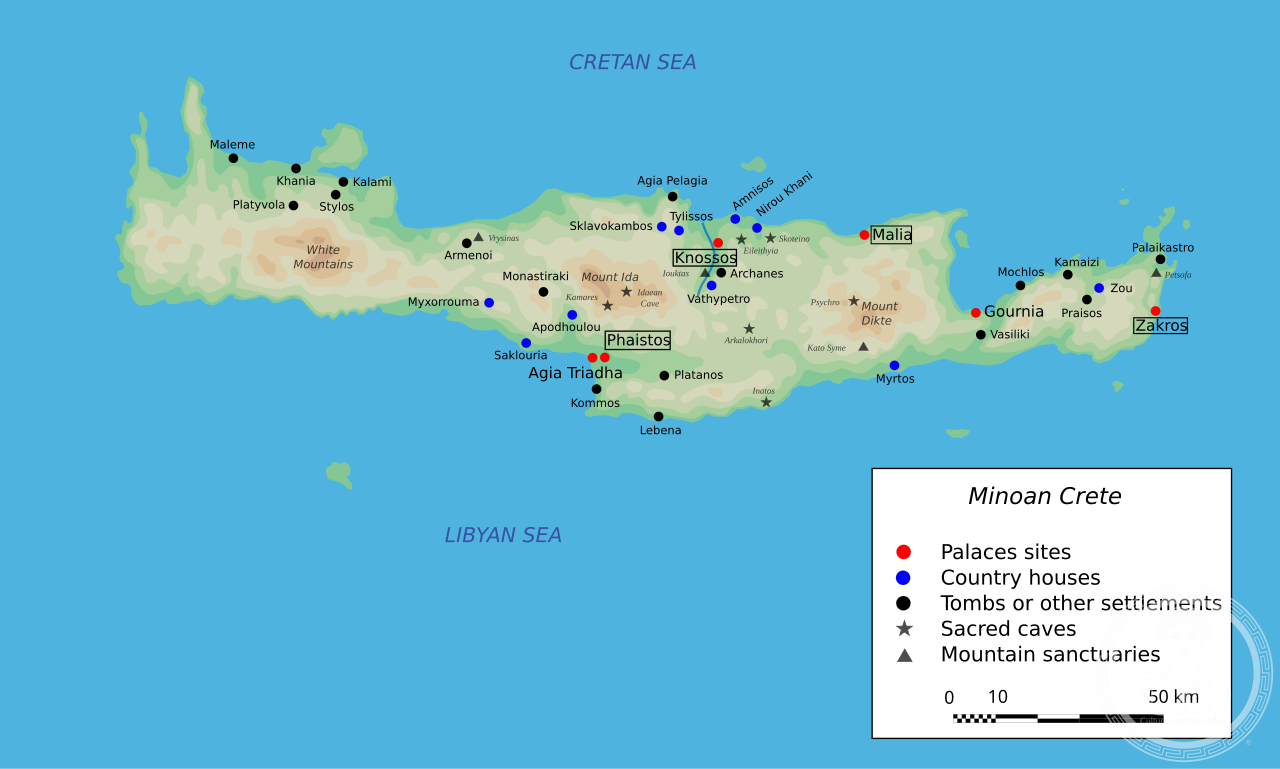
One of six major Minoan palaces, Zakros commanded Crete’s eastern coast as a thriving trade gateway to the Mediterranean east. Its remains reveal a sophisticated Bronze Age commercial center twice rebuilt and finally destroyed around 1450 BC.
At a glance
The Palace of Zakros stands on Crete’s easternmost shore, where a natural harbor served as a crucial port for Minoan merchants and seafarers. The site divides into Upper Zakros (Epano Zakros) on the hillside and Lower Zakros (Kato Zakros) near the water. A ravine carved through the landscape, known as the “Ravine of the Dead,” speaks to centuries of habitation and burial ritual.
History
The Palace of Zakros was originally constructed around 1900 BC, marking Zakros’s rise as a settlement of regional importance. Around 1600 BC, it was rebuilt and expanded, reflecting the prosperity of the Minoan civilization at its height. The palace fell silent around 1450 BC, destroyed in the same catastrophic event that ended other major Minoan centers.
Before the palace itself existed, a Minoan villa was erected on the road from Upper Zakros near the gorge. Dated to the Late Minoan IA period (c. 1700–1625 BC), this earlier dwelling yielded a pithos bearing a Linear A inscription recording 32 units of wine—evidence of the region’s agricultural wealth and commerce.
What you see
Extensive palace ruins remain visible today, revealing the layout and ambition of Minoan civic architecture. The site’s two geographical divisions reflect how the ancient town adapted to its dramatic terrain—the palace and civic center anchored the lower settlement while settlements and burial caves dotted the upper slopes. The “Ravine of the Dead,” carved naturally through bedrock, served as a necropolis, its cave walls honeycomb with tombs and ceremonial spaces.
Cultural significance
Zakros exemplifies the maritime wealth and strategic thinking of Minoan Crete. Its protected harbor and easterly position made it essential for trade networks spanning the eastern Mediterranean and beyond. The palace’s destruction connects directly to the larger mystery of Minoan civilization’s collapse—whether volcanic upheaval, invasion, or climate crisis—a question archaeology continues to explore.
Key facts
- Country: Greece
- Region: Lasithi, Crete
- Coordinates: 35.09805556, 26.26138889
- Palace construction phases: c. 1900 BC (original), c. 1600 BC (rebuild), c. 1450 BC (destruction)
- Status: One of six major Minoan palaces; popular tourist destination
Practical information & getting there
Zakros is located on Crete’s eastern coast and is readily accessible to visitors exploring the island’s Minoan heritage sites. Consult local tourism resources for current opening hours, access conditions, and guidance on exploring both Upper and Lower Zakros.
Sources & resources
Find it on the map
See this place and what’s around it →📷 Become a Cultural Heritage Online photographer
Share your photos of places: they stay published under your name as the author. The more they're seen, the more you get noticed — and soon a contest will reward the most appreciated photos.
Log in or sign up free to add a photoIs this page about you?
This page is read by travellers and heritage enthusiasts who find it on Google. Tell us how you are connected to this place and we will take it from there.