
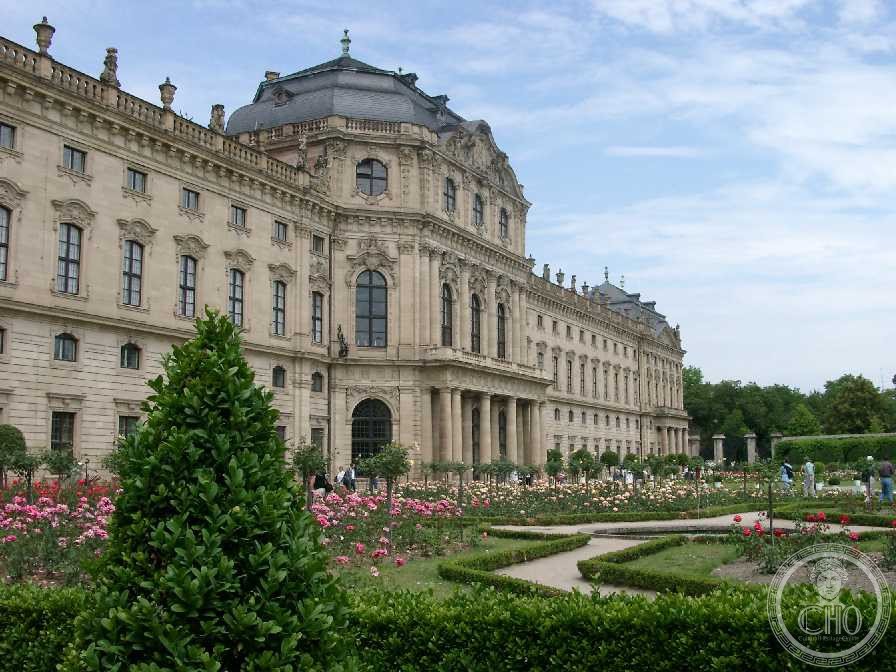
A masterwork of Baroque design, this princely palace synthesizes Austrian, German, and French architectural traditions through the genius of Balthasar Neumann and the artistry of Giovanni Battista Tiepolo.
At a glance
Commissioned in 1720 by Prince-Bishop Johann Philipp Franz von Schönborn and completed in 1744, the Würzburg Residence stands as one of Europe’s most significant Baroque palaces. Its grand staircase, chapel, and Imperial Hall represent the pinnacle of Baroque and Rococo design. The building survived World War II bombing and has undergone continuous restoration since 1945.
History
The Prince-Bishop Johann Philipp Franz von Schönborn and his brother Friedrich Carl commissioned the Residence in 1720 as an episcopal palace. Balthasar Neumann, the Bishop’s court architect, led the design and construction over two decades, drawing on expertise from across Europe. Giovanni Battista Tiepolo, the celebrated Venetian painter, arrived to execute the interior frescoes, assisted by his son Domenico, bringing Italian Rococo decoration to its fullest expression. Napoleon reportedly called it the “largest parsonage in Europe.” Allied bombing in World War II caused severe damage, yet restoration efforts beginning in 1945 have secured its survival.
What you see
The palace synthesizes Austrian/Southern German and French Baroque idioms. Johann Lukas von Hildebrandt, Maximilian von Welsch, Robert de Cotte, and Germain Boffrand all shaped its form. The grand staircase ascends beneath Tiepolo’s soaring frescoes. The chapel displays Baroque devotion through architecture and decoration. The Imperial Hall crowns the sequence of state rooms—a Rococo apotheosis of stucco, fresco, and gilt detail. Neumann’s spatial planning creates fluid transitions between rooms and courts.
Cultural significance
The Residence represents the last flourishing of the German prince-bishopric as a center of cultural patronage. It embodies the dialogue between German and Italian, Austrian and French sensibilities that defined late Baroque Europe. Tiepolo’s frescoes rank among his greatest achievements and establish the palace as a shrine to his art. The building’s survival and restoration demonstrate postwar commitment to preserving European heritage.
Key facts
- Location: Würzburg, Germany (49.7928°N, 9.9386°E)
- Commissioned: 1720
- Completed: 1744
- Principal architect: Balthasar Neumann
- UNESCO World Heritage Site since 1981
Practical information & getting there
The Residence is located in central Würzburg and is accessible by train and car. It functions as a museum open to visitors. Restoration work continues as part of ongoing conservation efforts. Contact local tourism or visit the official site for current opening hours and admission fees.
Sources & resources
Find it on the map
See this place and what’s around it →
📷 Become a Cultural Heritage Online photographer
Share your photos of places: they stay published under your name as the author. The more they're seen, the more you get noticed — and soon a contest will reward the most appreciated photos.
Log in or sign up free to add a photoIs this page about you?
This page is read by travellers and heritage enthusiasts who find it on Google. Tell us how you are connected to this place and we will take it from there.