

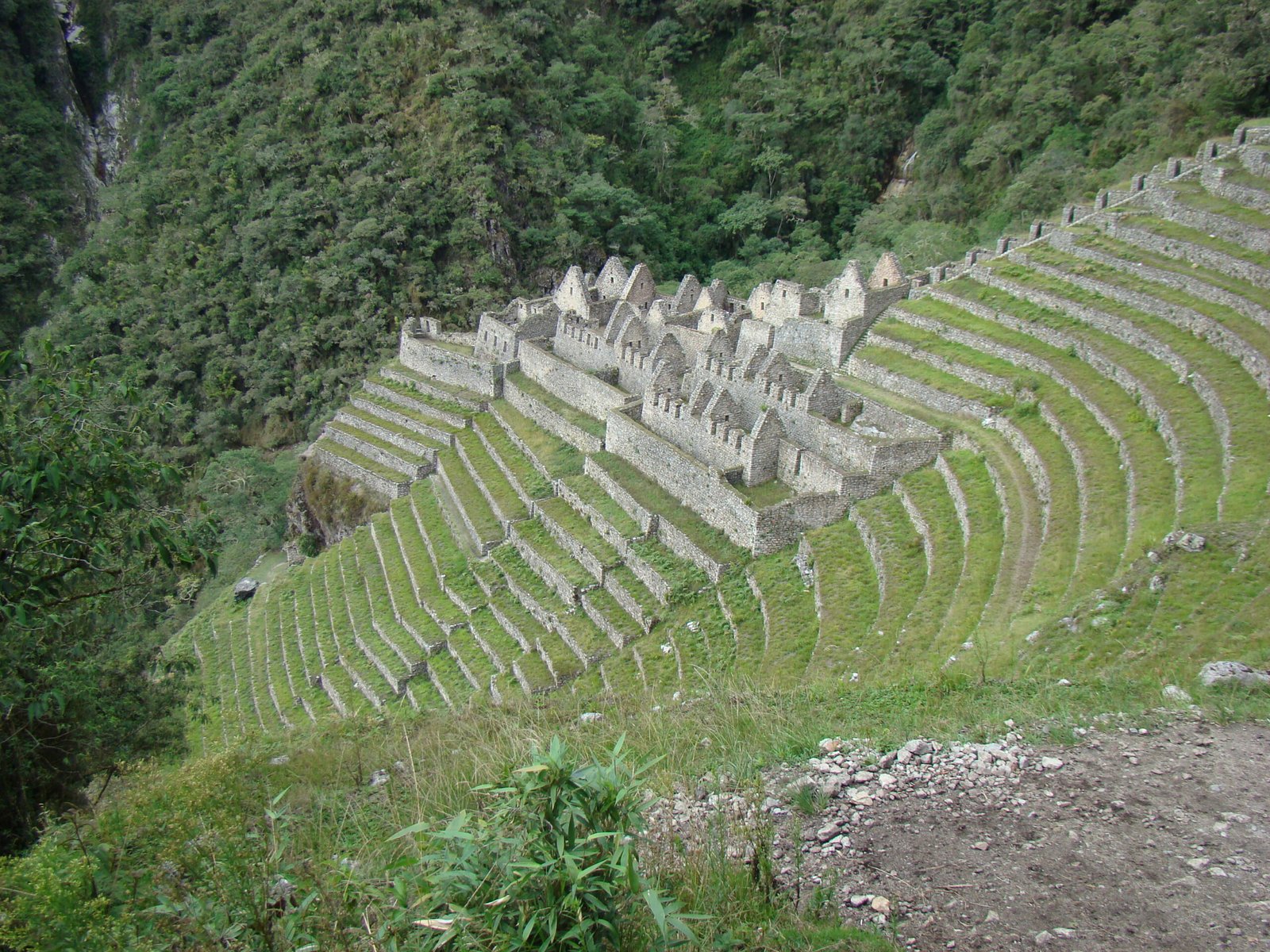
On the last day of the Classic Inca Trail, approximately 4 km before the Sun Gate, Wiñay Wayna presents the most spectacular cascade of Inca agricultural terracing, ritual water fountains, and fine ashlar architecture on the entire route — a perfectly realised example of Inca landscape design that receives only a fraction of Machu Picchu visitors.
At a glance
Wiñay Wayna — meaning Forever Young in Quechua, named after a local pink orchid — occupies a near-vertical slope of the Urubamba canyon at approximately 2,650 metres above sea level. The site combines approximately 180 agricultural terraces with two groups of carefully fitted stone buildings, a sequence of 19 ritual water fountains feeding continuous cascades of water through stone-cut channels, and a complex interpreted as a tambo (waystation) or ritual complex associated with the Machu Picchu sanctuary. Accessible only on foot via the Inca Trail, the site is limited to roughly 500 visitors per day — compared to Machu Picchu 5,000 — and retains an atmosphere of genuine remoteness. The fountain sequence was restored in the 1980s and all 19 outlets still flow continuously.
Key facts
- Location: Urubamba canyon, Cusco Region, Peru; 2,650 m above sea level; approx. 4 km from the Sun Gate (Inti Punku).
- Name: Wiñay Wayna (also Huinay Huayna) — Quechua for Forever Young; named after the pink orchid Epidendrum secundum that grows on the slopes.
- Period: c. 1450–1530 AD; Late Inca (Pachacuti–Huayna Capac period).
- Terraces: Approximately 180 agricultural andenes, each approximately 2.5 m wide, retained by near-vertical stone walls.
- Water fountains: 19 separate ritual water channels in continuous sequence; water still flows through all 19 outlets after 1980s restoration.
- Access: Inca Trail permit-holders only; maximum 500 visitors per day on the trail.
- Discovery: Identified and documented by Peruvian and international expeditions in the mid-20th century; systematically studied from the 1970s onward.
History
Wiñay Wayna was built during the height of the Inca Empire, most likely during the reigns of Pachacuti (1438–1471) or Huayna Capac (1493–1527) — the same period that produced Machu Picchu, approximately 4 km to the northwest along the trail. The site functions as a complex of complementary structures: the agricultural terraces that clothe the steep canyon slope were cultivated to produce crops for the Machu Picchu sanctuary, exploiting the microclimate of the Urubamba canyon to grow maize and other staples at an altitude where they would not otherwise thrive; the upper building group, with its fine ashlar masonry and trapezoidal niches, served ceremonial or elite residential functions; and the sequence of 19 water fountains — a continuous musical cascade running from the upper buildings down through the terraced zone — served ritual purposes associated with water worship, one of the central elements of Inca religion. The site was likely abandoned with the rest of the Inca Trail network following the Spanish conquest in the 1530s and the collapse of the Inca state that had maintained it.
Wiñay Wayna was rediscovered and documented by modern expeditions in the mid-20th century. The water fountain system was partially restored in the 1980s by Peruvian archaeologists, and all 19 channels were returned to functioning condition. The site is administered by the Peruvian Ministry of Culture as part of the Machu Picchu Historical Sanctuary, and access is tightly controlled through the Inca Trail permit system, which limits the total number of trekkers on the four-day classic route to approximately 500 per day, preserving the site from the visitor pressure experienced at Machu Picchu itself.
What you see
The site is divided into an upper building group and a lower building group, separated by the great cascade of terraces and fountains. The upper group contains a series of rooms with characteristic Inca trapezoidal doorways and niches, built in the dry-stone ashlar technique that Inca masons perfected: tightly fitted irregular stone blocks with no mortar, able to flex slightly during earthquakes. The quality of the stonework in the upper group is comparable to the finest buildings at Machu Picchu. The lower group contains a larger open courtyard structure that has been interpreted variously as a tambo (waystation for travellers on the royal Inca road), a ceremonial hall, or an administration centre for the agricultural terraces.
The water fountain sequence is the most dramatic feature of the site: 19 separate stone-cut channels, each slightly different in design, descending through the terraced zone in a continuous cascade. At dawn or in rain, when mist rises from the Urubamba canyon 300 metres below and the sound of water combines with the sound of the cloud forest, the effect is among the most affecting on the entire Inca Trail. The pink orchid Wiñay Wayna blooms on the slopes between approximately March and May, giving the site its name and adding an unexpected note of colour to the green and grey of the canyon walls.
Practical information
- Permits: Inca Trail permits are required and must be booked months in advance (typically sell out within days of release for peak season); permits are non-transferable and require passport details.
- Booking: Through licensed Peruvian tour operators authorised by the Ministry of Culture; permits available from October for the following year.
- Trek options: Classic 4-day Inca Trail (Km 82 to Machu Picchu) or the shorter 2-day version (Km 104, passing Wiñay Wayna and the Sun Gate); both options access Wiñay Wayna.
- Entry: Included in the Inca Trail permit; there is no separate entry fee for Wiñay Wayna itself.
- Facilities: A basic campsite and toilet facility is located at Wiñay Wayna; food and water must be carried or supplied by the tour operator.
- Best season: May–October (dry season); April and November can be acceptable; December–March is the wet season with muddy trails and frequent cloud.
Getting there
Wiñay Wayna is accessible only on foot via the Classic Inca Trail (4-day trek from Km 82) or the 2-day version beginning at Km 104 (Chachabamba). Both routes begin from the Urubamba River Valley and require licensed guides as part of a permitted tour group. The starting points are reached from Aguas Calientes (the town at the base of Machu Picchu, itself accessible by train from Cusco and Ollantaytambo) or from Cusco by road to Km 82/104. There is no road, helicopter, or other access to Wiñay Wayna — this exclusivity is a defining feature of the experience.
Nearby
- Machu Picchu — The culmination of the Inca Trail, approximately 4 km northwest via the Sun Gate; the most famous Inca site and a UNESCO World Heritage property.
- Sun Gate (Inti Punku) — The ceremonial entrance to Machu Picchu on the Inca Trail ridge, approximately 4 km northeast of Wiñay Wayna; the classic first view of Machu Picchu from the trail.
- Phuyupatamarca — Another Inca site on the trail, approximately 2 hours before Wiñay Wayna; also features an impressive sequence of water fountains.
- Aguas Calientes — The base town for Machu Picchu visits, approximately 10 km below by trail; train connections to Cusco and Ollantaytambo.
Sources
- Reinhard, Johan and Ceruti, Maria Constanza. Inca Rituals and Sacred Mountains. Los Angeles: UCLA Cotsen Institute, 2010.
- Wright, Ruth M. and Valencia Zegarra, Alfredo. The Machu Picchu Guidebook. Boulder: Johnson Books, 2004.
- Peru Ministry of Culture. Inca Trail Permit Regulations. Lima, 2024.
- Wikipedia contributors. Winay Wayna. Wikipedia, The Free Encyclopedia. Retrieved June 2026.
- Wikipedia contributors. Inca Trail to Machu Picchu. Wikipedia, The Free Encyclopedia. Retrieved June 2026.
Find it on the map
See this place and what’s around it →📷 Become a Cultural Heritage Online photographer
Share your photos of places: they stay published under your name as the author. The more they're seen, the more you get noticed — and soon a contest will reward the most appreciated photos.
Log in or sign up free to add a photo