
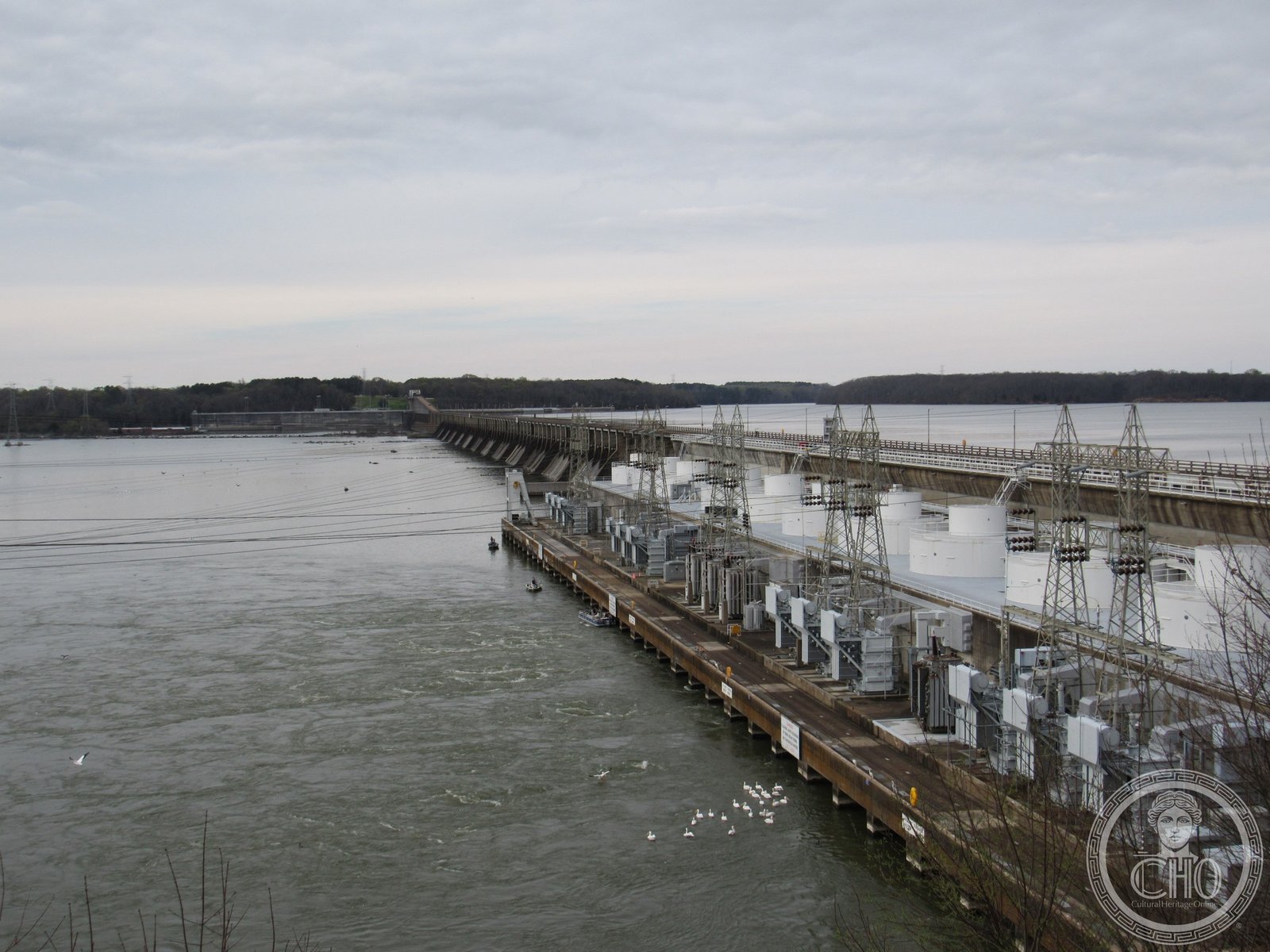
At 6,342 feet, Wheeler Dam is the longest hydroelectric dam on the Tennessee River — a New Deal landmark built by the Tennessee Valley Authority between 1933 and 1936 to tame the Muscle Shoals rapids and bring power and flood control to an isolated river valley.
At a glance
Wheeler Dam spans the Tennessee River between Lauderdale County and Lawrence County in northern Alabama, standing 72 feet high and stretching more than a mile across the water. Built by the Tennessee Valley Authority as one of its earliest major construction projects, the dam was completed on November 9, 1936, after three years of work that employed up to 4,700 workers at peak activity. Its reservoir, Wheeler Lake, covers 67,070 acres with more than 1,000 miles of shoreline. With a generating capacity of 411,800 kilowatts and 60 tainter gates, Wheeler Dam has served for nearly ninety years as a key element in TVA’s integrated management of the Tennessee River system.
Key facts
- Completed: November 9, 1936
- Style: TVA New Deal engineering architecture
- Length: 6,342 feet — longest TVA dam on the Tennessee River
- Height: 72 feet
- Generating capacity: 411,800 kilowatts
- Reservoir: Wheeler Lake (67,070 acres)
- Builder: Tennessee Valley Authority / U.S. Army Corps of Engineers
- Named for: Civil War general and congressman Joseph Wheeler
- NRHP: June 26, 2016 (Wheeler Hydroelectric Project)
- Location: Between Lauderdale and Lawrence counties, Alabama
History
The Tennessee River’s descent through northern Alabama had long thwarted navigation. A series of shoals around Muscle Shoals and the Elk River dropped the river more than 130 feet over a short stretch, making regular commercial river traffic impossible even after nineteenth-century canal improvements. Congressman Joseph Wheeler introduced legislation as early as 1898 to secure federal funding for Muscle Shoals development. The construction of Wilson Dam upstream in the 1920s opened a navigable channel, but only at high water flows. The stretch remained an obstacle to the economic development of the upper Tennessee Valley.
When Congress created the Tennessee Valley Authority in 1933, the Wheeler Dam site was among the first earmarked for construction. Work began on November 21, 1933 — TVA’s second major dam project after Norris Dam — and proceeded on an emergency employment basis. At peak, 4,700 workers were on site. The project required the relocation of 840 families and 176 graves, and the clearance of more than 31,000 acres of land. TVA drew on engineering expertise from the Army Corps of Engineers and the Bureau of Reclamation for the dam’s structural design. Wheeler Dam was completed at a cost of $87,655,000 on November 9, 1936.
Named for Civil War general and U.S. Congressman Joseph Wheeler, an early champion of federal river development in the Muscle Shoals area, the dam was listed on the National Register of Historic Places in 2016 as part of the Wheeler Hydroelectric Project — recognized for its role in the New Deal transformation of the Tennessee Valley.
What you see
Wheeler Dam’s physical scale is the defining experience. The concrete crest stretches 6,342 feet — more than a mile — across the Tennessee River, carrying Alabama State Route 101 (Wheeler Dam Highway) over the water. Sixty tainter gates regulate the spillway, and the river surface is held 72 feet higher on the upstream face than below. The powerhouse, built in the functional concrete construction style that TVA engineers developed during the New Deal construction boom, houses the generating equipment. Two navigation locks raise and lower vessels up to 52 feet between Wheeler Lake and Wilson Lake downstream: the main lock measures 110 by 600 feet; the auxiliary lock, 60 by 360 feet.
Driving or walking across the dam crest on Route 101 offers unobstructed views of both the reservoir upstream and the tailwaters below, with Wilson Dam visible in the distance. Wheeler Lake extends 74 miles upstream to the base of Guntersville Dam, and its 1,027 miles of shoreline are lined with state park land and recreational facilities.
Practical information
- Access: Alabama State Route 101 crosses the dam crest — the primary public viewpoint
- Joe Wheeler State Park: adjacent to the reservoir; camping, cabins, full marina, and boat launch
- Dam structure: no public entry (TVA security); viewing from the road and park areas only
- Best seasons: spring and fall for reservoir recreation; bald eagles visible along Wheeler Lake in winter
- Wheeler Wildlife Refuge: major waterfowl stopover on the reservoir; excellent birdwatching in migration seasons
Getting there
Wheeler Dam is located about 7 miles southwest of Rogersville, Alabama, and roughly 30 miles downstream from Decatur along the Tennessee River corridor. From Rogersville, take Alabama Route 101 southwest directly to the dam crossing. From the Muscle Shoals / Florence area (about 15 miles southwest), take US-72 east and connect with County Road 200 and Route 101. The nearest commercial airport is Muscle Shoals Regional Airport (MSL), approximately 20 miles southwest of the dam.
Nearby
- Wilson Dam (1924) — NRHP-listed TVA dam 15 miles downstream; earliest TVA dam on the Tennessee River
- Muscle Shoals / Florence — historic Quad Cities area, FAME Studios, Muscle Shoals Sound Studio
- Joe Wheeler State Park — camping, boating, golf, and fishing on Wheeler Lake
- Wheeler National Wildlife Refuge — major waterfowl habitat on the reservoir
Sources
- Wikipedia: “Wheeler Dam” (accessed 2026); basis for construction dates, dimensions, location, and NRHP status
- Tennessee Valley Authority, The Wheeler Project: A Comprehensive Report on the Planning, Design, Construction, and Initial Operations of the Wheeler Project, TVA Technical Report No. 2 (Knoxville: TVA, 1940)
- National Register of Historic Places: Wheeler Hydroelectric Project, NRHP #16000431 (added June 26, 2016), nps.gov
- TVA Wheeler Reservoir data, tva.com
Find it on the map
See this place and what’s around it →Record researched and written by Luigi De Marchi for Cultural Heritage Online, 2026.
📷 Become a Cultural Heritage Online photographer
Share your photos of places: they stay published under your name as the author. The more they're seen, the more you get noticed — and soon a contest will reward the most appreciated photos.
Log in or sign up free to add a photoIs this page about you?
This page is read by travellers and heritage enthusiasts who find it on Google. Tell us how you are connected to this place and we will take it from there.