
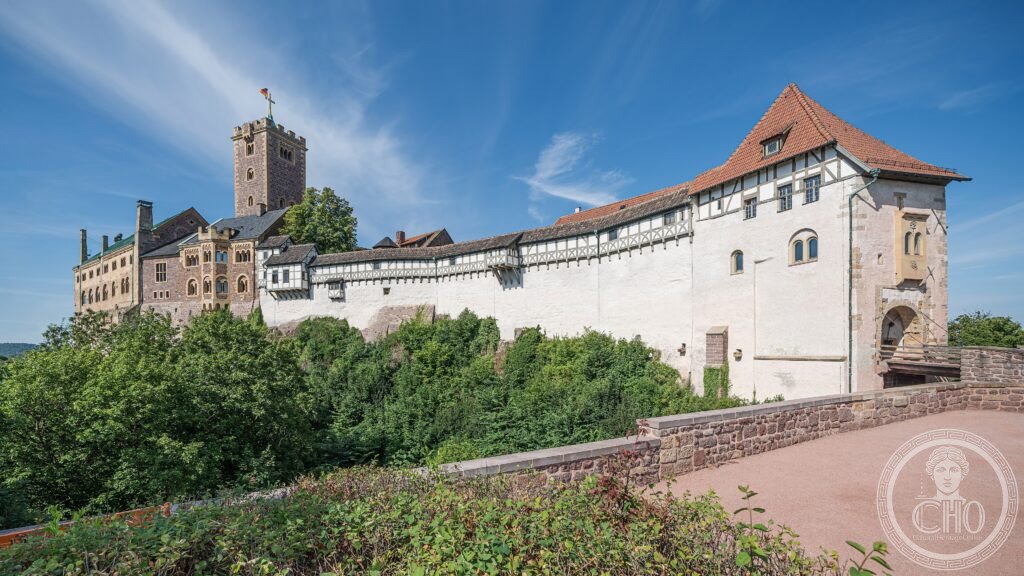
The most symbolically charged castle in Germany — three events that shaped German history converge at Wartburg: the court of the 13th-century minnesänger (the legendary song contest that inspired Wagner’s Tannhäuser), the residence of St Elizabeth of Hungary (the most popular medieval German saint), and the hiding place of Martin Luther (1521–1522), where he translated the New Testament into German and, in doing so, laid the foundations of the modern German literary language.
At a glance
Wartburg stands on a rocky forested ridge of the Thuringian Forest (Thüringer Wald), 1 km south-east of the town of Eisenach (itself the birthplace of Johann Sebastian Bach, 1685) at an altitude of 411 metres. The castle is reached by a winding road (20 min walk from Eisenach, or bus to the car park 500m from the entrance). The castle complex covers approximately 3 hectares and includes the Romanesque Palas, the great dining hall (Festsaal, with 19th-century historicist frescoes by Moritz von Schwind), the Luther Room, the Elizabeth Oratory, and the museum in the keep. The castle is owned by the Thuringian state and managed as a museum.
Key facts
- The Romanesque Palas (1155–1162 AD): the most important single building at Wartburg and the best-preserved secular Romanesque building in Germany — the Palas (the main palace hall building) was built by Landgrave Ludwig II of Thuringia approximately 1155–1162 AD; it is a three-storey Romanesque building in light-coloured limestone with a remarkably intact exterior (the original carved column capitals, blind arcades, and corbel tables on the exterior walls are largely complete and of high quality); the ground floor was a service space, the first floor (the Kemenaten) were the private apartments, and the second floor (the Rittersaal, the knight’s hall) was the ceremonial and social space; the Rittersaal at Wartburg is the largest surviving secular Romanesque hall interior in Germany, with its original vault responds and window openings, though the decorative programme is 19th-century restoration (by Bodo Ebhardt)
- The court of the minnesänger and the Song Contest of 1206/07: the most famous event in the cultural history of Wartburg — Landgrave Hermann I of Thuringia (1190–1217) was the most important literary patron in Germany of his time; his court at Wartburg attracted the greatest minnesingers of the Staufen period: Walther von der Vogelweide (the most important medieval German lyric poet, the equivalent of the troubadours’ leading voice; his poem of political complaint against Pope Innocent III, “Ich saz ûf eine Steine”, is the first political lyric in German literature), Wolfram von Eschenbach (the author of “Parzival”, the greatest German medieval romance and the source for Wagner’s Parsifal), and the poet Heinrich von Veldeke (who completed his romance “Eneas” at Hermann’s court); a song contest of 1206/07 (the “Sängerkrieg auf der Wartburg”, or Wartburg War of Bards) became the basis for an extensive literary tradition and eventually for Wagner’s opera “Tannhäuser” (1845)
- St Elizabeth of Hungary (1207–1231): the castle’s most celebrated resident — Elizabeth, daughter of King Andrew II of Hungary, was brought to Wartburg as a child bride at age 4 (1211) and formally married to Landgrave Ludwig IV of Thuringia in 1221; she lived at Wartburg 1211–1227, practising a radical form of charitable asceticism (giving away food and money to the poor, nursing the sick in person, building hospitals at the foot of the castle) that scandalised the court but was recognised as holy immediately after her death; she died at Marburg in 1231 at age 24 and was canonized in 1235 (one of the fastest canonizations in medieval history); her canonization made the Wartburg one of the great pilgrimage sites of 13th-century Germany; the legend of the “miracle of the roses” (Elizabeth was carrying bread to the poor when confronted by Ludwig, who demanded to see what she was carrying; she opened her cloak and the loaves were miraculously transformed into roses) is one of the most famous miracle legends of medieval hagiography and is depicted in the 19th-century frescoes of the Elisabeth Gallery in the castle
- Martin Luther at Wartburg (May 1521–March 1522): the most historically consequential episode in Wartburg’s history — after the Diet of Worms (April 1521), where Luther refused before Emperor Charles V to recant his writings against the Catholic Church, he was declared an outlaw; Elector Frederick the Wise of Saxony arranged for Luther to be “kidnapped” by disguised knights and taken to Wartburg, where he lived under the pseudonym “Junker Jörg” (Knight George) in a small room in the south wing; during 10 months in this room he translated the New Testament from Erasmus’s 1519 Greek edition into German in approximately 11 weeks (the “September Testament”, published in Wittenberg in September 1522, sold 5,000 copies in 2 months; the complete Bible translation, the “Lutherbibel”, was completed in 1534); the Luther translation established a relatively unified German literary language (drawing on Central German vernacular dialects that could be understood in both the North and South German dialect regions) and had a decisive influence on the development of German prose style; the Luther Room (the small chamber where he worked) is the most-visited room in the castle
- Heritage: UNESCO World Heritage Site, Wartburg Castle, inscribed 1999
- GPS: 50.9670° N, 10.3080° E
History
The castle was founded c. 1067 AD by Ludwig the Springer (Ludwig I, Count of Thuringia); the Romanesque Palas was built 1155–1162; the castle was the seat of the Landgraviate of Thuringia, one of the most important principalities in the Holy Roman Empire, until 1247; it passed through various hands until acquired by the Wettin dynasty of Saxony in the 14th century; it fell into disrepair in the 15th–18th centuries; the Romantic movement of the early 19th century rediscovered Wartburg as the embodiment of German medieval culture; Grand Duke Carl Alexander of Saxe-Weimar-Eisenach commissioned an extensive (and somewhat controversial) restoration 1838–1867, adding the historicist frescoes and the neo-Romanesque elements that now dominate the interior; the 1817 Wartburgfest (October 18, 1817, the 300th anniversary of Luther’s posting of the 95 Theses and the 4th anniversary of the Battle of Leipzig) was one of the first German national gatherings, organized by nationalist student fraternities (Burschenschaften), and was a landmark in the history of German nationalism; UNESCO inscription 1999.
What you see
The castle tour begins in the courtyard (the outer courtyard preserves the essential medieval layout, though most of the buildings are 19th-century restorations); the essential spaces are the Romanesque Palas exterior (examine the column capitals and corbel tables of the exterior arcade — many are original 12th-century carving of high quality), the museum rooms in the Vogtei tower (with original Romanesque stone carvings from the castle and medieval artefacts from the region), the great Festsaal (the banqueting hall with Moritz von Schwind’s historicist frescoes 1854–1855, depicting the legend of the Wartburg Song Contest and the life of Elizabeth of Hungary — historically unreliable but visually magnificent), and the Luther Room (a small panelled room with the desk at which Luther worked; the tradition of visitors scratching their names in the ink stain on the wall dates from the 16th century; the inscription on the wall “Der Teufel war hier” — the devil was here — refers to Luther’s own account of throwing an inkpot at a vision of the Devil that appeared to him during his isolation). Allow 2 hours for the castle; allow 30 minutes extra for the forest walk from Eisenach town centre.
Practical information
- Admission: approximately €12 adult (includes access to the historical rooms of the Palas, the Luther Room, the museum, and the panorama terrace; guided tours approximately €5 additional, available in German and English at set times; the guide is recommended for the context of the Palas interiors and the Luther Room); open daily 8:30am–5pm (winter), 8:30am–8pm (summer); the castle is extremely popular in summer — arrive before 10am or after 3pm to avoid crowds
- Getting there: Eisenach is on the main Frankfurt-Erfurt ICE/IC rail line (Frankfurt Hbf to Eisenach approximately 1h 15 min by ICE; Erfurt to Eisenach approximately 35 min); from Eisenach station the castle is 1 km (20 min walk uphill through the old town, or bus 10 to Wartburg car park then 10 min walk); by car from Frankfurt: 200 km (2h via A4/A7 motorway); from Erfurt: 65 km (45 min via A4); from Leipzig: 130 km (1h 30 min via A4/A9)
- Eisenach and the Bach circuit: Eisenach is the birthplace of Johann Sebastian Bach (1685) — the Bachhaus (the most complete Bach museum in Germany, in the house where he was born) is 5 minutes from the Eisenach main station; the Luther House (Lutherhaus) in Eisenach is the house where Luther lived as a schoolboy (1498–1501), now a museum; the Georgenkirche (where Bach was baptized in 1685 and where Luther preached in 1521 on his way to the Diet of Worms) closes the Bach-Luther triangle in Eisenach’s old town
Getting there
ICE train Frankfurt to Eisenach (1h 15min). From Erfurt (35min by IC). 20min uphill walk or bus 10 from station to castle. GPS: 50.9670, 10.3080.
Nearby
- Erfurt — 65 km east of Eisenach (45 min by IC train or car); the most completely preserved medieval city centre in Germany and one of the great under-visited destinations of central Europe — the Krämerbrücke (Merchant Bridge, 1325; the longest inhabited bridge in Europe north of the Alps; 32 timber-frame houses built directly on the bridge, their back walls overhanging the Gera river; the shops on the bridge sold books, spices, and silk during the medieval period) is the most extraordinary medieval urban structure in Germany; the Erfurt Cathedral (Dom St Marien, 12th–15th century; the spectacular Gothic cathedral on the domberg, with a magnificent choir screen of 14th-century sandstone figures; the Gloriosa bell of 1497, the largest medieval free-swinging bell in the world, 11.5 tonnes) and the Church of St Severus (next to the cathedral, same hilltop, 13th–14th century) form the most dramatic ecclesiastical ensemble in Thuringia; Martin Luther studied at Erfurt University (1501–1505) and was ordained at the Augustinian monastery in Erfurt (1507; the Augustinerkloster is now a hotel with the surviving medieval cloister and Luther’s cell)
- Gotha and Friedenstein Castle — 20 km east of Eisenach (25 min by car); the Schloss Friedenstein in Gotha (completed 1654, the most completely preserved early Baroque palace in Germany, seat of the Duchy of Saxe-Coburg-Gotha, the dynasty that provided the ruling houses of Britain, Belgium, Portugal, and Bulgaria) has the most important 17th-century art collection in Thuringia, including one of the best collections of Dutch and Flemish Golden Age painting in Germany; the palace theatre (the Ekhoftheater, 1683, with its complete original 17th-century stage machinery intact) is the oldest theatre in Germany with its original backstage mechanism and is UNESCO-listed as part of the “Historic Organ Landscape of Thuringia”
- Weimar — 80 km east of Eisenach (1h by ICE train or car); the intellectual capital of 18th-century German culture — the Weimar of Goethe, Schiller, Herder, and Wieland (the four great writers of German Classicism, all of whom lived in Weimar simultaneously at the court of Duchess Anna Amalia and Duke Carl August in the late 18th and early 19th centuries); the Goethe-Wohnhaus and Schiller-Wohnhaus (the original residences of Goethe and Schiller, both preserved as museums), the Herzogin Anna Amalia Bibliothek (the most beautiful Rococo library room in Germany, opened 1766, UNESCO WHS 1998 jointly with the Bauhaus and its Sites), and the Bauhaus-Museum (the school founded by Walter Gropius in 1919 that revolutionised 20th-century design) make Weimar an essential stop in any Thuringian itinerary
Sources
- Wikipedia, Wartburg; Martin Luther at Wartburg; Landgraviate of Thuringia; Elizabeth of Hungary, accessed June 2026
- UNESCO, Wartburg Castle, WHS reference 897, inscribed 1999
- Roland Bannasch and Horst Haider Munske, Luther und die Wartburg, Wartburg-Stiftung, 2013
- Lyndal Roper, Martin Luther: Renegade and Prophet, Random House, 2016, chapters 14–15 (the Wartburg period)
Find it on the map
See this place and what’s around it →
📷 Become a Cultural Heritage Online photographer
Share your photos of places: they stay published under your name as the author. The more they're seen, the more you get noticed — and soon a contest will reward the most appreciated photos.
Log in or sign up free to add a photoIs this page about you?
This page is read by travellers and heritage enthusiasts who find it on Google. Tell us how you are connected to this place and we will take it from there.