
The most important early medieval monastery in the German-speaking world and the birthplace of Ottonian manuscript illumination — the island of Reichenau in Lake Constance, site of a Benedictine abbey since 724 AD, produced the most spectacular illuminated manuscripts of the Carolingian and Ottonian periods (9th–11th centuries AD), including the Bamberg Apocalypse and the Gospels of Otto III; its three pre-Romanesque churches contain the oldest surviving church frescoes in Germany, including the complete cycle of Ottonian miracle paintings in the Church of St George at Oberzell (c. 990 AD).
At a glance
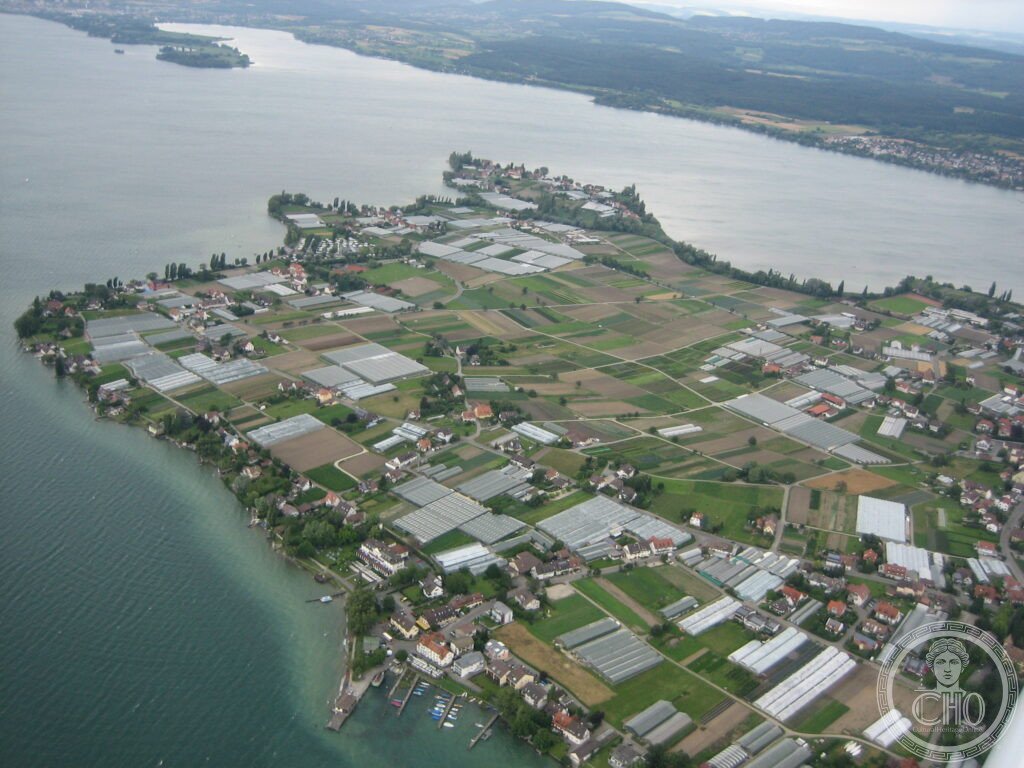
Reichenau Island (4.3 km long, 1.5 km wide) lies in the western arm of Lake Constance (the Untersee), 25 km west of Constance (Konstanz) and connected to the mainland by a causeway. The island (area 4.3 km², population approximately 5,200) is today known both for its UNESCO monastery complex and for its intensive market gardening (Reichenau provides vegetables — tomatoes, lettuce, cucumbers — to much of Baden-Württemberg and is one of the most productive agricultural areas in Germany by area). Three medieval churches are the main visitor draw, distributed across the three historic settlements of the island: Mittelzell (the central village, with the main minster), Oberzell (east end), and Niederzell (west end).
Key facts
- The founding and the Carolingian period (724–900 AD): the Benedictine Abbey of Reichenau was founded in 724 AD by St Pirmin (a Frankish missionary active in the Alemannic territories bordering the Rhine); the island location in Lake Constance gave the community physical security (difficult to approach by land) and access to the network of Carolingian and post-Carolingian courts (Constance, St Gallen, Zurich, and the Rhine corridor); under Abbot Waldo (786–806) and Abbot Haito (806–823), Reichenau became one of the leading scriptoria (book-production workshops) in the Carolingian realm; the abbey also had a significant role in early medieval music history: the Notker of Reichenau (Balbulus, c. 840–912) and the monk Tuotilo (died c. 915) contributed substantially to the development of the musical sequence (a new form of liturgical composition that spread throughout the Western Church); the oldest German monastery garden is documented at Reichenau in the Hortulus of Walahfrid Strabo (abbot of Reichenau 842–849), a poem describing the medicinal and culinary plants he cultivated in the monastery garden in prose poem form — the most important document of early medieval horticulture in the German-speaking world
- The Ottonian manuscript illumination school (c. 950–1050 AD): the most important artistic achievement of Reichenau and one of the defining contributions of the Holy Roman Empire to medieval European art — the Reichenau scriptorium produced the most spectacular illuminated manuscripts of the Ottonian period (the era of the Ottoman Empire in Germany, 919–1024 AD) under the patronage of the Ottonian emperors Otto I, Otto II, Otto III, and Henry II; the principal Reichenau manuscripts include: the Bamberg Apocalypse (c. 1000 AD, Bamberg State Library; a commentary on the Book of Revelation with 50 full-page miniatures of extraordinary expressive power, depicting apocalyptic visions in a flat, colour-saturated, intensely spiritual style characteristic of Reichenau); the Gospels of Otto III (c. 998–1001 AD, Bayerische Staatsbibliothek Munich; dedicated to Emperor Otto III, with full-page evangelist portraits and scenes from Christ’s life of exceptional quality; the portrait of Otto III enthroned in majesty, receiving the homage of four provinces personified as female figures, is one of the most powerful political images of the medieval West); the Pericopes of Henry II (c. 1007–1012 AD, Bayerische Staatsbibliothek Munich; produced for Emperor Henry II; the most sumptuously produced of the Reichenau manuscripts); the Codex Egberti (c. 977–993 AD, Stadtbibliothek Trier; produced for Archbishop Egbert of Trier; the earliest German manuscript with a complete cycle of narrative scenes from the Life of Christ, establishing the iconic image type for the German Gospel illustration tradition for the next century)
- Kirche St Georg at Oberzell (the Ottonian frescoes, c. 990 AD): the most important surviving example of early medieval monumental painting in Germany — the Church of St George at Oberzell was built approximately 880–900 AD (the nave and choir are original 9th-century construction, with a 10th-century crypt containing the relics of St Gregory); the nave walls carry a complete cycle of frescoes painted approximately 990 AD (Ottonian period, approximately the same time as the great Reichenau manuscripts) depicting 8 healing miracles of Christ (the Healing of the Blind, the Healing of the Leper, the Healing of the Possessed, the Raising of the Widow’s Son, the Healing of the Paralytic, the Stilling of the Tempest, the Raising of Jairus’s Daughter, the Feeding of the Five Thousand); these frescoes (recently restored and clearly visible) are the only complete Ottonian narrative fresco cycle in situ in Germany and one of the most important survivals of 10th-century monumental painting in Northern Europe
- Münster St Maria und Markus at Mittelzell (9th–11th century): the main abbey church, considerably larger than St George but less pure architecturally (having been modified and enlarged through the medieval period); the original 9th-century nave structure survives in the walls; the westwork (the massive west tower complex, a characteristic Carolingian and Ottonian architectural form) dates from the 10th century; the Abbey Treasury (Münsterschatz) contains an important collection of medieval metalwork, relics, and ivory carvings from the 9th–12th centuries
- Heritage: UNESCO World Heritage Site, Monastic Island of Reichenau, inscribed 2000
- GPS: 47.6969° N, 9.0614° E
History
The abbey was founded 724 AD by St Pirmin; it reached its first peak of importance in the Carolingian period under abbots Waldo, Haito, and Walahfrid Strabo; the second and greater peak came in the Ottonian period (c. 950–1050 AD) when the imperial manuscripts were produced; the abbey declined gradually after 1050 (the manuscripts tradition was superceded by newer workshops at Cologne, Regensburg, and Salzburg); the island became part of the Habsburg domains in 1540 and the monastery was secularised in 1803 (following the Napoleonic reorganisation of German ecclesiastical territories); the monastery church of St Mark at Mittelzell remained an active parish church; the St George and St Peter and Paul churches also continued as parish churches; restoration of the Ottonian frescoes at St George was carried out in the 1880s and again in the 1970s–1990s; UNESCO inscription 2000.
What you see
The three churches are spread across 3.5 km of the island and best visited in sequence by bicycle (rental available at the causeway car park) or on foot: begin at Oberzell (east end) with the Church of St George (the essential stop; the interior is small and intimate, which makes the Ottonian frescoes on the nave walls immediately legible; the paintings are at approximately eye level; the recently restored colours are vivid; allow 30–45 minutes here); continue west to Mittelzell (the Münster church and the Abbey Treasury Museum; the treasury is the primary repository for the Reichenau metalwork collection); end at Niederzell (west end) with the Church of Saints Peter and Paul (11th–12th century; Romanesque; the apse fresco of Christ in Majesty between SS Peter and Paul is 12th century; the crypt is 11th century). The island itself is worth a bicycle circuit (approximately 12 km perimeter; the views across Lake Constance to the Alps in clear weather are exceptional).
Practical information
- Admission: all three churches are free to enter (donations requested; the treasury museum at Mittelzell charges a small fee approximately €3); open daily; the churches post their opening hours at each door (St George typically 8am–6pm in summer, shorter in winter); guided tours of the Ottonian frescoes at St George are run by the local heritage association on weekends in summer (highly recommended for context)
- Getting there: from Constance (Konstanz) by car or bus: 25 km west on the B33 then the island causeway (30 min); by bicycle from Constance: 25 km on the lake cycling path (excellent cycling route through the Rhine meadows, approximately 1h 30 min); from Radolfzell by bus: service 7393 to Reichenau via the causeway (30 min); from Zurich by train to Constance (1h 15 min via Schaffhausen), then by car or bus to Reichenau (30 min from Constance); from Munich by train to Constance (2h 30 min via Lindau or Radolfzell), then bus
- Lake Constance circuit: Reichenau pairs well with the Constance Old Town (the most complete medieval German city on Lake Constance; the Cathedral of Our Lady, the Dominican island of Mainau, the Rosgartenmuseum with its collection of medieval art from the Lake Constance region) and the Abbey of Saint-Gall (St Gallen, Switzerland, 45 km east of Constance; UNESCO WHS 1983; the most complete surviving Carolingian monastery complex in Europe, with the extraordinary 8th-century library containing 170,000 volumes including the oldest surviving map of a monastery, the Plan of Saint Gall, c. 820 AD, which shows the ideal layout for a Carolingian monastery — simultaneously a historical document and a utopian vision of monastic order)
Getting there
From Constance by car or bus (25 km, 30min via causeway). From Zurich by train to Constance (1h 15min) + bus. From Munich by train to Constance (2h 30min) + bus. GPS: 47.6969, 9.0614.
Nearby
- Abbey of Saint-Gall (St Gallen, Switzerland) — 45 km east of Reichenau (50 min by car; 30 min by direct train from Constance); the most important surviving Carolingian monastery in Europe and a UNESCO WHS (1983) that forms a natural companion to Reichenau in any study of early medieval monastic culture — the Abbey Library of Saint Gall (the oldest surviving library room in the German-speaking world, founded c. 720 AD; the current late Baroque library hall, 1758–1767 by Peter Thumb, is one of the most beautiful Rococo interiors in Switzerland; the collection includes 160,000 volumes, 2,100 manuscripts including the Codex 914 — the oldest German illustrated psalm manuscript — and the Plan of Saint Gall, c. 820 AD, the world’s oldest surviving large-scale architectural drawing); the Cathedral of St Gallen (a twin-towered late Baroque cathedral, 1755–1766 by Johann Michael Beer von Bildstein, with an extraordinarily rich Rococo interior)
- Lindau (Bavaria, Germany) — 50 km east of Reichenau (50 min by car or 45 min by ferry from Constance); the most picturesque town on the German shore of Lake Constance — the old town of Lindau is on an island connected to the mainland by a bridge and causeway (a similar island configuration to Reichenau, but dramatically different in character: Lindau is a prosperous medieval trading town, Reichenau is a monastery island); the harbour entrance (two 19th-century lighthouse towers flanking the approach, one with a Bavarian lion and the other with a lighthouse proper) is one of the most photographed views in Germany; the town centre preserves 15th–17th century merchant houses and the Baroque Cavazzen house (now the municipal museum)
- Meersburg — 20 km south of Reichenau (25 min by ferry from Constance, or 30 min by car); the most beautifully preserved medieval town on the German shore of Lake Constance — the Altes Schloss (Old Castle, 7th–9th century; the oldest inhabited castle in Germany, now a private museum) perches above a vineyard slope that descends to the lake; the town’s steep cobbled lanes lined with half-timbered buildings are picturesque without being over-touristed; the Meersburg Winery (on the lake shore below the castle) produces some of Baden’s most interesting white wines from the steep vineyard slopes above the lake (the same microclimate that allows Reichenau’s intensive market gardening also enables productive viticulture on the lake shore towns)
Sources
- Wikipedia, Reichenau Island; Reichenau Abbey; St George’s Church, Reichenau; Walahfrid Strabo, accessed June 2026
- UNESCO, Monastic Island of Reichenau, WHS reference 974, inscribed 2000
- Henry Mayr-Harting, Ottonian Book Illumination: An Historical Study, Harvey Miller, 1991 (definitive study of the Reichenau manuscripts)
- Wolfgang Erdmann, Die Insel Reichenau im Bodensee, Badisches Landesmuseum Karlsruhe, 2001
Find it on the map
See this place and what’s around it →📷 Become a Cultural Heritage Online photographer
Share your photos of places: they stay published under your name as the author. The more they're seen, the more you get noticed — and soon a contest will reward the most appreciated photos.
Log in or sign up free to add a photo