
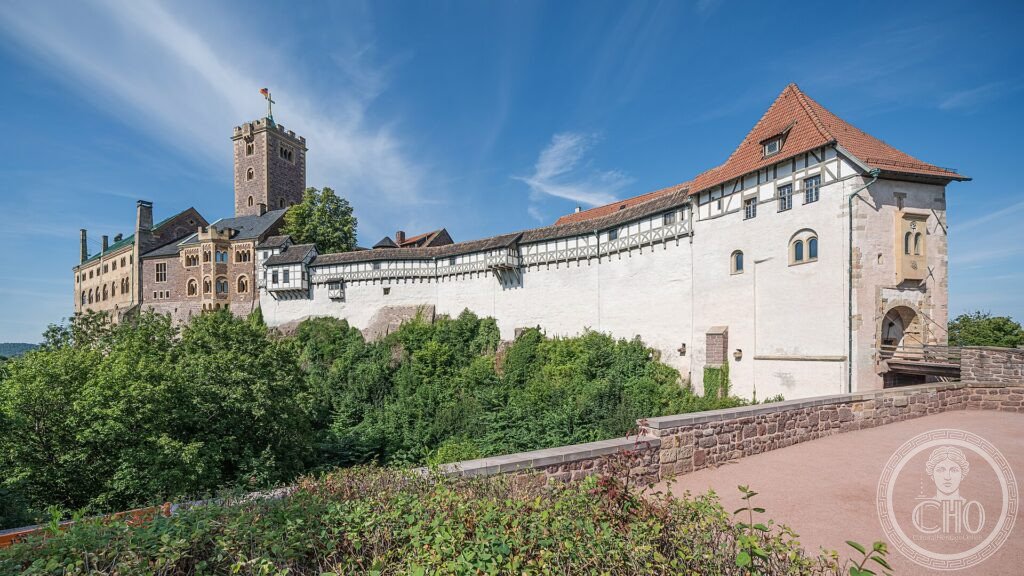
Nel 1521, nascosto sotto il falso nome di “Junker Jörg”, Martin Lutero passò qui dieci mesi e tradusse il Nuovo Testamento in tedesco: un atto che plasmò la lingua e cambiò l’Europa. Ma la Wartburg era già leggendaria, fra tornei di poeti e sante medievali.
At a glance
The Wartburg rises on a rocky spur above Eisenach in Thuringia, a castle whose history reaches back to the 11th century. It is bound to two defining moments of German culture: the medieval contest of minstrels (the Sängerkrieg, later dramatised by Wagner), and the ten months in 1521–22 when Martin Luther, in hiding, translated the New Testament into German. Carefully restored in the 19th century, the Wartburg was inscribed by UNESCO in 1999 as an outstanding monument of the feudal period and a place of profound cultural memory.
Key facts
- UNESCO: World Heritage since 1999
- Founded: traditionally 1067, by Ludwig der Springer
- Luther: translated the New Testament here in 1521–22, disguised as “Junker Jörg”
- Saint Elisabeth of Hungary: lived at the castle in the early 13th century
- Wartburg Festival (1817): student gathering for German unity and liberty
- Romanesque palas: one of the best-preserved late-Romanesque secular buildings north of the Alps
History
According to tradition the Wartburg was founded in 1067 by Count Ludwig the Springer. Under the Ludowingian landgraves of Thuringia it became a centre of courtly culture: legend places here the Sängerkrieg, a contest of Minnesänger. In the early 13th century Elisabeth of Hungary, later canonised, lived at the castle and devoted herself to the poor.
In 1521, condemned as an outlaw after the Diet of Worms, Martin Luther was spirited away to the Wartburg by his protector the Elector of Saxony. Hidden for ten months, he translated the New Testament from Greek into German — a text that shaped the modern German language. In 1817 students gathered here for the Wartburg Festival, calling for a unified, free Germany. The castle was extensively restored in the 19th century.
What you see
The approach climbs through forest to the drawbridge and the long inner courtyard. The Romanesque palas, with its arcaded galleries, holds the festival hall later evoked by Wagner. A guided route leads to the Elisabeth chambers, glittering with 19th-century mosaics, and to the modest, wood-panelled Luther study, where a simple desk recalls the months of translation.
From the ramparts the view opens over the Thuringian Forest, the wooded landscape that surrounds the castle on every side.
Practical information
- Entry: the courtyard is accessible; the palas and museum require a guided tour ticket
- Access: a steep footpath (about 20 minutes) or a shuttle from the car park below
- Time needed: 1.5–2 hours including the tour
- Note: guided tours in German; audio guides available in other languages
Getting there
The Wartburg stands above Eisenach in western Thuringia, on the mainline between Frankfurt and Erfurt. From Eisenach station it is a short bus or taxi ride to the foot of the hill, then a footpath or shuttle to the gate. GPS: 50.9663° N, 10.3066° E.
Nearby
- Bach House, Eisenach — museum in the city where Johann Sebastian Bach was born
- Thuringian Forest — walking country, with the Rennsteig ridge trail
- Erfurt — the medieval Thuringian capital, about 60 km east
Sources
- UNESCO World Heritage Centre — “Wartburg Castle” (ref. 897)
- Wartburg-Stiftung Eisenach — official castle foundation
- Encyclopaedia Britannica — Wartburg; Martin Luther
Find it on the map
See this place and what’s around it →📷 Become a Cultural Heritage Online photographer
Share your photos of places: they stay published under your name as the author. The more they're seen, the more you get noticed — and soon a contest will reward the most appreciated photos.
Log in or sign up free to add a photoIs this page about you?
This page is read by travellers and heritage enthusiasts who find it on Google. Tell us how you are connected to this place and we will take it from there.