
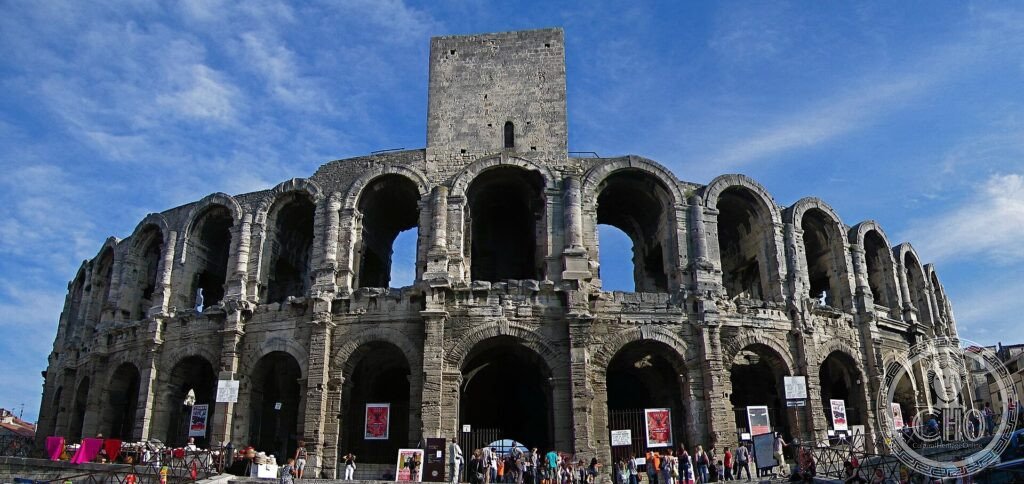
Arles was the «little Rome of the Gauls»: an amphitheatre for twenty thousand spectators, a theatre, baths, cryptoporticoes, a necropolis that pilgrims believed to be blessed. And when the Empire fell, the arena became a fortress town with two hundred houses inside it. A thousand years later, the Romanesque portal and cloister of Saint-Trophime gave the city a second masterpiece.
At a glance
Arles, on the Rhône at the edge of the Camargue, was one of the great cities of Roman Gaul — favoured by Caesar and by Constantine, who held court here — and it preserves an exceptional group of Roman monuments alongside the Romanesque masterpieces of its medieval revival. The amphitheatre, the theatre and the underground galleries date from the 1st century; the baths of Constantine and the Alyscamps necropolis from a 4th-century golden age; and the church and cloister of Saint-Trophime from the 12th. UNESCO listed “Arles, Roman and Romanesque Monuments” in 1981 as a model of an ancient city carried over into medieval Europe.
Key facts
- UNESCO: World Heritage since 1981 (Arles, Roman and Romanesque Monuments)
- The Amphitheatre (Arènes): built around AD 90, 136 × 109 m with two tiers of 60 arches each; held some 20,000 spectators — still used for events today
- The Roman Theatre: late 1st century BC, one of the earliest in the Roman West; its two surviving columns are an emblem of the city
- Late-antique Arles: the Baths of Constantine and the Alyscamps necropolis recall the city’s 4th-century splendour, when it was an imperial residence
- Saint-Trophime: the Romanesque church with its carved portal (a Last Judgment) and its cloister are among the finest in Provence
- Medieval reuse: after Rome fell, the amphitheatre was turned into a walled town with towers and more than 200 houses inside — cleared only in the 19th century
History
Roman Arelate prospered as a port linking the Mediterranean to the Rhône; rewarded by Julius Caesar for backing him against Marseille, it was endowed with all the monuments of a great Roman city — forum, theatre, amphitheatre, circus, baths. Under Constantine in the 4th century it became an imperial capital of the West, and later the seat of the prefecture of Gaul. The arena hosted gladiatorial games and beast-hunts before crowds of twenty thousand.
As the Empire collapsed, the people sheltered inside the great stone arena, walling it and filling it with houses and chapels until it was a fortified town in its own right. Arles revived again in the 11th and 12th centuries as a centre of the church and of the pilgrimage roads, building Saint-Trophime; the houses inside the amphitheatre were removed only in the 1820s, restoring the Roman monument we see today.
What you see
The amphitheatre still dominates the old town, its two storeys of arches ringing an arena where bullfights and concerts are held; three medieval towers, left from its fortress centuries, rise above the Roman stone. A short walk away, the Roman theatre keeps its two tall columns and part of its tiered seating, still used for the city’s summer festivals. Beneath the old forum run the cryptoporticus, vast U-shaped underground galleries that once supported the public square.
On the central square, Saint-Trophime offers the other Arles: its 12th-century portal carved with Christ in majesty and the Last Judgment, and, behind, a cloister whose capitals are a high point of Romanesque sculpture. South of the centre lies the Alyscamps, the avenue of antique sarcophagi painted by Van Gogh and Gauguin.
Practical information
- Visiting: the amphitheatre, theatre, cryptoporticus, baths, Alyscamps and Saint-Trophime cloister are ticketed (a combined “Arles Pass” covers the monuments)
- Events: the arena hosts the Féria and concerts; the theatre, summer festivals
- Time needed: a full day for the Roman and Romanesque circuit
Getting there
Arles is on the Rhône in the Bouches-du-Rhône. Trains link it to Avignon, Nîmes and Marseille; the monuments are all within the walkable old town. GPS (Amphitheatre): 43.6778° N, 4.6314° E.
Nearby
- Fondation Van Gogh & the painter’s Arles — the places he painted in 1888–89
- The Camargue — the Rhône delta of flamingos, white horses and salt, south of the city
- Nîmes & the Pont du Gard — more of Roman Provence, to the west
Sources
- UNESCO World Heritage Centre — “Arles, Roman and Romanesque Monuments” (ref. 164)
- Arles Tourisme / Musée départemental Arles antique
- Encyclopaedia Britannica — Arles
Find it on the map
See this place and what’s around it →📷 Become a Cultural Heritage Online photographer
Share your photos of places: they stay published under your name as the author. The more they're seen, the more you get noticed — and soon a contest will reward the most appreciated photos.
Log in or sign up free to add a photo