
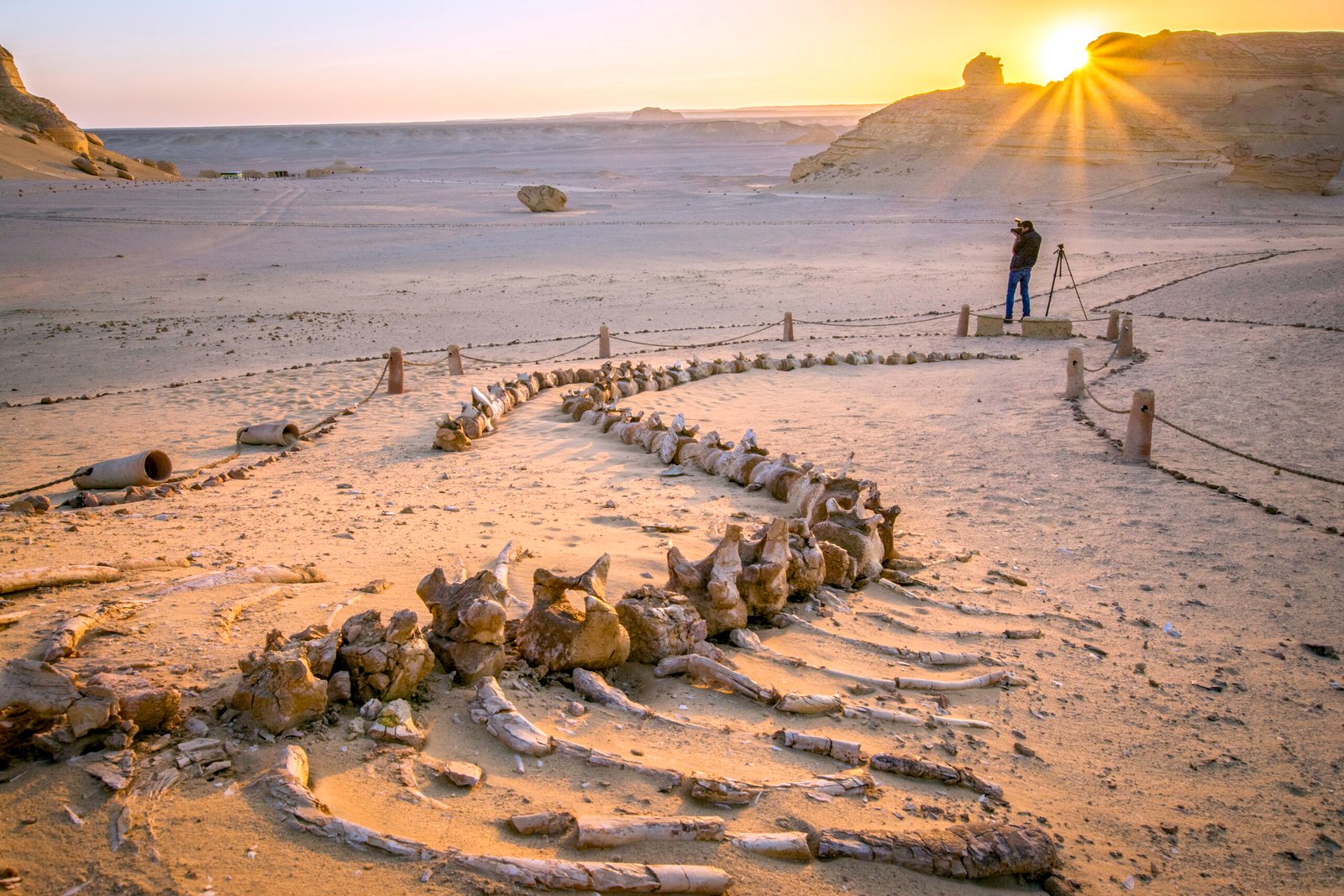
In the Western Desert of Egypt, approximately 150 kilometres southwest of Cairo, lies one of the most scientifically important landscapes on Earth: Wadi el-Hitan — the Valley of the Whales. Here, in a depression of the Fayyum Oasis region, 40 million years of erosion have stripped away the rock layer by layer until the bones of ancient whales lie exposed on the desert surface like enormous scattered puzzle pieces. These fossils are the definitive evidence for one of evolution’s most dramatic documented transitions: the descent of modern whales from land-dwelling, four-legged mammals. UNESCO World Heritage Site since 2005.
When This Desert Was a Sea
Between approximately 40 and 34 million years ago, the Eocene epoch, the area now occupied by the Western Desert of Egypt was covered by a shallow, warm inland sea — the southern edge of the ancient Tethys Ocean. This sea was rich in fish and other marine life; it was also the place where the ancestors of modern whales were completing their transformation from land to water.
The geological record is precise: the rock layers at Wadi el-Hitan date to the Eocene and contain the fossilized remains of archaeocete whales — the most ancient fully aquatic whales known to science. These animals are not the whales’ evolutionary ancestors (those were earlier, semi-aquatic creatures) but their immediate predecessors: the first whales to have committed entirely to an aquatic life, still carrying in their skeletons the residual evidence of the land-dwelling past from which they came.
Over the 40 million years since the sea retreated, differential erosion in the Fayyum Depression has stripped away the overlying sediment to expose the fossils. The desert surface at Wadi el-Hitan is essentially the floor of that ancient sea, now visible in the open air.
Basilosaurus and Dorudon: The Key Fossils
The two whale species whose remains dominate the Wadi el-Hitan fossil beds are Basilosaurus and Dorudon. Basilosaurus — whose misleading name (it means “king lizard”, assigned before its mammalian nature was understood) was never corrected despite being incorrect — was a genuinely enormous animal: up to 18 metres in length, the largest animal on Earth at that time. It is believed to have been an apex predator of the Eocene seas.
Dorudon was smaller — approximately 5 metres — and more dolphin-like in overall body plan. Both species had long, serpentine bodies with forelimbs modified into flippers; both had lost their hind limbs in most functional respects. But crucially, both retained small, vestigial rear limbs: non-functional remnant legs that prove, beyond any reasonable doubt, that their ancestors had walked on land.
These vestigial hind legs — discovered in the 1990s at Wadi el-Hitan — resolved a longstanding scientific puzzle. The fossil record already pointed to the hoofed mammals (artiodactyls, related to hippopotamuses and deer) as the ancestors of whales; the discovery of functional but reduced hind limbs in archaeocete fossils confirmed the sequence. Modern molecular biology has since confirmed this evolutionary connection through DNA analysis.
The Open-Air Museum
More than 400 individual whale skeletons have been identified at Wadi el-Hitan. The density suggests that this particular area of the shallow Eocene sea served as a congregation zone — possibly a feeding ground, possibly a birthing area — where whales gathered and, when they died, their remains accumulated in sediment that preserved them exceptionally well over geological time.
The experience of visiting Wadi el-Hitan is unlike any conventional museum. Several complete or near-complete whale skeletons are left in situ: lying on the desert sand where erosion has exposed them, protected by minimal shelters from the worst of the desert wind and sun, but essentially untouched and unreconstructed. Visitors walk among the bones on designated paths. Some skeletons show sharks’ tooth marks on the bones — evidence of scavenging after death. Others have the fossilized remains of fish preserved inside what was the whale’s gut at the time of death: the last meal, 40 million years old.
There is no narrative device here, no theatrical lighting or interactive display. The bones are simply there, on the desert floor, in the same approximate position they fell when the ancient whale died in an ancient sea. The effect is extraordinary: the flatness of the Fayyum Depression, the silence, the scale of the skeletons, and the visibility of the individual bones create an encounter with deep time that no museum reconstruction can replicate.
UNESCO Recognition
UNESCO inscribed Wadi el-Hitan on the World Heritage List in 2005 under natural criteria: outstanding universal value as the most important site in the world for demonstrating one of the great evolutionary transitions documented in the fossil record — the origin of whales from land-dwelling mammals. The inscription specifically notes the site’s scientific significance as providing the most complete, in-situ fossil record of this evolutionary sequence available anywhere.
The site is a protected national park administered by the Egyptian Environmental Affairs Agency (EEAA). A small visitor center and fossil museum have been established at the site entrance; the museum provides context for the open-air fossil field, with specimens, diagrams, and explanatory material about the Eocene environment and the whale evolution story.
Visitor Information
Wadi el-Hitan is located in the Fayyum Governorate of Egypt, approximately 150 km southwest of Cairo and about 80 km southwest of the city of Fayyum. The access road from Fayyum city is paved for most of the route but becomes rough track for the final section; a 4WD vehicle is recommended, particularly after rain. Several tour operators in Cairo and Fayyum offer day-trip excursions to the site; independent visitors with 4WD can drive directly.
The site opens at sunrise and closes at sunset; entry fees apply. The main fossil field is accessible on a clearly marked walking route; rangers are present and guide visitors through the key specimens. The best visiting period is October through April: summer temperatures in the Western Desert are extreme, and the site has no shade outside the visitor center.
The Broader Fayyum Heritage
Wadi el-Hitan sits within a region of multiple layered heritage. The Fayyum Depression itself — the largest oasis in Egypt, fed by a branch of the Nile — contains extensive Pharaonic, Graeco-Roman, and Byzantine remains, including the Crocodile City of Karanis (an exceptionally preserved Graeco-Roman town) and the Fayyum Portraits — the extraordinary panel paintings produced between the 1st and 3rd centuries AD that constitute the earliest surviving examples of naturalistic portraiture in Western art. Birket Qarun (Lake Qarun), the ancient Lake Moeris of classical sources, occupies the northern depression; its shores were a favored hunting ground of Egyptian pharaohs.
For visitors combining Wadi el-Hitan with Fayyum’s other sites, the Fayyum Oasis is accessible as a day trip from Cairo or as an overnight stay with accommodation available in Fayyum city and at several lake-shore lodges near Birket Qarun.
Find it on the map
See this place and what’s around it →📷 Become a Cultural Heritage Online photographer
Share your photos of places: they stay published under your name as the author. The more they're seen, the more you get noticed — and soon a contest will reward the most appreciated photos.
Log in or sign up free to add a photo