
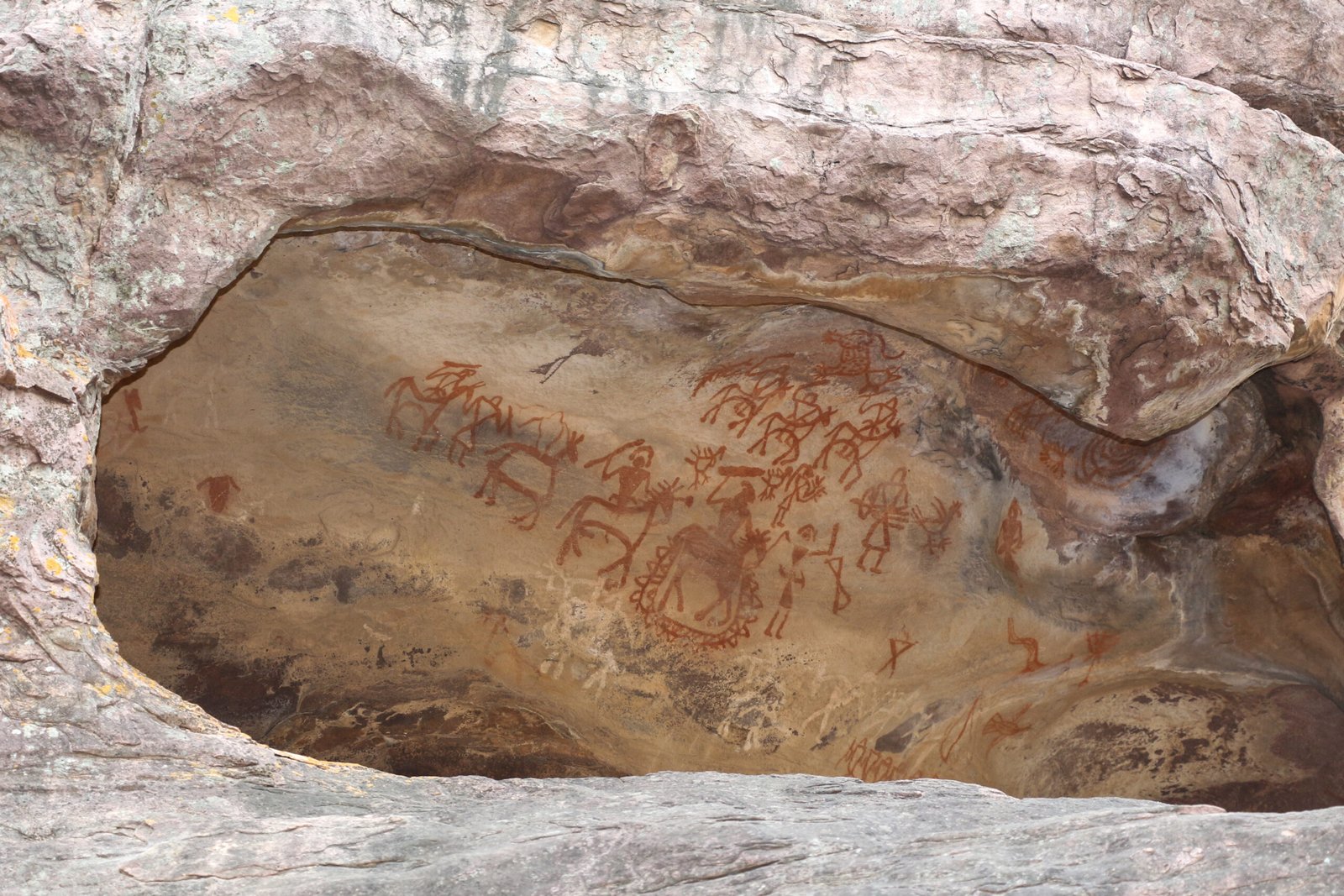
In the Vindhya Range foothills of Madhya Pradesh, central India, a complex of more than 700 natural rock shelters contains the most temporally extensive collection of prehistoric rock paintings in the world — images spanning from approximately 30,000 BC to the medieval period. Bhimbetka is not merely an archaeological record: it is a living tradition. The same visual motifs that appear in its oldest paintings can be found today in the folk art of Gond tribal communities whose villages surround the shelters — a 30,000-year thread of continuous artistic expression still unbroken. UNESCO World Heritage Site since 2003.
Thirty Thousand Years of Painted Time
At least 243 of Bhimbetka’s 700-plus rock shelters contain paintings. The oldest belong to the Upper Palaeolithic period (c. 30,000–10,000 BC): large animals rendered in green and dark red — bison with massive horns, rhinoceroses moving across the rock face, bears in profile. These earliest images share a stylistic vocabulary with Upper Palaeolithic cave art in Europe — the same tendency toward accurate animal silhouette, the same use of the rock surface’s natural contours to give volume to a painted form.
The Mesolithic period (c. 8000–4000 BC) produced the most numerous and dynamically energetic paintings at Bhimbetka: hunting scenes rendered with extraordinary narrative compression, communal dances where human figures form rhythmic processions across the rock, stick figures running, jumping, engaged in the daily activities of a hunter-gatherer community that seems, across 10,000 years of artistic production, to have been perpetually in motion.
Later periods — the Chalcolithic, the historical — introduce new subjects: horses, elephants, writing-like symbols. Each layer is a visual stratum; the full sequence at Bhimbetka constitutes an uninterrupted pictorial history of human life in central India across the entire time span that separates us from the last Ice Age.
A Living Tradition: The Gond Connection
The most remarkable feature of Bhimbetka is not its antiquity — it is its continuity. Several specific motifs, particularly a characteristic style of human figure and a cup-mark pattern created by pressing a pointed tool into the rock surface, appear in BOTH the prehistoric paintings inside the shelters AND in the folk art still produced today by Gond tribal communities in the surrounding villages.
The Gond are one of India’s largest indigenous peoples, with a documented presence in the Vindhya region stretching back for millennia. Whether their visual traditions descend in direct cultural continuity from the prehistoric painters of Bhimbetka, or whether they independently rediscovered and adopted similar forms, is debated by anthropologists. The visual evidence for a connection is striking regardless of its mechanism: standing in a Bhimbetka shelter and comparing a 10,000-year-old figure on the rock wall to a contemporary Gond painting is one of the most remarkable experiences of cultural continuity available anywhere in the world.
The Discovery: A Window from a Train
Bhimbetka was unknown to archaeology until 1957, when Indian archaeologist Vishnu Shridhar Wakankar noticed the rocky quartzite hills rising from the surrounding plain while traveling by train through Madhya Pradesh. Something about the particular shape of the outcrops — eroded into the rounded mushroom forms that create natural overhangs — reminded him of prehistoric shelters he had seen in France and Spain. He stopped at the next station, returned to investigate, and found the paintings.
The site had not been hiding, exactly. Local communities knew the shelters and used them: Wakankar found, at the time of his discovery, that the shelters were still being used by local people for exactly the purposes they had served for 30,000 years — shelter, refuge, and meeting places. The shelters’ utility is unchanged; only the archaeologist’s recognition of their age was new.
The Rock Shelters: Geology and Structure
The shelters at Bhimbetka are created by differential erosion in the Vindhyan sandstone and quartzite. Harder rock caps protect softer layers below; over millions of years, the soft layers erode to leave overhanging rock shelters — naturally roofed spaces ranging from small alcoves to large chambers 30 metres across. The paintings are on the inner surfaces of these overhangs, protected from direct rain by the rock above and from ground moisture by the elevated stone floor.
The Vindhya Range itself runs east-west across the subcontinent; the Bhimbetka shelters sit in the foothills where the range descends toward the Narmada River plain. The landscape is dense dry deciduous forest: teak, sal, mahua. The forest provides cover that would have made the shelters difficult to see from a distance — which may explain why systematic archaeological discovery waited until the twentieth century despite the site’s extensive use by local communities throughout recorded history.
UNESCO Recognition and Archaeological Significance
UNESCO inscribed Bhimbetka Rock Shelters on the World Heritage List in 2003, citing the outstanding testimony to the beginning of the South Asian Stone Age and the development of human ingenuity and cultural evolution across an unmatched time span. The inscription also notes the evidence for early human settlement in the region going back to the Acheulean period — stone tools found at Bhimbetka indicate human activity at the site as far back as 100,000 years ago, predating the oldest paintings by 70,000 years.
The paintings themselves are classified as Criterion (iii) — exceptional testimony to a cultural tradition — and Criterion (v) — outstanding example of traditional human settlement. The combination of prehistoric rock art with evidence of continuous occupation and a living descendant tradition makes Bhimbetka unusual among World Heritage rock art sites.
Visitor Information
Bhimbetka is located approximately 46 km south of Bhopal, the capital of Madhya Pradesh, on National Highway 46. The site is accessible by road from Bhopal (roughly 1 hour by car or taxi); there is no direct public bus service to the shelters themselves from Bhopal, but shared auto-rickshaws and local buses run to Obaidullaganj village nearby, from which auto-rickshaws cover the remaining 9 km.
The Archaeological Survey of India manages the site; entry is via a ticket booth at the main gate. A marked trail connects the main viewable shelters; the most famous (Shelter 7, known as the Zoo Rock for its density of animal images) and Shelter 8 are within easy walking distance of the entrance. Visiting hours run from sunrise to sunset; the site is closed on Fridays. Photography is permitted without flash inside the shelters.
Related Places
Madhya Pradesh’s heritage landscape extends well beyond Bhimbetka. Sanchi, 46 km north of Bhopal, contains the oldest surviving stone structures in India — the Mauryan-era Buddhist stupas that include the Great Stupa of Ashoka (3rd century BC), another UNESCO World Heritage Site. Khajuraho, approximately 375 km northeast of Bhopal, contains the famous medieval temple complex known for its erotic sculptures.
In the broader context of prehistoric rock art, Bhimbetka belongs to a global family of sites that includes Cueva de las Manos in Argentina, the Chauvet Cave in France, and the rock paintings of the Drakensberg in South Africa — each a window onto the same universal human impulse to mark stone with meaning.
Find it on the map
See this place and what’s around it →📷 Become a Cultural Heritage Online photographer
Share your photos of places: they stay published under your name as the author. The more they're seen, the more you get noticed — and soon a contest will reward the most appreciated photos.
Log in or sign up free to add a photo