

The Polish Pompeii — an Iron Age lake village preserved in anaerobic sediment for 2,500 years, whose wooden houses, streets, and towering palisade were excavated intact, revealing the most completely known prehistoric community in Europe.
At a glance
In a shallow lake near the town of Żnin in central Poland, the wooden island settlement of Biskupin was built around 738 BC by the Lusatian culture and occupied for roughly 250 years before being abandoned when rising lake levels submerged its foundations around 500 BC. The anaerobic lake sediment preserved the timber structures with extraordinary completeness — enough for archaeologists, beginning in 1934, to reconstruct the entire settlement plan in detail and to date its construction by tree-ring analysis to within a single decade.
What emerged from excavation was not a village shaped by accident and accumulation but a precisely planned community: an artificial island enclosed by a defensive palisade of 35,000 oak posts driven diagonally into the lake bed, with 13 parallel rows of identical long-houses lining a single main street, providing standardised accommodation for an estimated 700–1,000 inhabitants. The regularity of the layout — a pre-state society that built as if following a blueprint — has made Biskupin one of the most discussed sites in European prehistoric archaeology.
Key facts
- Culture: Lusatian culture (late Bronze Age / early Iron Age)
- Construction dated: 738 BC by dendrochronology (tree-ring analysis)
- Abandoned: c. 500 BC, likely due to rising lake levels
- Island circuit: palisade approximately 450 metres in circumference
- Houses: approximately 100 identical long-houses, each c. 9 × 8 metres
- Population estimate: 700–1,000 people
- Palisade posts: over 35,000 oak posts driven diagonally into the lake bed
- Protected status: UNESCO Tentative List; Polish National Historic Monument
History
The Lusatian culture occupied a broad swathe of central Europe from roughly 1300 to 500 BC, a society whose material culture — distinctive pottery, bronze metalwork, cremation burial — spread across modern Poland, Germany, and the Czech Republic without, as far as archaeology can establish, a corresponding political unity. The builders of Biskupin were a local Lusatian community living in the lake district of what is now the Kuyavian-Pomeranian region of central Poland. Their decision to build in the lake — rather than on the adjacent shore — reflects a combination of defensive logic (water as moat) and practical engineering: the shallow lake bottom offered stable founding conditions for the log platform on which the settlement was raised, and the water itself provided fish, waterfowl, and reeds for thatch.
Construction began in 738 BC — a date established with unusual precision by the dendrochronology of the preserved timbers. The alder logs used for the foundation platform are among the earliest precisely dated construction timbers in European archaeology. The settlement was built largely in a single coordinated episode over roughly a decade, suggesting either a strong communal authority capable of organising hundreds of workers or the resettlement of an existing community that replicated its previous organisation in the new location. The village was abandoned around 500 BC, most likely as lake water levels rose and the outer palisade foundations became waterlogged beyond repair.
The site was rediscovered in 1933 by a local teacher, Walenty Szwajcer, who noticed wooden stakes emerging from the dried lake bed during a summer drought. Systematic excavation began the following year under Józef Kostrzewski and continued with interruptions — including wartime disruption when German archaeologists briefly renamed the site Urstädt and attempted to reframe it as Germanic heritage — until the 1970s. Today the archaeological park at Biskupin includes both the original excavation trenches and a full-scale open-air reconstruction of a section of the settlement, including the outer palisade and breakwater, the gatehouse, and several long-houses.
What you see
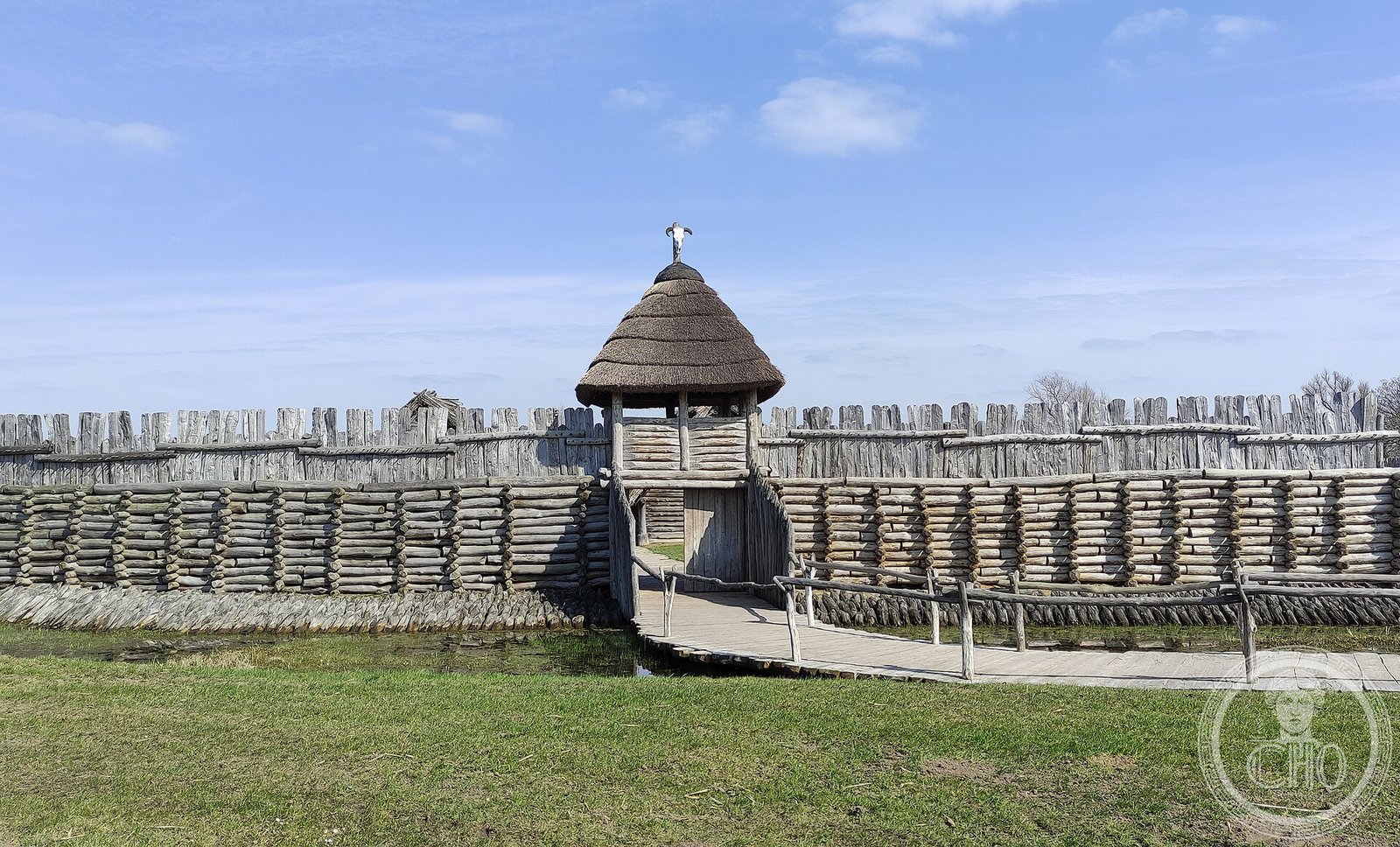
The defensive system of Biskupin is its most immediately striking feature. The outer ring was not a simple wooden fence but an inclined palisade — 35,000 oak posts driven at an angle into the lake bed to form a continuous sloped wall approximately 3 metres high — designed to deflect attackers rather than simply block them. Behind this outer palisade ran a breakwater of wooden logs laid horizontally in a crib pattern, creating a second barrier and also protecting the island platform from wave erosion. The single entrance gateway, reconstructed at the archaeological park, gives a vivid sense of the controlled access to the settlement: a narrow wooden corridor flanked by timber walls, leading through the palisade to the interior street system.
Inside, 13 parallel rows of long-houses were arranged along a main street running the length of the island, with each house divided into a vestibule (which served as storage and animal shelter) and a main room with an open hearth and raised sleeping platforms along the walls. The floor plan of every house was essentially identical — approximately 9 metres by 8 metres — a standardisation remarkable in a prehistoric context. The streets between the house rows were paved with split logs laid transversely to prevent mud, and the main street was wide enough for a cart. All of this survived because the rising lake waters that drove the community away also sealed the wooden structures in anaerobic conditions that prevented bacterial decay.
Practical information
- Address: Biskupin Archaeological Museum, ul. Biskupińska, 88-410 Gąsawa, Poland
- Opening hours: April–October daily 08:00–18:00; November–March Tue–Sun 09:00–16:00 (verify before visiting)
- Admission: Charged; discounts for students and children
- Annual festival: Archaeological Festival of Biskupin (September) — one of Poland’s largest outdoor history events
- On site: Open-air reconstruction, covered excavation trenches, permanent exhibition museum, guided tours
Getting there
Biskupin lies approximately 70km south of Bydgoszcz and 60km northeast of Gniezno in the Kuyavian-Pomeranian region. By car from Poznań (approx. 90km): take the S5 expressway north toward Bydgoszcz, exit at Żnin, then follow signs to Biskupin. A narrow-gauge tourist railway (Żnin–Gąsawa–Wenecja) operates seasonally between Żnin and Biskupin station. Direct bus connections from Żnin operate on market days and during the summer season.
Nearby
- Gniezno Cathedral (60km south): seat of the first Polish archbishopric, with the bronze Gniezno Doors (c. 1170 AD) depicting the life of St Adalbert
- Wenecja Castle ruins (12km northwest): 14th-century Gothic keep on the Gąsawa lake shore, adjacent to the narrow-gauge railway route
- Piast Route: Biskupin lies on the cultural tourism route connecting the earliest sites of Polish state formation — Gniezno, Poznań, Ostrów Lednicki
Sources
- Rajewski, Z. (1959). Biskupin: A fortified settlement dating from 700–400 B.C. Poznań: PTPN.
- Harding, A. (2000). European Societies in the Bronze Age. Cambridge University Press.
- Wikipedia: Biskupin
- Biskupin Archaeological Museum: biskupin.pl
Find it on the map
See this place and what’s around it →📷 Become a Cultural Heritage Online photographer
Share your photos of places: they stay published under your name as the author. The more they're seen, the more you get noticed — and soon a contest will reward the most appreciated photos.
Log in or sign up free to add a photo