
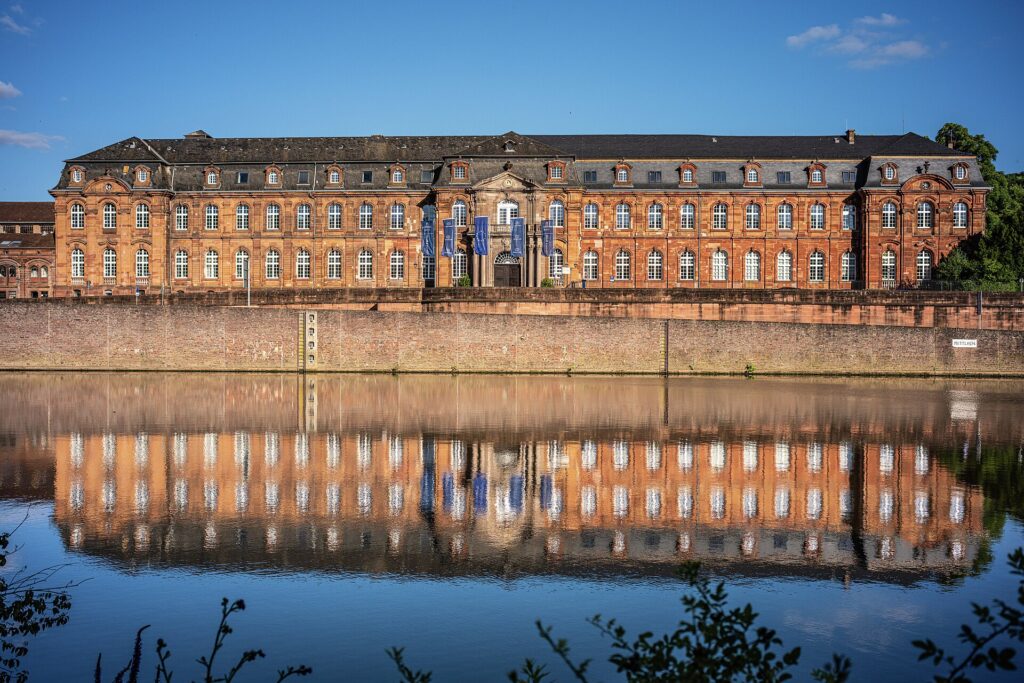
The global headquarters of Villeroy & Boch occupies a former Benedictine abbey on the river Saar — a Carolingian foundation rebuilt in the seventeenth century, seized in the Revolution, and repurposed for ceramic manufacturing in 1809. Inside the abbey church, the Keravision experience museum traces 260 years of tile and tableware history; outside stands the Alte Turm, an octagonal chapel from 994 AD and one of the oldest surviving structures in the Saarland.
At a glance
The Villeroy & Boch Erlebniszentrum (Experience World) at Mettlach is the company’s flagship heritage destination: part museum, part factory outlet, part architectural monument. The site combines the former Abbey of Mettlach — a building complex rooted in medieval monastic history — with the living operations of one of Europe’s largest ceramic manufacturers. The centrepiece of the museum experience is Keravision, an immersive installation within the former abbey nave that tells the story of ceramic production and design from the eighteenth century to the present. The adjacent factory outlet is one of the largest of its kind in Germany. The ensemble sits directly on the Saar river, making it a natural stop on the Saarland’s scenic river routes.
History
The Abbey of Mettlach was founded in the late seventh or early eighth century. The Alte Turm — the octagonal Carolingian chapel that still stands on the grounds — dates from 994 AD, a remnant of the tenth-century Benedictine reform building programme. The abbey was dissolved during the French Revolutionary period and its properties confiscated. In 1809, Jean-François Boch purchased the secularised abbey buildings and established a faïence (tin-glazed earthenware) factory within them — an act that began the company’s Mettlach chapter. The Villeroy & Boch merger followed in 1836, when the Boch family combined operations with Nicolas Villeroy’s Vaudrevange factory, creating the group that would become one of Europe’s dominant ceramic producers. Throughout the nineteenth century, Mettlach developed a speciality in Mosaic and stoneware products, including the Mettlacher Platte (Mettlach tiles) that covered the floors of major public buildings across Germany and beyond. In the twentieth century the company expanded into bathroom fixtures and tableware; today the Mettlach headquarters continues to produce tiles and serves as the group’s symbolic and administrative centre.
What you see
The Alte Turm is the non-negotiable centrepiece: an octagonal Carolingian chapel with a crypt, standing approximately 14 metres high, built in 994 AD as a funerary chapel for the abbots of Mettlach. Its round arches and stone masonry represent pre-Romanesque Carolingian architecture at its most legible, and the structure is one of the few buildings in Saarland that predates the year 1000. The former abbey church now houses Keravision, an immersive multimedia experience that uses projections, models, and original pieces to trace the company’s 260-plus year history. Highlights include the papal tableware produced for Pope Benedict XVI, mosaic panels from major European public buildings, and a reconstruction of the nineteenth-century Mettlach tile production process. The factory outlet building adjacent to the abbey sells the full current range of Villeroy & Boch products across all categories.
Cultural significance
The Mettlach site is one of Germany’s most compelling examples of industrial heritage layered over monastic heritage. Few factory sites in Europe can claim a building from 994 AD within their perimeter. The Alte Turm alone would justify a heritage visit; combined with a company history that shaped the material culture of German and European domestic interiors over two and a half centuries, the ensemble is unusually rich. For Saarland — a region whose industrial identity was shaped by steel, coal, and ceramics — Villeroy & Boch Mettlach is a primary symbol of the transition from heavy industry to design-led manufacturing. The company’s survival and continued headquarters presence in the town reflects a commitment to the site that goes beyond economic logic alone.
Key facts
- Villeroy & Boch founded 1748 (Villeroy) / 1836 (merger with Boch)
- Site: former Benedictine Abbey of Mettlach, secularised 1794, industrial use from 1809
- Alte Turm (Octagon): Carolingian chapel, 994 AD — one of the oldest structures in Saarland
- Keravision museum: immersive exhibition inside the former abbey church
- Papal tableware for Pope Benedict XVI produced at Mettlach
- Factory outlet: one of the largest V&B outlets in Germany
- Location: Saaruferstraße 1-3, 66693 Mettlach, Saarland
Practical information
The Erlebniszentrum is open Monday to Saturday from 09:30 to 18:00 and on Sundays from 10:00 to 18:00 (hours may vary seasonally; check the website). Admission to Keravision is charged; access to the factory outlet and abbey grounds (including the Alte Turm exterior) is free. The Alte Turm crypt can be entered during opening hours at no additional charge. Audio guides are available in German, English, and French for the Keravision experience. The factory outlet accepts all major cards. The site is accessible to wheelchair users throughout. A restaurant serves regional Saarland dishes on the river terrace.
Getting there
Mettlach is in the Saarland, approximately 40 kilometres southwest of Saarbrücken. By car from Saarbrücken: take the B51 south along the Saar valley; Mettlach is well signposted and the abbey complex is visible from the river road (approximately 45 minutes). By rail: take a regional train from Saarbrücken to Merzig, then a connecting regional service or bus to Mettlach (total journey approximately 1 hour). The site is directly on the Saar cycle route (Saarradweg), making it accessible to cyclists following the river from Saarbrücken or Trier. Free parking is available in the large car park adjacent to the abbey complex.
Sources & resources
- Villeroy & Boch Erlebniszentrum: villeroy-boch.com/mettlach
- Saarland regional heritage documentation: saarland.de/kulturerbe
- Alte Turm Mettlach: listed monument, Saarland Denkmalliste
- Beeh-Lustenberger, Suzanne, Das Steingut und die feinen Steinzeuge von 1840 bis 1900 (Frankfurt, 1982)
Find it on the map
See this place and what’s around it →📷 Become a Cultural Heritage Online photographer
Share your photos of places: they stay published under your name as the author. The more they're seen, the more you get noticed — and soon a contest will reward the most appreciated photos.
Log in or sign up free to add a photoIs this page about you?
This page is read by travellers and heritage enthusiasts who find it on Google. Tell us how you are connected to this place and we will take it from there.