
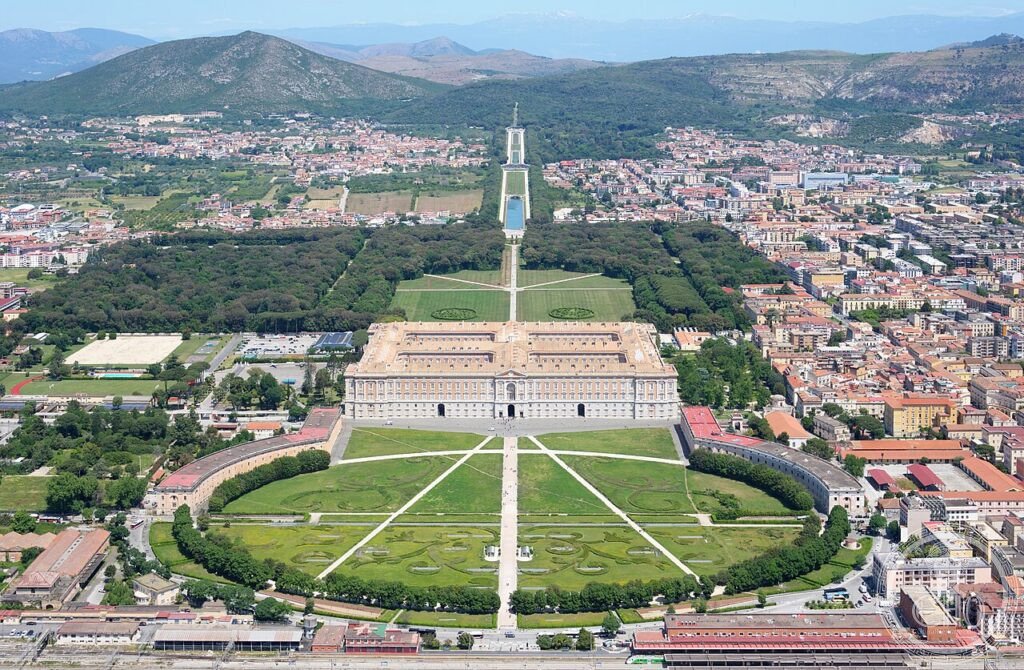
The largest royal palace in the world by volume: 1,200 rooms, 1,790 windows, 34 km of aqueduct, and a park of 120 hectares that ends in a cascade of waterfalls — all designed by Luigi Vanvitelli for the Bourbon King of Naples as an Italian answer to Versailles.
At a glance
The Reggia di Caserta was commissioned in 1751 by Charles III of Bourbon, King of Naples, and designed by the Neapolitan architect Luigi Vanvitelli (1700–1773). The palace covers 47,000 square metres of floorspace across four identical courtyards; the garden axis runs 3 km from the north façade to the Grande Cascata waterfall at the end of the park. Vanvitelli designed everything at the site — palace, chapel, theatre, park, fountains, and the 38 km Carolino Aqueduct that supplied all the park water — as a single unified composition visible from the air as a Roman military camp redrawn in the Baroque idiom. UNESCO inscribed it in 1997 under criteria i, ii, iii, and iv, noting it as “one of the outstanding masterpieces of late-Baroque art.”
Key facts
- Dimensions: 249 m × 190 m × 36 m high; 1,200 rooms; 1,790 windows; 1,026 fireplaces
- Architect: Luigi Vanvitelli, 1700–1773; continued by his son Carlo Vanvitelli after 1773
- Construction: 1752–1780; 40,000 workers employed; sandstone from Monte Virgo quarries
- Cappella Palatina: modelled on the Versailles chapel; octagonal dome; frescoes by Domenico Mondo and others
- Teatro di Corte: horseshoe-plan court theatre; capacity 500; original Bourbon box preserved
- Parco e Giardino Inglese: 120 hectares; 3 km vista axis; Cascata Grande — 78 m waterfall; English Garden (1785, John Andrew Graefer)
- Acquedotto Carolino: 1753–1762, Vanvitelli; 38 km, 529 arches; still operative
- UNESCO inscription: 1997, criteria i, ii, iii, iv
- Coordinates: 41.0745° N, 14.3265° E — Google Maps
History
Charles III of Bourbon (1716–1788) became King of Naples in 1734 and immediately began planning a new capital worthy of a major European monarchy. The site of Caserta was chosen for its distance from the coast (a strategic buffer against naval raids), its flat terrain suitable for the axial garden, and its proximity to hunting grounds in the hills. Charles commissioned Vanvitelli in 1751; the foundation stone was laid on 20 January 1752. Vanvitelli worked on the project until his death in 1773; his son Carlo completed the garden and chapel.
The palace entered its most splendid period under Ferdinand IV of Bourbon (reigned 1759–1825), who added the English Garden in 1785 on the advice of Sir William Hamilton (the British envoy and husband of Emma Hamilton, later Nelson's companion). Marie Caroline of Austria, Ferdinand's consort, used the palace as her principal residence; her apartments in the southern wing were decorated in the Neoclassical style by Gioacchino Toma and Antonio De Simone. Napoleon's brother Joseph Bonaparte and, after him, Joachim Murat held court here during the French decade (1806–1815); Allied forces used the palace as headquarters in 1943–1945 and it was here that the German surrender in Italy was signed on 29 April 1945.
What you see
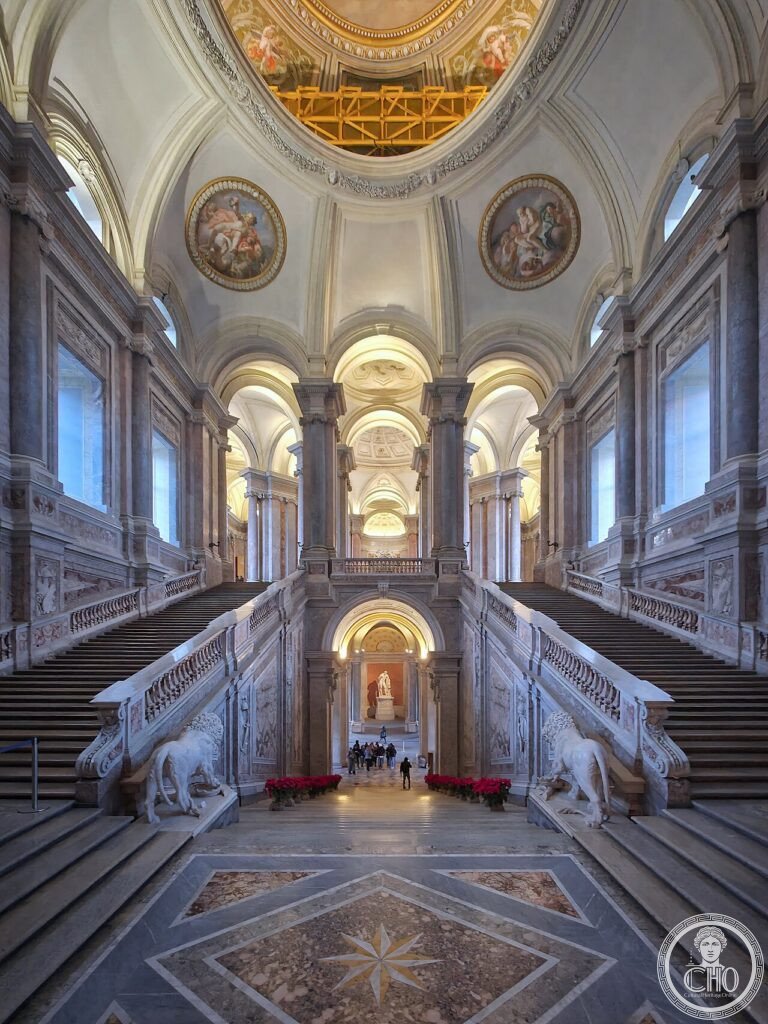
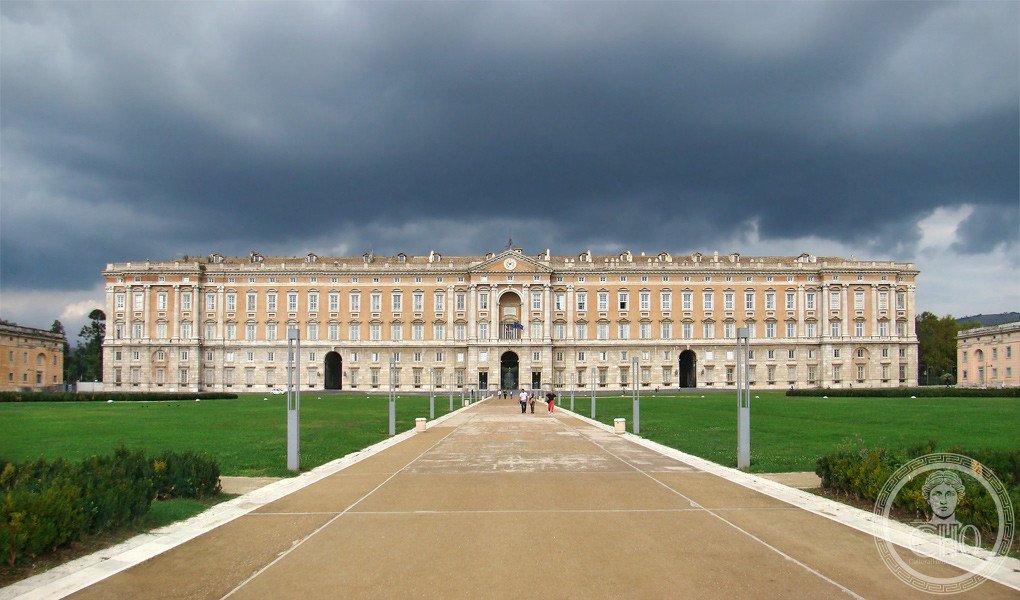
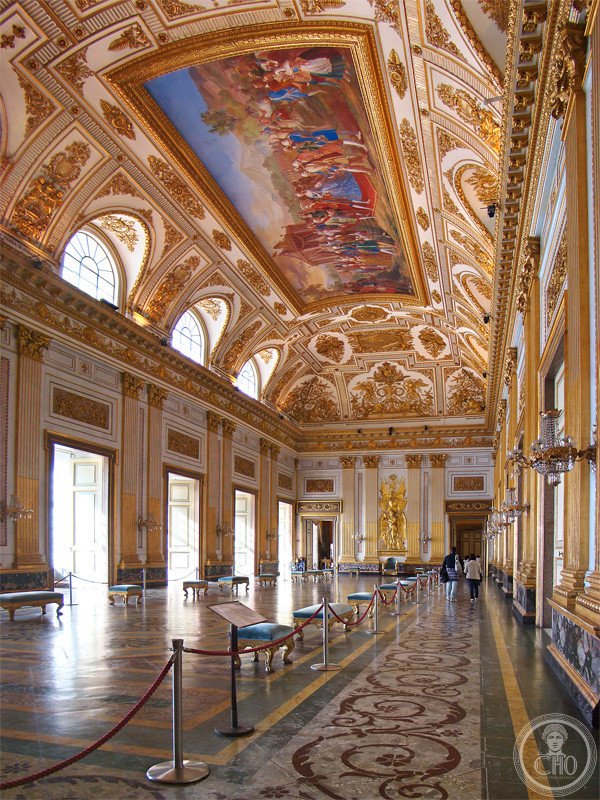
The north façade presents a succession of 243 windows per storey across its 249-metre width, divided by pilasters in the giant order that give the building its taut vertical rhythm despite the horizontal spread. From the entrance vestibule, three identical barrel-vaulted passages lead to the octagonal central atrium, where the Grand Staircase (Scalone d'Onore, 1752–1774) rises between ramping balustrades of white Carrara marble inlaid with grey African marble. The staircase is Vanvitelli's single greatest invention: a double-ramped structure that arrives at a landing supported by 16 columns, then divides into two converging upper flights under a barrel-vaulted ceiling that seems, from below, to extend to infinity.
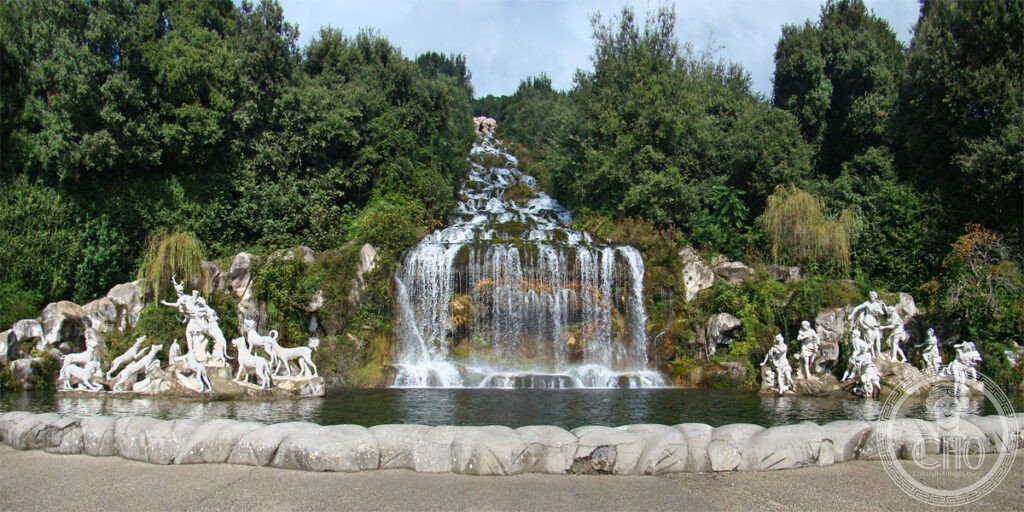
The garden axis is the building's true climax. From the north terrace, the eye travels 3 km along the central canal past 14 fountains to the Cascata Grande, which falls 78 metres down a hillside landscape of mythological sculptures (Diana and Actaeon; the Fountain of Ceres; the Fountain of Aeolus). The English Garden occupies the northeast corner of the park: a studied informality of winding paths, artificial ruins, a Temple of Venus, a bathing pool, and specimen trees that contrasts deliberately with the geometric perfection of the main axis. Its 1785 date makes it one of the earliest English Gardens in southern Italy.
Practical information
- Opening hours: Wednesday–Monday 08:30–19:30 (last entry 18:00); closed Tuesday
- Tickets: reggiaDicaserta.it; combined palace + park tickets; reduced for EU under-18
- Park transport: Shuttle train runs the 3 km from palace to Cascata Grande (fee); bicycle rental at entrance
- Time needed: 2 hours minimum for palace; 3–4 hours for full park; full day with English Garden
- Photography: Permitted throughout; tripods require advance permission
Getting there
Caserta railway station is 500 metres from the palace entrance (walk through Piazza Carlo III). Frequent Trenitalia regional trains from Naples Centrale (35 minutes) and Rome Termini (1 hour 30 minutes). By car: A1 motorway exit Caserta Sud, follow signs to Reggia; free parking in Piazza Carlo III. Naples International Airport (NAP) is 40 km south; take the Circumvesuviana to Naples then connect to Caserta.
Nearby
- Acquedotto Carolino, Ponti della Valle: 8 km east — Vanvitelli's monumental aqueduct bridge, 529 arches, 55 m high at the valley crossing
- Anfiteatro Campano, Santa Maria Capua Vetere: 10 km west — Roman amphitheatre, capacity 60,000, once rival to the Colosseum
- Napoli: 35 km south — Museo Nazionale Archeologico with Pompeii treasures, Spaccanapoli, Certosa di San Martino
Gallery
Sources
- UNESCO World Heritage List — 18th-Century Royal Palace at Caserta, rif. 549, inscribed 1997
- Reggia di Caserta — reggiadicaserta.beniculturali.it
- Anthony Blunt, Neapolitan Baroque and Rococo Architecture, 1975
- Wikimedia Commons — CC BY-SA images of Reggia di Caserta
Find it on the map
See this place and what’s around it →📷 Become a Cultural Heritage Online photographer
Share your photos of places: they stay published under your name as the author. The more they're seen, the more you get noticed — and soon a contest will reward the most appreciated photos.
Log in or sign up free to add a photoIs this page about you?
This page is read by travellers and heritage enthusiasts who find it on Google. Tell us how you are connected to this place and we will take it from there.