
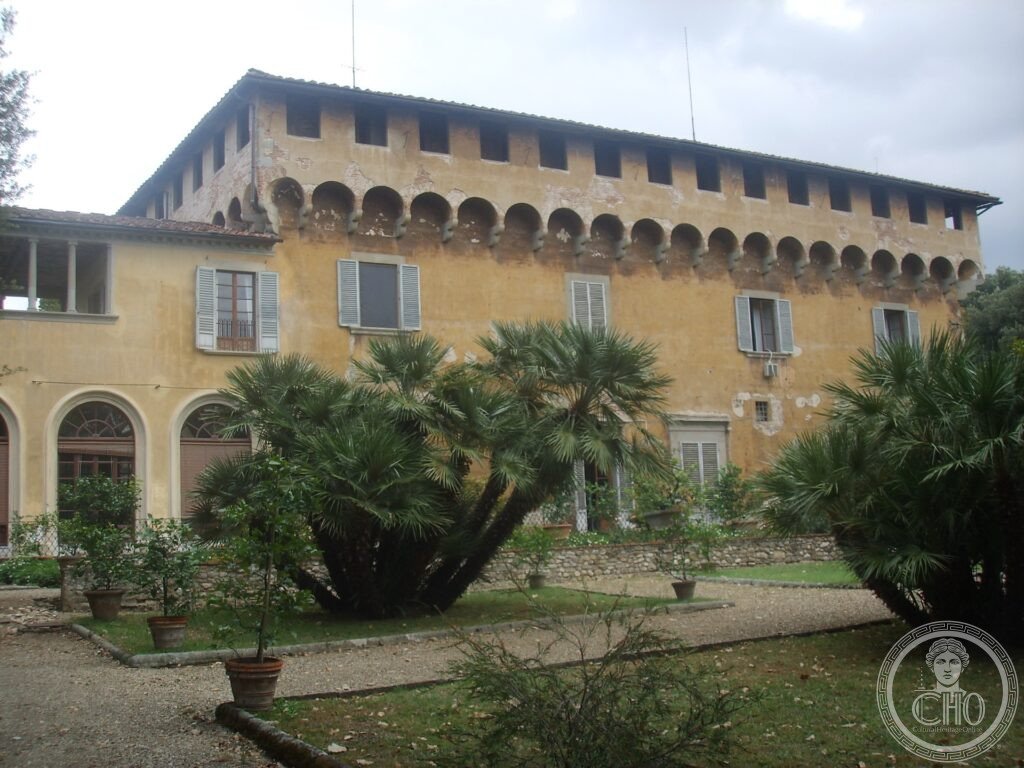
Four generations of Medici lived and died at Careggi — Cosimo the Elder’s favourite retreat, the philosophical laboratory of the Platonic Academy, and the place where Lorenzo the Magnificent died in 1492.
At a glance
Villa Medicea di Careggi stands on a low hill 3 km north-west of Florence, close to the current university hospital complex that now borders its grounds. The oldest of the significant Medici villas outside the city, it was acquired by Giovanni di Bicci de’ Medici — Cosimo the Elder’s father and founder of the Medici banking dynasty — in 1417. Michelozzo di Bartolommeo redesigned it between 1457 and 1459 for Cosimo, adding the loggia and regularising the courtyard. For nearly a century it served as the Medici’s most private retreat: Cosimo the Elder died here in 1464, and Lorenzo the Magnificent in 1492, reportedly receiving news of the fall of Negroponte (Chalcis) to the Ottomans in this garden. In 2013, UNESCO inscribed Careggi as one of the twelve Medici Villas and Gardens in Tuscany (ref. 175bis).
Key facts
- UNESCO inscription: 2013, “Medici Villas and Gardens in Tuscany,” ref. 175bis
- Acquired by Medici: 1417, Giovanni di Bicci de’ Medici; redesigned by Michelozzo, 1457–1459, for Cosimo the Elder
- Historical events: death of Cosimo the Elder (1 August 1464); death of Lorenzo the Magnificent (8 April 1492); meetings of the Platonic Academy (1460s–1490s) under Marsilio Ficino
- Platonic Academy: Cosimo the Elder established an informal gathering of humanist scholars here in the early 1460s, centred on Marsilio Ficino’s translations of Plato and Plotinus
- Current use: property of the Azienda Ospedaliera Careggi (hospital complex); restored interior and garden accessible by appointment and on open days
- Architecture: 14th-century fortified farmhouse core; Michelozzo loggia and courtyard; later additions under Lorenzo and subsequent owners
History
Giovanni di Bicci de’ Medici purchased the property in 1417, converting a working farmstead into a country residence. His son Cosimo the Elder — who made the Medici the dominant power in Florence through banking rather than arms — preferred Careggi’s informality to the more ceremonial settings of Palazzo Medici. He commissioned Michelozzo to add a proper loggia and rationalise the courtyard between 1457 and 1459, though the medieval tower and farmhouse character were preserved. Cosimo spent increasing amounts of time here as his health declined and died at Careggi on 1 August 1464 — the first ruler of Florence to die a natural death after a full reign in decades.
His grandson Lorenzo the Magnificent continued the tradition, using Careggi as a retreat from the pressures of Florentine politics. The philosopher Marsilio Ficino, whose Latin translations of Plato and the Hermetic texts inaugurated Renaissance Neoplatonism, lived in a house provided by Lorenzo near the villa and hosted the informal gatherings of the Platonic Academy here — discussions that drew the young Pico della Mirandola, the poet Poliziano, and Cristoforo Landino. When news arrived of the fall of Negroponte to the Ottomans in 1470, Lorenzo was reportedly at Careggi; he is said to have received news of the loss of Chalcis — the last significant Venetian outpost in Greece — here in the garden.
Lorenzo died at Careggi on 8 April 1492, attended by Ficino, Poliziano and the young Savonarola, who later claimed to have urged him to repentance. After the Medici exile in 1494, the villa fell into decay; it was later used as a military barracks and eventually incorporated into the hospital complex that now surrounds it. The hospital restored the Michelozzo loggia and courtyard in the 20th century.
What you see
Careggi is the least monumental of the principal Medici villas, which is precisely its historical character: it reads as an expanded farmhouse, not a palace, retaining the medieval tower and the irregular massing of a building that grew organically over a century. Michelozzo’s intervention — the loggia on the north facade, with its round arches on pietra serena piers — is the most refined architectural element and the most imitated by later Florentine country houses. The courtyard behind the loggia is a small, quiet space of the kind Renaissance humanists called locus amoenus — a pleasant place for philosophical conversation.
The garden, while much reduced from its 15th-century extent by the hospital development, retains a portion of the historic grounds including a wisteria-covered pergola along the south wall. The restored rooms of the piano nobile contain 15th-century frescoes (partially preserved) and period furnishings; access is by guided tour on scheduled open days.
Practical information
- Access: by appointment or on scheduled open days; contact the Azienda Ospedaliera Careggi (AOC) cultural heritage office
- Admission: free on open days; small fee for guided tours
- Note: the villa is surrounded by the active hospital complex; follow signs from Via delle Oblate
- Best season: spring and autumn; avoid August (Italian holiday closures)
- Time needed: 45 minutes–1 hour for courtyard, loggia and accessible rooms
Getting there
Bus ATAF lines 14, 20 from central Florence toward Careggi hospital; ask for the Villa Medicea di Careggi stop. By car: from Florence take Viale Giovanni Pieraccini; the villa is on the hospital grounds. GPS: 43.8122° N, 11.2544° E.
Nearby
- Villa Medicea La Petraia — Buontalenti’s panoramic villa with Giambologna fountain, 2 km south-west; UNESCO 2013
- Villa Medicea di Castello — Cosimo I’s residence with Tribolo’s allegorical garden, 2.5 km south-west; UNESCO 2013
- Museo di San Marco — Fra Angelico’s frescoed convent in central Florence, 4 km south
Sources
- UNESCO World Heritage List — “Medici Villas and Gardens in Tuscany,” ref. 175bis (whc.unesco.org)
- Wikipedia — “Villa Medicea di Careggi” (en.wikipedia.org/wiki/Villa_Medicea_di_Careggi)
- Lauro Martines, April Blood: Florence and the Plot against the Medici, Oxford, 2003
- Christopher Hibbert, The House of Medici: Its Rise and Fall, Morrow, 1975
Find it on the map
See this place and what’s around it →📷 Become a Cultural Heritage Online photographer
Share your photos of places: they stay published under your name as the author. The more they're seen, the more you get noticed — and soon a contest will reward the most appreciated photos.
Log in or sign up free to add a photoIs this page about you?
This page is read by travellers and heritage enthusiasts who find it on Google. Tell us how you are connected to this place and we will take it from there.