
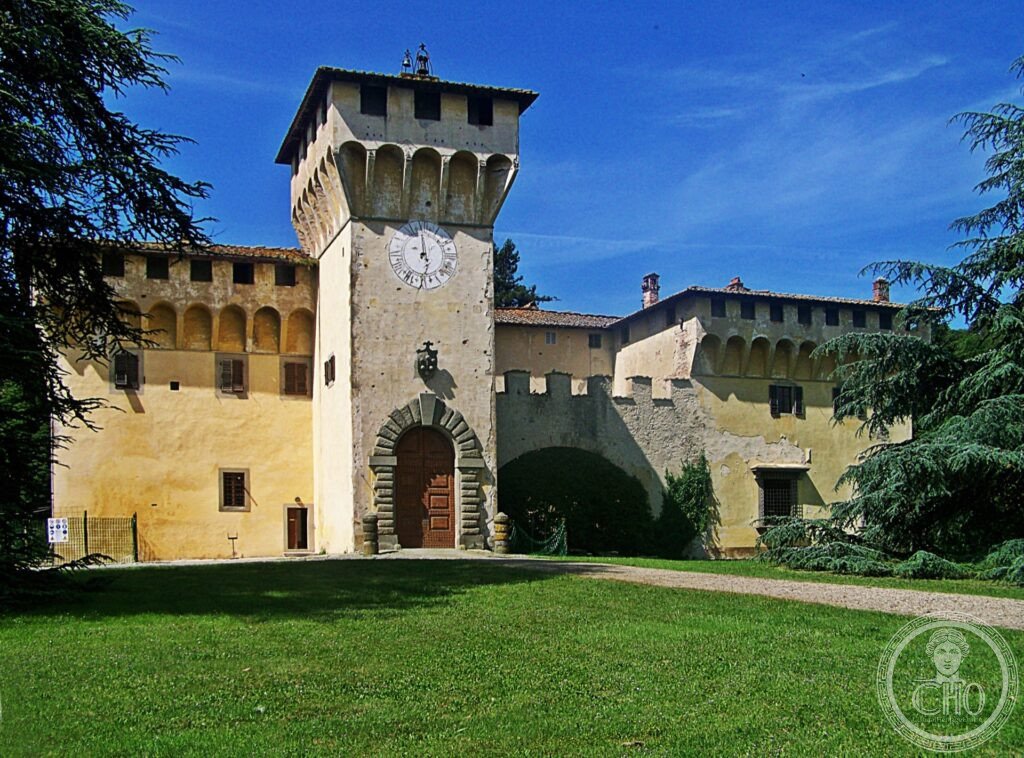
In the Mugello where the family had its roots, Cosimo the Elder commissioned Michelozzo to turn a medieval castle into the dynasty’s first rural villa — where Lorenzo and Giuliano spent their childhood.
At a glance
Villa di Cafaggiolo stands at the foot of the Apennine foothills in the Mugello valley, 30 km north of Florence, in the territory from which the Medici family originally came. The site was a fortified farmstead belonging to the Medici since the 14th century; in 1451 Cosimo the Elder commissioned Michelozzo di Bartolommeo to redesign the complex as a proper country villa. Michelozzo preserved the medieval tower and curtain walls while adding Renaissance loggia elements and regularising the plan. For decades it served as the summer retreat where Medici children — including Lorenzo the Magnificent and his brother Giuliano, who was later murdered in the Pazzi Conspiracy of 1478 — spent the hottest months. In 2013, UNESCO inscribed Cafaggiolo as one of the twelve Medici Villas and Gardens in Tuscany (ref. 175bis).
Key facts
- UNESCO inscription: 2013, “Medici Villas and Gardens in Tuscany,” ref. 175bis
- Origin: Medici family property since the 14th century; redesigned 1451 by Michelozzo di Bartolommeo for Cosimo the Elder
- Historical guests: Lorenzo the Magnificent and Giuliano de’ Medici as children; Poliziano tutored them here during summer stays
- Distinctive feature: retains the medieval crenellated tower and corner towers — more fortress-like than later Medici villas
- Ceramics: Cafaggiolo gave its name to a distinctive Italian Renaissance majolica ware (Cafaggiolo maiolica, late 15th–early 16th century) produced by a workshop the Medici sponsored near the villa
- Current status: private property; exterior visible from the road; interior access by appointment
History
The Mugello valley is the ancestral territory of the Medici — the family’s name itself may derive from a local toponym, and they owned land here before their rise to Florentine banking prominence. Cosimo the Elder, who acquired the property in the early 15th century, chose Michelozzo in 1451 to convert the existing fortified house into a country villa suitable for summer residence. Michelozzo’s approach was characteristically pragmatic: he retained the medieval walls and the square corner tower, adding Renaissance windows and a loggia on the courtyard side while leaving the fortress silhouette largely intact.
Cafaggiolo became the primary summer retreat for the Medici children. Angelo Poliziano, the humanist poet appointed tutor to Lorenzo’s sons in the 1470s, spent extended periods here teaching Greek and Latin among the hills. Lorenzo himself continued to visit in adult life, describing the Mugello landscape in his poetry with a directness unusual for the period. After the Medici exile in 1494, the villa changed hands several times; by the 18th century it had passed to the Borghese family, who modified the gardens. The name Cafaggiolo entered the history of decorative arts through the distinctive blue-and-white and polychrome maiolica produced nearby — among the most refined Italian Renaissance ceramics.
What you see
Cafaggiolo presents the most fortress-like exterior of the principal Medici villas: the square crenellated tower at the main entrance, the corner towers, and the high curtain walls are unmistakably medieval in character, and Michelozzo made no attempt to disguise them. This is not a failure of design but a choice: in the Mugello, where the Medici were landed lords rather than merchant princes, the fortified manor was the appropriate architectural language. The contrast with Michelozzo’s contemporary Villa Medicea di Fiesole — open, terraced, view-oriented — shows the breadth of his register.
The interior courtyard, accessible on guided visits, shows the Renaissance accommodation within the medieval shell: a loggia with round arches in pietra serena, proportioned in the calm manner Michelozzo used in all his Medici work. The gardens are largely 18th-century in their current layout, following modifications by the Borghese family, though the productive orchard character of the original — fruit trees, kitchen garden, fishponds — is preserved in the estate use.
Practical information
- Access: private property; exterior visible from Via Cafaggiolo; guided interior visits by advance booking
- Best season: spring and summer; the Mugello valley roads are scenic year-round
- Nearby: the Mugello circuit (Formula 1 testing track) and the medieval borgo of Scarperia are 5 km south; Monte Senario monastery 10 km south-east
- Time needed: 30–45 minutes for exterior and grounds if open
Getting there
By car: from Florence take the A1 motorway north (direction Bologna) and exit at Barberino di Mugello; follow signs to Cafaggiolo (SP503). By train to Borgo San Lorenzo (Florence–Faenza line), then bus or taxi 8 km to Cafaggiolo. GPS: 43.9867° N, 11.2869° E.
Nearby
- Villa il Trebbio — the companion Medici Mugello villa (1427, Michelozzo), 4 km south-east; UNESCO 2013
- Scarperia e San Piero — medieval borgo known for traditional bladed knife-making; 5 km south
- Lago di Bilancino — reservoir in the Mugello hills, summer recreation area; 8 km west
Sources
- UNESCO World Heritage List — “Medici Villas and Gardens in Tuscany,” ref. 175bis (whc.unesco.org)
- Wikipedia — “Villa di Cafaggiolo” (en.wikipedia.org/wiki/Villa_di_Cafaggiolo)
- Giusto Utens, Lunette delle Ville Medicee, 1599–1602 (Museo Storico Topografico “Firenze com’era”)
- Timothy Wilson, Ceramic Art of the Italian Renaissance, British Museum Press, 1987 (on Cafaggiolo maiolica)
Find it on the map
See this place and what’s around it →📷 Become a Cultural Heritage Online photographer
Share your photos of places: they stay published under your name as the author. The more they're seen, the more you get noticed — and soon a contest will reward the most appreciated photos.
Log in or sign up free to add a photoIs this page about you?
This page is read by travellers and heritage enthusiasts who find it on Google. Tell us how you are connected to this place and we will take it from there.